A series of high-profile murders ripples through the city, each killing meticulously traced back to institutional rot and concealed crimes that demand exposure. When investigators finally snare a suspect, the murders don’t stop, they accelerate, pulling the detective deeper into a conspiracy where the cost of truth becomes lethal.
Director Shankar Sarathi’s Tamil action-thriller operates within familiar crime investigation territory, but the film’s weight rests entirely on how its ensemble carries the moral weight of uncovering what institutions have buried. Chethan Cheenu shoulders the investigative burden as the film’s anchor, tasked with the physically and psychologically demanding work of holding a conspiracy together across its 129-minute runtime.
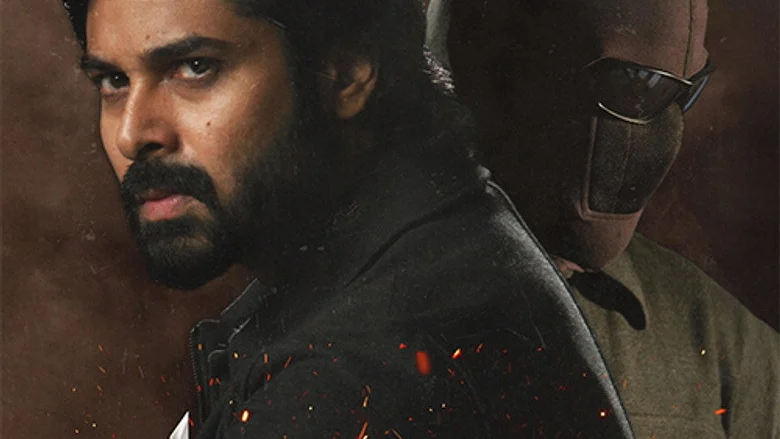
Chethan Cheenu’s Detective Grind
Cheenu’s performance becomes the throughline that binds the film’s institutional mechanics to something viscerally human. He embodies the investigator as someone being methodically hollowed out by each discovery, carrying the accumulation of betrayal from systems meant to protect rather than conceal. The actor’s restrained intensity works precisely because he doesn’t perform the detective’s frustration, he lives it, allowing the role’s exhaustion to settle into his posture and eyes rather than exploding outward.
Sarathi’s Investigation, Conspiracy’s Clockwork
Sarathi constructs the thriller’s architecture around institutional failure, tracking how systems designed for justice become weaponized by those already embedded within them. The director’s framing of the investigation escalates beyond individual murders into something systemic, though the screenplay occasionally stumbles when balancing the procedural detail required for credibility against the momentum needed for a commercial entertainer. The conspiracy’s unfolding logic remains the film’s strongest asset, anchoring what could otherwise dissolve into formula.
Action-Thriller Mechanics in Service of Plot
The action sequences integrate into the investigative momentum rather than interrupt it, treating combat and pursuit as extensions of the detective’s forward momentum rather than spectacle unto themselves. Choreography stays grounded in physical consequence, characters move through spaces as though hunted and hunting simultaneously, refusing the weightless precision that dilutes tension.
Pacing sustains the conspiracy’s spiral through both halves, maintaining pressure even as individual set pieces might register as functional rather than inventive. The thriller framework demands escalation, and Sarathi delivers it through mounting stakes rather than stylistic flourish, letting each revelation compound upon the last.
What emerges is a genre exercise where the mechanics serve the thematic investigation, justice as something that demands institutional betrayal to be achieved, making every victory feel contingent and costly. The film doesn’t transcend its blueprint, but it executes the blueprint with clarity and conviction.
For those seeking deeper dives into Tamil thriller craft, Tamil Thriller reviews on this platform offer broader context for how Valluvan positions itself within the landscape.
Ashna Zaveri and Manobala’s Institutional Anchors
Ashna Zaveri functions as a critical counterweight to Cheenu’s investigative obsession, embodying the institutional perspective from which truth must be extracted. Her presence signals the film’s investment in showing how systems protect their own, and she carries that tension without needing explicit dialogue to articulate it. Manobala’s casting as institutional authority figure speaks to the film’s thematic concerns, his presence alone suggests complicity embedded within bureaucratic structures, the kind of betrayal that comes from within rather than external antagonism.
Conspiracy as System, Not Villain
The film sidesteps creating a singular antagonist, instead positioning the conspiracy itself as the villain, a distributed network of institutional protection that no single arrest can dismantle. This structural choice demands more from the ensemble than a traditional thriller would require, forcing each supporting player to embody fragments of the larger corruption. The UA16+ certificate and commercial runtime suggest an attempt to balance accessibility with thematic substance, though achieving that balance consistently proves more elusive than the synopsis promises.
Valluvan works best as an ensemble crime thriller where Chethan Cheenu’s relentless investigative performance anchors a film more interested in institutional exposure than action spectacle. It’s a competent thriller that knows what it wants to say about the price of uncovering institutional betrayal, even if the execution doesn’t always match the ambition. Watch it for the performance work and the conspiracy’s architectural construction, though don’t expect the film to reinvent the genre it’s operating within.
Similar institutional corruption frameworks appear in Moondraam Kan review, where layered detective work exposes human failure beneath surface-level case closure.
Valluvan executes its crime-thriller blueprint with competent conviction, anchored by Chethan Cheenu’s grounded detective work, a solid 3.5/5 that satisfies its genre contract without overreaching beyond it.
The dual-identity tension that surfaces in Double Occupancy verdict shares similar thematic DNA about institutional deception and the fractured self.

Ankit Jaiswal is the Chief Author, covering Indian cinema and OTT releases with honest, no-filler criticism. An SEO strategist by background, he brings a research-driven approach to film writing, cutting through hype to tell you exactly what's worth your time.