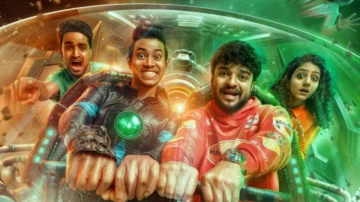
A fortified gate in 1790. Maharaja Padmanabhan Thampuran and Azam Khan in a charged confrontation. Then, the same crumbling location in 2025, where Paapan and Dude activate something called Star Dust, yanking characters across timelines from antiquity into a distant 2370. It’s an audacious comic setup, and for a brief stretch, it holds. But ambition and execution are two very different currencies, and Aadu 3 spends the first while burning through one without earning the other.
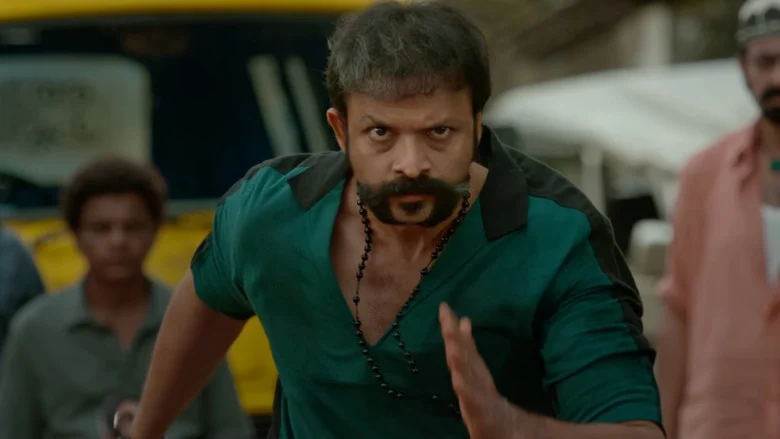
Jayasurya carries the weight of a franchise on familiar shoulders
Jayasurya returns as Shaji Pappan with the ease of a man who has lived in this character’s skin. The physical comedy, the timing, the specific brand of Kerala-inflected absurdism, it’s all still there. But the writing around him has thinned. He’s handed a framework that keeps shifting under his feet, and no amount of performance can substitute for a character given something concrete to react to.
I found myself watching Jayasurya work harder than he should have to, filling gaps the screenplay never bothered to seal. That’s a structural problem, not a performance one.
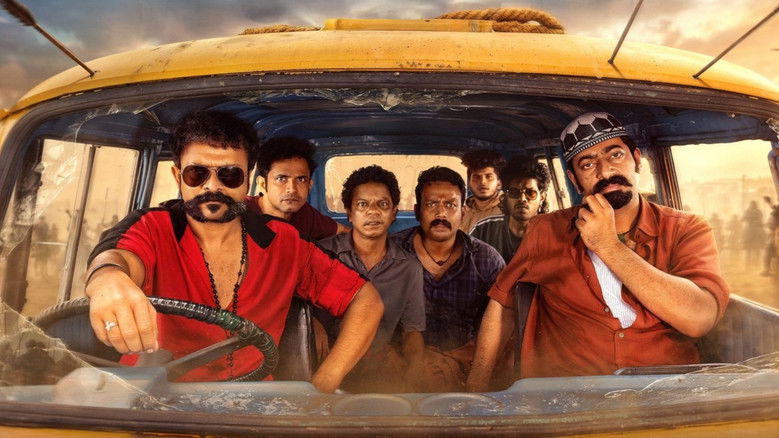
Midhun Manuel Thomas bets big on chaos, loses control mid-flight
Midhun Manuel Thomas wrote and directed all three films in this franchise. His strength has always been in finding the absurd logic inside Kerala’s social fabric and weaponising it for comedy. That instinct hasn’t completely deserted him here. The core premise, reincarnations and temporal ruptures generating comic chaos, is genuinely inventive on paper.
Where the direction falters is in tonal management. Juggling 1790, 2025, and 2370 within a single comedic register demands surgical precision. The screenplay instead meanders, piling timeline onto timeline without allowing any single thread enough oxygen to breathe.
At 162 minutes, the film simply refuses to edit itself. The bloat is unmistakable from the second hour onward, and no structural ambition justifies a runtime that outlasts its own comedic momentum by at least 30 minutes.

Vinayakan as antagonist and the ensemble’s diminishing returns
Vinayakan stepping in as the antagonist is a casting choice that demands attention. His screen presence in Malayalam cinema has always carried an unpredictable edge. Whether the writing honours that here is a different question, the role seems more functional than fearsome.
Vijay Babu, Sunny Wayne, Saiju Kurup, and Dharmajan Bolghatty return with their familiar rhythms largely intact. But the characters feel like echoes of who they once were. The ensemble charm that made the original franchise crackle has been diluted somewhere in the translation to big-budget territory.
For Malayalam comedy fans eager to track where the genre is heading, Malayalam Fantasy reviews on this site cover the full spectrum of what’s currently worth your time in the space.
Franchise nostalgia is doing most of the heavy lifting at the box office
No controversies surround Aadu 3, no censorship rows, no casting storm. What surrounds it instead is the weight of its own legacy, and that is arguably the harder burden. The film has earned the distinction of being the highest-grossing Malayalam film of 2026, which says a great deal about franchise loyalty in Kerala’s theatrical market. It says rather less about whether the film deserved that position on merit.
The original Aadu built its cult following on economy, small cast, rough edges, sharp comedy rooted in character. A big-budget sequel that multiplies timelines and production scale without multiplying the wit ends up revealing exactly what made the original work so well by contrast.
If the franchise’s sharp-edged character comedy resonates with you, the Prathichaya 2026 review raises similar questions about what happens when character-driven storytelling loses its footing.
Aadu 3 is a film built for its fanbase, and on that narrow metric alone, it will deliver intermittent pleasures. Go in with recalibrated expectations, not for the sharp, scrappy comedy of the originals, but for a nostalgia ride that occasionally remembers what made it loveable before getting distracted by its own scale. Theatrical viewing will amplify the crowd energy, which frankly does a lot of this film’s emotional work for it.
Aadu 3: One Last Ride – Part 1 is worth a watch strictly for committed franchise loyalists, but as a piece of craft it earns a reluctant 2.5 out of 5, a sequel that mistakes ambition for discipline and budget for wit.
For another actor-driven film where performance outpaces its screenplay, the Suyodhana 2026 verdict makes for a revealing companion watch.

Ankit Jaiswal is the Chief Author, covering Indian cinema and OTT releases with honest, no-filler criticism. An SEO strategist by background, he brings a research-driven approach to film writing, cutting through hype to tell you exactly what's worth your time.