Krishna emerges from Vrindavan as a figure caught between earthly longing and cosmic duty, his face etched with the weight of separation from Radha. Hardik Gajjar’s opening frames establish this tension immediately, not through spectacle, but through the quiet devastation of a man choosing destiny over love, setting the tone for a 149-minute meditation on devotion that privileges feeling over forward momentum.
This is a film that knows exactly what it wants to be: a reverent, relationship-centered mythological drama that treats Krishna’s emotional interior as sacred terrain. Whether that territorial choice satisfies depends entirely on your tolerance for narrative slowness and repetitive relational exposition, two qualities that define both its ambition and its undoing.
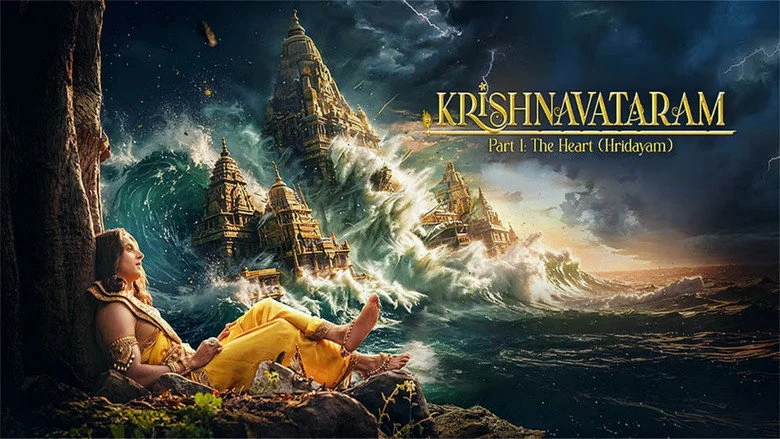
Siddharth Gupta Sustains Krishnavataram Through Spiritual Composure
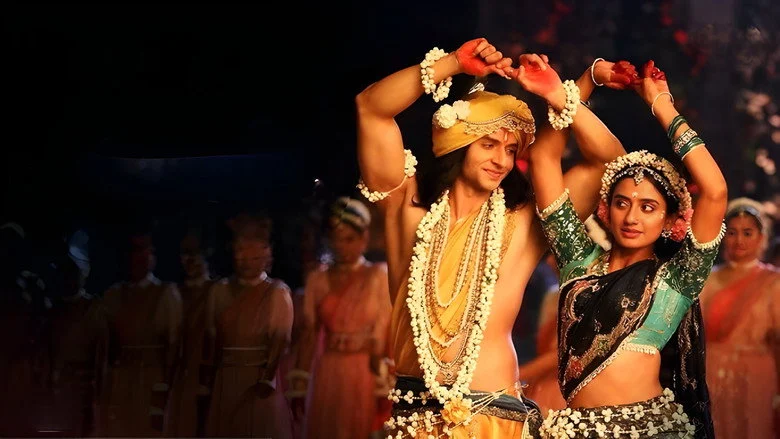
Siddharth Gupta carries this film on the strength of restraint, a performance built from stillness rather than volatility. His Krishna never raises his voice in the relationship sequences; instead, he holds conversations with Radha, Sathyabhama, and Rukmini as meditative exchanges where spiritual acceptance functions as emotional architecture. The opening portrayal after separation from Radha showcases Gupta’s ability to convey devastation through measured silence, a technique that works beautifully in intimate scenes but becomes a liability during the slower stretches of the middle section, where his calmness threatens to calcify into monotone.
What distinguishes his work is its refusal of conventional leading-man dynamics. Gupta positions Krishna not as the emotional center of conflict but as a spiritual anchor around which others orbit, which demands a particular kind of performative authority. It’s technically sound. Whether it’s enough to justify nearly two and a half hours depends on your investment in mythological reverence over dramatic propulsion.
Gajjar’s Direction Confuses Devotion With Narrative Inertia
Hardik Gajjar demonstrates genuine control over the film’s devotional tone and visual scale, the mythological setting receives cinematographic grandeur that respects the source material. His strength lies in organizing the narrative around relational centerpieces rather than action, a bold choice for a Krishna film that could have easily become spectacle-driven.
The weakness is structural: his screenplay, co-written with Prakash Kapadia and Raam Mori, mistakes repetitive emotional beats for deepening complexity. The narrative slows into extended devotional exposition in the first half, where the same conversations about duty, separation, and acceptance cycle through different character combinations without advancing the emotional or mythological stakes. The pacing is uneven, favoring reverence over compression.

Devotional Drama’s Scale Overwhelms Its Relational Core
The film’s visual presentation is its most immediate asset. The grand staging of mythological settings and the large-scale devotional sequences support the film’s attempt to frame Krishna’s life as sacred rather than biographical. Cinematography here functions as spiritual apparatus, positioning audiences in temple-like relation to the material rather than intimate engagement with character psychology.
Where this strategy falters is in the middle section, where conversation-heavy relational scenes unfold against lavish visuals that dwarf the emotional specificity. The visuals demand awe; the screenplay demands patience. These impulses work against each other. The journey passages toward Dwarka and Kurukshetra provide mythological momentum, but critics have noted that these sections arrive too late and too briefly to counterbalance the opening-half slowness.
The soundtrack, built from devotional songs like “Kunj Bihari” and “Shyamal Sanware”, reinforces this reverent architecture. Yet the music also emphasizes the film’s resistance to plot momentum, favoring lyrical meditation over dramatic punctuation. Background score feedback remains sparse, but the devotional-romantic framing is consistent across all musical choices.
We can appreciate mythological respect without excusing narrative sluggishness, and this film asks viewers to choose between them rather than integrate both. For some audiences, that choice lands; for others, it reads as self-indulgence masquerading as reverence.
Sanskruti Jayana and Sushmitha Bhat Ground the Film’s Relational Geometry
Sanskruti Jayana, as Sathyabhama, occupies the film’s emotional and devotional conflict through presence rather than active dramatic work. Her role signals the film’s intent to position Krishna’s bond with different women as different dimensions of love rather than competing romantic stakes, a smart thematic choice that her casting supports without her needing to carry additional dramatic weight.
Sushmitha Bhat’s Radha anchors the opening frame through absence and remembered longing. Her separation from Krishna establishes the film’s emotional premise immediately, and while her screen time appears limited, her character’s gravity pulls the entire narrative structure toward spiritual pathos. Nivaashiyni Krishnan as Rukmini completes the relational triad, contributing to the film’s comparative presentation of companionship and devotion without disrupting the tonal uniformity Gajjar maintains across all performances.
Krishnavataram Part 1 Avoids Villains by Internalizing All Opposition
The film’s most unusual structural choice is its refusal of a personified antagonist. The central opposition is entirely internal and thematic, Krishna versus his own earthly longings, duty versus personal happiness. This approach distinguishes it from conventional mythological dramas that externalize conflict through named villains.
Whether this decision strengthens or weakens the film depends on execution, and here the screenplay struggles to generate dramatic momentum from pure internal conflict across 149 minutes. The devotional framing that positions separation as part of divine purpose rather than tragedy becomes the film’s philosophical anchor, but also its structural ceiling. Without external opposition, the narrative must generate forward energy from relational nuance alone, and that’s where pacing concerns become inevitable.
Hindi devotional dramas deserve platform-specific consideration. For audiences seeking meditative mythological storytelling over conventional character arcs, Hindi Drama reviews on this site offer context for where Krishnavataram fits within the broader landscape of recent devotional cinema.
Krishnavataram Part 1: The Heart is a film built to reward viewers who equate slowness with depth and who understand Krishna’s spiritual authority as cinematically sufficient without dramatic urgency. Siddharth Gupta’s measured performance supports this approach, but Gajjar’s repetitive structure tests patience repeatedly. The visuals justify theatrical viewing; the screenplay justifies streaming with selective engagement. This is a first installment that assumes trilogy length justifies individual installment pacing, a gamble that hasn’t fully paid off in its execution.
The film’s relational focus and devotional reverence find strong parallel in Star Wars review, where spiritual authority operates through composure rather than demonstrative emotion.
Krishnavataram Part 1 is a technically accomplished devotional drama hampered by uneven pacing and repetitive structure, a 3 out of 5 film that respects its source material more than it respects viewer momentum.
Gajjar’s approach to relational storytelling echoes similar thematic priorities in Michael verdict, where visual grandeur and intimate relationship work occupy competing rather than complementary space.

Ankit Jaiswal is the Chief Author, covering Indian cinema and OTT releases with honest, no-filler criticism. An SEO strategist by background, he brings a research-driven approach to film writing, cutting through hype to tell you exactly what's worth your time.