Dinesh Shrivastava sits across from Meera Ranganathan in a Noida office, nursing feelings he cannot articulate, watching her belong to someone else. When a Japan trip lands him before a Fortune Bell, he makes the only wish that matters: one day with her. What unfolds is not a romance, it is a premise masquerading as one, a high-concept setup that collapses under the weight of its own expiry date.
Sunil Pandey’s film is built on an elegant trap. The one-day-relationship device should amplify stakes; instead, it diminishes them. When Meera forgets the entire experience by film’s end, the narrative gamble becomes a narrative forfeit.

Junaid Khan’s Muted Anchor in a Concept That Outlives Its Craft
Junaid Khan understands the assignment: Dino must be invisible in the office, then seen only within a single rotated day. The actor commits to restraint, playing internal frustration as a series of glances and hesitations rather than declarations. His performance in the Japan stretch, where Meera suddenly reciprocates, requires a tonal shift from shy observer to accepted romantic partner, a transition Khan executes without melodrama.
But restraint, however technically sound, cannot compensate for a screenplay that treats his emotional arc as secondary to its magical-realism conceit. Khan anchors the film where it exists; the film does not exist long enough for that anchor to matter.
Screenplay’s Structural Elegance Masks Narrative Thin-ness
Writers Sneha Desai and Spandan Mishra construct a clean three-act skeleton: office setup, Japan wish, memory erasure. The architecture is sound. The execution is not. The post-wish segment, where Meera has no recollection and Dino must process the loss, receives minimal development despite being the thematic core.
Director Pandey communicates the premise clearly, office realism to romantic fantasy to cruel reset, but does not excavate what that reset costs emotionally. The film ends with consequence; it does not sit with it.
Romance Genre Mechanics Stall Under Permanent-Relationship Logic
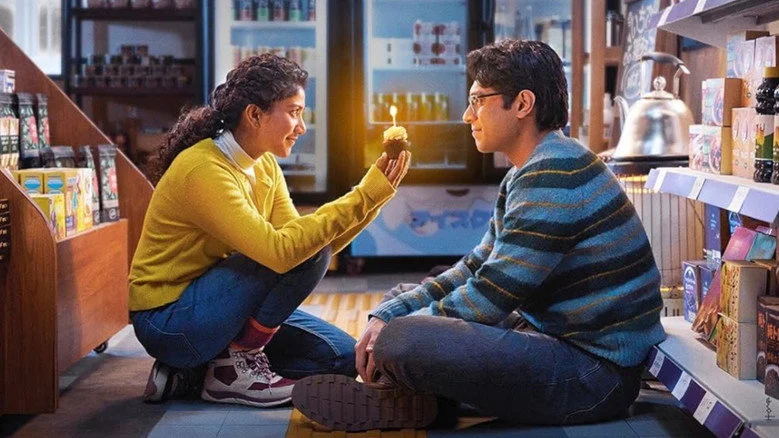
The Fortune Bell wish functions as the film’s narrative engine, converting a standard office-romance setup into something temporally bounded. Sai Pallavi’s Meera must embody two states: the unreachable colleague and, after the wish, the woman who falls in love with Dino. The genre demands emotional contrast between these poles.
The one-day Japan stretch attempts to deliver that contrast through concentrated romantic beats, the confession, the acceptance, the physical proximity, compressed into a single frame. The structure is romantic-comedy orthodox; the premise is melodramatic inversion.
What breaks the genre execution is the memory reset itself. Standard romance cinema builds toward permanence, toward a couple existing in the world as a unit. This film’s central device ensures impermanence, making every romantic moment feel posthumous even as it occurs. The genre cannot breathe under that condition.
Browse more Hindi drama reviews at our Hindi Romance reviews to explore how contemporary romance narratives navigate emotional stakes.
Sai Pallavi and Kunal Kapoor in Service of an Undercooked Conflict
Sai Pallavi carries the film’s emotional weight on her shoulders, first as the unattainable object of Dino’s affection, then as the woman who falls for him, then as someone stripped of that memory. The role demands tonal precision; her performance suggests she understands the assignment more fully than the screenplay supports it. In the one-day sequence, she conveys genuine affection with economy.
Kunal Kapoor’s Nakul Bhasin functions as romantic obstacle rather than character, the boss whose prior involvement with Meera establishes the imbalance Dino must overcome. Kapoor’s presence signals wealth and authority; his character never becomes more than a marker of what Dino cannot compete with.
Opening-Day Box-Office Collapse Reflects Audience Skepticism Toward the Device
Ek Din opened to Rs 1.15 crore on its first day across India, according to Times of India reporting via Sacnilk, a figure that telegraphs immediate audience rejection. The pairing of Sai Pallavi and Junaid Khan, while marketed as the film’s primary draw, could not overcome skepticism about whether a one-day romance sustains feature length.
Critical response amplified that skepticism. The film was widely described as failing to develop emotional payoff from its high-concept premise. Audiences grasped the Japan setting and the wish-based structure instantly; what they questioned was whether the film had anything to say about love after the wish expired.
If you engage with the film at all, watch it as a test of how far one good premise can carry a narrative without sufficient dramatic infrastructure. The Japan cinematography offers visual relief, but visual geography cannot resolve conceptual thinness. This is a film that knew exactly what it wanted to say and stopped saying it too soon.
Sai Pallavi’s emotional restraint in Krishnavataram Part review demonstrates how controlled performance can anchor a narrative in crisis, a skill this film’s supporting cast mirrors without identical payoff.
Ek Din is a premise that mistakes elegance for depth, offering 2 out of 5 stars, technically composed but emotionally inert, a film that knows the shape of romance without understanding its weight.
Like the masked restraint in Star Wars verdict, Junaid Khan’s controlled awkwardness works within genre constraint, but the film itself refuses to transcend that constraint.

Ankit Jaiswal is the Chief Author, covering Indian cinema and OTT releases with honest, no-filler criticism. An SEO strategist by background, he brings a research-driven approach to film writing, cutting through hype to tell you exactly what's worth your time.