A young warrior watches his family’s name dragged through mud by oppressive rulers before he is even born. By film’s end, he wears a crown. Raja Shivaji presents this arc across three hours with the ambition of a historical epic and the intimate stakes of a man learning what sovereignty actually costs, but the two don’t always sit comfortably in the same frame.
Riteish Deshmukh directs himself as the titular Maratha leader, a dual responsibility that reveals both his clearest instinct as a filmmaker and his most limiting one as a storyteller. The film is structured in nine chapters, each a deliberate beat in Shivaji’s rise from persecuted heir to crowned ruler. That architecture works best during the opening political persecution and the final coronation sequence, where ceremonial weight and personal stakes align. In between, ambition sometimes exceeds execution.
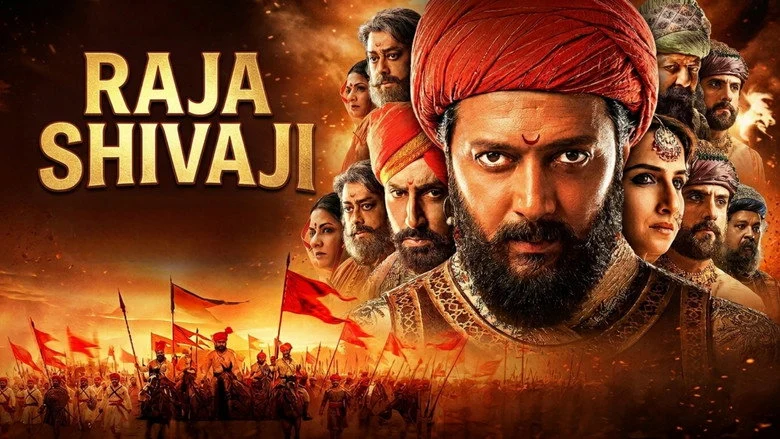
Deshmukh’s Performance Carries Weight Where Direction Falters
Riteish Deshmukh inhabits the lead role with surprising conviction, particularly in sequences demanding emotional restraint. Early reaction coverage singled out his performance as career-best, and the praise makes sense: he moves through Shivaji’s transformation from resistant youth to sovereign authority with a physical sensitivity that many historical actors avoid. The coronation scene is his strongest work, a moment where performance, direction, and production design briefly merge into something genuinely affecting.
Yet the same filmmaking choices that highlight his strengths expose a directorial weakness. Too often, Deshmukh the director frames Deshmukh the actor in wide shots designed for scale rather than nuance, diluting the intimate moments that make this biography matter.
Sanjay Dutt’s Afzal Khan Threatens But Never Unsettles
Sanjay Dutt arrives as the antagonist Afzal Khan, a figure positioned as the film’s primary opposing force. Early audience coverage praised his performance favorably, positioning him as a counterweight to Deshmukh’s rising protagonist. Yet the screenplay grants him little interiority, he exists primarily as a stage for Shivaji’s resistance to land.
Dutt brings gravitas to the role, but without deeper motivation or complexity, even a seasoned actor can only project threat. The film needed to complicate their opposition beyond “tyranny versus resistance” if it wanted the antagonism to resonate beyond plot mechanics.
The Historical War Drama Sustains Itself on Spectacle, Not Substance
The film’s primary strength lies in its chapter-based historical structure and commitment to large-scale battlefield staging. The opening sequence establishing political persecution creates genuine dramatic stakes, while the coronation delivers the emotional climax audiences came for. These sequences prove Deshmukh understands how to marshal resources and build ceremonial weight.
Yet between these peaks, the narrative coasts on war imagery and court conflict without deepening its thematic grip. The film repeatedly frames Shivaji as a leader who fights against tyranny to establish Swarajya, emphasizing that resistance through strategy matters more than force alone. This ideology is sound, but the screenplay rarely dramatizes the moral cost of that philosophy, it simply asserts it.
Ajay-Atul’s music emerges as the film’s most reliable emotional channel, stepping in where dialogue or scene-craft falter. Multiple audience responses identified the score as the strongest element, a signal that the film’s emotional architecture depends less on narrative momentum than on compositional support. That’s not necessarily a failure, but it reveals where the screenplay leaves gaps.
Abhishek Bachchan and Genelia Deshmukh Orbit Without Definition
Abhishek Bachchan appears as Sambhaji Shahaji Bhonsale, and early reactions praised his performance specifically, yet the available material offers no scene-level breakdown of his arc or function beyond supporting the main narrative. Genelia Deshmukh is listed as Saibai, a role that receives no performance notes in audience coverage, suggesting minimal development or narrative weight.
A cast this deep, including Vidya Balan, Fardeen Khan, Sachin Khedekar, Boman Irani, and Mahesh Manjrekar, signals intent to create a world rather than a spotlight. That intent doesn’t fully materialize on available evidence, leaving the supporting ensemble as architectural fill rather than dramatic substance.
For those interested in how Hindi historical dramas continue to reckon with state-building myths, our wider coverage of Marathi Action reviews explores similar territory across recent releases.
Deshmukh’s Control as Director Creates Coherence if Not Depth
Riteish Deshmukh’s directorial hand is visible throughout in ways both productive and limiting. The chapter-based structure provides narrative scaffolding that keeps a three-hour runtime from feeling untethered. The grand staging and multilingual presentation (Hindi, Marathi, Tamil, Telugu, Kannada, Malayalam) demonstrate technical ambition. Yet the screenplay’s linear progression from oppression to coronation offers little room for genuine surprise, the destination is always visible, which flattens tension.
This is a film that knows what it wants to say about power and resistance but struggles to dramatize why those ideas matter beyond historical precedent. Deshmukh stages his beliefs rather than interrogating them, a choice that serves audiences hungry for affirmation more than those seeking complexity.
Raja Shivaji is built for viewers who value epic scope, ceremonial climax, and earnest historical reverence. It delivers those reliably. Ajay-Atul’s score carries emotional weight that the narrative sometimes fails to earn, and the coronation sequence justifies the scale. But between spectacle and soul lies empty space where a tighter screenplay or bolder characterization might have made the three-hour investment feel less like obligation and more like revelation. Watch it for the production values and Deshmukh’s centrality to the role, but don’t expect the film to deepen your understanding of either Shivaji or the mythology surrounding him.
Deshmukh’s refusal to complicate Shivaji’s heroism echoes the restraint that limited Ek Din review, though with far greater resources deployed in service of similar caution.
Raja Shivaji (2026) is a confident historical epic that chooses affirmation over interrogation, spectacle over psychology, competent enough to warrant a theatrical viewing, but not so adventurous as to demand one. I’d rate it 2.5/5 stars.
The mythology of Shivaji continues across registers in Krishnavataram Part verdict, another recent film wrestling with how to animate historical grandeur.

Ankit Jaiswal is the Chief Author, covering Indian cinema and OTT releases with honest, no-filler criticism. An SEO strategist by background, he brings a research-driven approach to film writing, cutting through hype to tell you exactly what's worth your time.