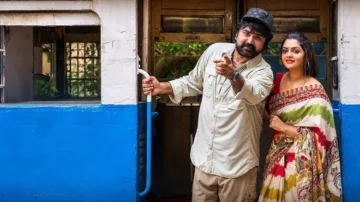
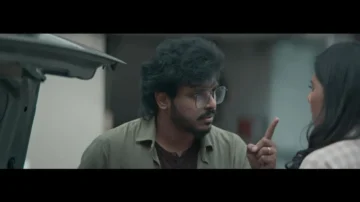
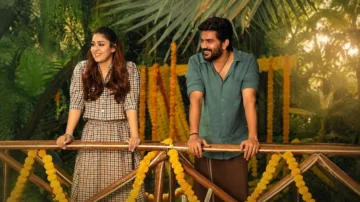
A vegetable vendor in Palakkad receives an unexpected plea from a stranger to help rescue his girlfriend, and what unfolds across a single night is less a thriller than a series of emotional conversations threading through romantic entanglements and tense silences. East Coast Vijayan’s film moves with deliberate stillness, prioritizing intimacy over urgency in a genre space that traditionally demands the opposite. The question isn’t whether the film succeeds, it’s whether a soft whisper can carry the weight of what it’s trying to say.

Dhyan Sreenivasan’s Lived-in Ease Deserves Better
Sreenivasan brings natural authenticity to Murukan, the vegetable vendor at the film’s center, making the character feel earned rather than performed. His stillness grounds the narrative even when the screenplay fails to dig deeper into the past that clearly shapes him. The gap between what he brings and what the writing provides creates an uncomfortable tension, not the kind the film intends.

East Coast Vijayan’s Subversion Works Until It Doesn’t
The director deliberately sidesteps the madcap energy promised in marketing, opting instead for intimate, conversation-driven moments that prioritize emotional texture over plot momentum. This restraint occasionally lands, but more often leaves the narrative feeling loose and unfocused, as if the film is unsure whether to commit to its quiet approach or satisfy audience expectations for actual drama.
A Comedy That Forgets to Make You Laugh
The film is marketed as a madcap comedy set against a one-night thriller structure, yet it struggles to land a single genuine laugh throughout its two-hour-twenty-two-minute runtime. The humor exists in theory, awkward encounters, romantic misunderstandings, tonal shifts, but rarely translates to moments that register as actually funny rather than merely unusual.
Ranjin Raj and K.A. Latheef’s music quietly blends into the film’s emotional atmosphere without demanding attention, which is both a strength and a missed opportunity. In a comedy that fails to generate laughter through dialogue or situation, the songs might have provided genuine relief, instead, they simply exist in harmony with the film’s hushed tone.
Ratheesh Ram’s cinematography captures a calm, introspective mood that matches the director’s vision, and John Kutty’s editing maintains narrative flow across the single night’s structure. The technical work is competent but serves a film that hasn’t earned its own patience with itself. The choices feel precise in service of a destination the film never quite reaches.
A Supporting Cast Trapped in Underdeveloped Dynamics
Vishnu Unnikrishnan as Aravindan carries the film’s central inciting incident, while Divya Pillai’s Rasiya exists largely as the motivating absence driving others’ actions. Neither performer receives sufficient material to transcend their narrative function as plot devices dressed in character names.
The Quiet Desperation of Almost-Landing
Times of India captured the film’s central frustration: “Bhishmar ultimately feels like a soft conversation that comes close to saying something beautiful, but stops just before it truly does.” The film knows what it wants to explore, love in different forms converging across a single chaotic night, yet struggles to articulate why any of it matters beyond abstract emotional tourism.
For audiences drawn to Malayalam cinema’s recent embrace of intimate, character-driven narratives, this reaches toward something genuine but falls short of connection. The film exists in a space between genres without fully inhabiting any of them, and between emotional intentions without quite grasping them. Watch it if you’re patient with films that prioritize conversation over payoff, and skip it if you expect a madcap comedy to actually contain comedy. Intimate character studies work best when the characters give you reasons to stay invested, here, they mostly give you reasons to look away.
Explore more Malayalam Comedy reviews to discover narratives that land their emotional ambitions with precision.
The quiet restraint mirrors the directorial sensibility evident in G O review that build character through stillness rather than spectacle.
Bhishmar reaches for the intimate vulnerability found in Maragatha Malai verdict, though with less commitment to its own tonal chaos.

Ankit Jaiswal is the Chief Author, covering Indian cinema and OTT releases with honest, no-filler criticism. An SEO strategist by background, he brings a research-driven approach to film writing, cutting through hype to tell you exactly what's worth your time.