A wealthy family arrives at a sprawling Indian bungalow for a destination wedding, only to find the mansion breathing with malevolent presences that refuse simple explanation. Priyadarshan’s comedy-horror hybrid leans hard into the visual chaos of haunted spaces, but the film’s machinery creaks under the weight of its own structural ambitions.
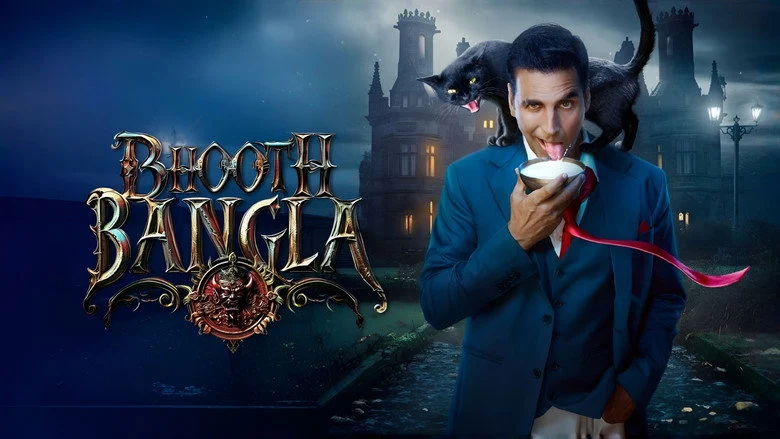
Fourteen years after their last collaboration, Akshay Kumar and Priyadarshan reunite to excavate familiar terrain. The pairing carries nostalgic weight, yet Bhooth Bangla reveals how much has shifted in Hindi cinema’s appetite for blended genres. Kumar’s dual role as Arjun Acharya anchors the narrative, but the performance becomes increasingly difficult to parse when the screenplay demands he carry both comedic and spectral registers simultaneously, a split that demands either greater specificity or sharper editorial clarity than the film provides.
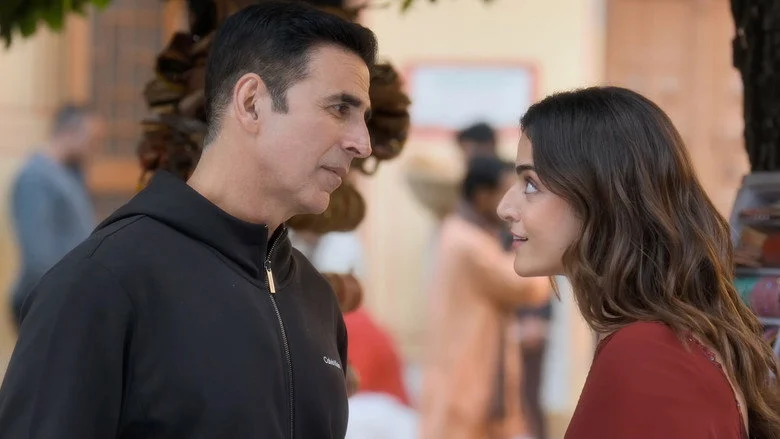
Akshay Kumar’s Dual Identity: Stretching One Actor Across Two Tones
Kumar’s dual casting signals the director’s intent: use the star’s comedic timing as a counterweight to supernatural dread. The premise asks him to embody both the rational visitor and the haunted presence, a framework that works only if the screenplay maintains rigid separation between registers. Here, that discipline appears absent.
The dual role becomes less a narrative device and more a structural liability, requiring Kumar to anchor both the family’s earthly panic and the supernatural mythology without sufficient tonal scaffolding between them.
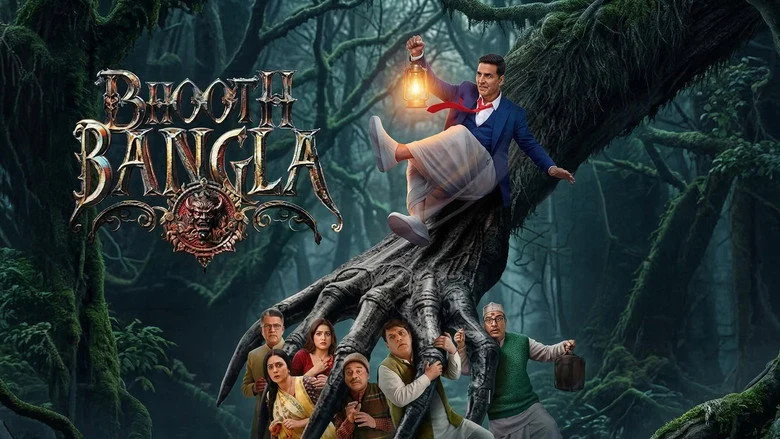
Priyadarshan’s Directorial Return: Competence Without Innovation
Priyadarshan brings three decades of genre fluency to the project, but Bhooth Bangla feels like competent assembly rather than reimagining. His strength lies in managing ensemble chaos, the supporting cast functions smoothly, which suggests strong on-set control. The screenplay weakness emerges in pacing: the film allows its mythology-driven exposition to dominate Act Two, flattening the comedic momentum that the genre hybrid demands.
The writing (Rohan Shankar, Abilash Nair, and Priyadarshan) roots itself in Vedic and Mahabharata-inspired black magic, ambitious thematic territory that requires screenplay architecture capable of threading mythological weight into domestic farce. The film attempts this fusion but rarely achieves it with conviction.
Horror-Comedy Mechanics: When Genre Hybrids Demand Stricter Editing
The genre’s core challenge, maintaining comic rhythm while sustaining dread, calls for editorial precision that Bhooth Bangla doesn’t quite marshal. Cinematographer Divakar Mani captures the bungalow’s spaces with clear geography, a technical choice that actually works against the genre’s need for visual disorientation.
Comedy-horror requires audiences to feel caught between modes: uncertain whether to laugh or recoil. When the visual language favors clarity over unease, the horror component withers. The bungalow becomes merely a set rather than a character, a backdrop where chaos occurs but doesn’t radiate from the space itself.
Editor Aiyappan Nair M.S. structures the film around character-driven beats rather than tonal ones. This choice privileges narrative momentum over the rhythmic precision that comedy-horror demands, the form needs shorter, sharper cuts between comedic and horrific moments, a tempo that keeps audiences perpetually off-balance.
Paresh Rawal and Rajpal Yadav: Anchor Points in Ensemble Drift
Both actors anchor the supporting structure, reprising their working relationship with Priyadarshan and Kumar from earlier projects. Paresh Rawal provides gravitas as a foundational presence, though the screenplay doesn’t grant him sufficient material to transcend functional responsibility.
Rajpal Yadav leans into comedy, a register where his timing remains reliable. Mithila Palkar as Meera operates in a tighter dramatic space, her character requiring emotional authenticity rather than comedic exaggeration, a differentiation the film respects, even if it doesn’t develop her arc beyond functional necessity. Jisshu Sengupta’s Dr. Vasudev Acharya carries mythological weight, though again without scene-level depth that would distinguish his presence.
Box Office Success and Audience Appetite: Reception Without Context
The film’s performance speaks to market appetite: ₹94.35 crore places it as the 9th highest-grossing Indian film of 2026 and the 3rd highest-grossing Hindi film of that year. The numbers suggest audiences found sufficient entertainment value to justify theatrical attendance, a validation that contradicts any dismissal of the project as incompetent.
Yet financial success doesn’t resolve the film’s structural tensions. Audiences embraced it, apparently, which indicates the genre-blending worked for the intended demographic, horror-comedy enthusiasts and Priyadarshan-Kumar followers. The film accomplishes its commercial objective without requiring critical rehabilitation.
For those seeking analysis of how Hindi cinema approaches mythology-inflected horror-comedy, Hindi Horror reviews provide broader context for understanding where Bhooth Bangla fits within contemporary genre practice.
Bhooth Bangla remains a competent entertainment that understands its audience and delivers accordingly. The technical craft is sound, the ensemble functions as intended, and the directorial hand proves steady. What it lacks is the editorial discipline and tonal specificity required to elevate the comedy-horror hybrid from functional to genuinely unsettling. If you admire Priyadarshan’s control over ensemble chaos and don’t demand innovative genre deconstruction, the film rewards theatrical viewing, though streaming would serve it equally well, since the visual geography doesn’t mandate theatrical immersion.
Priyadarshan’s reuniting with Kumar on mythology-driven material mirrors Lee Cronin review, where family dynamics weaponize supernatural threat rather than merely populate it.
Bhooth Bangla operates as efficient genre entertainment with sturdy bones but limited ambition, a competent execution that lands solidly within the 3/5 bracket for cinephiles seeking rigorous form innovation, though general audiences likely scored it higher.
Both films explore how domestic spaces betray their inhabitants through forces, supernatural or psychological, that blur family bonds with existential dread in Nee Forever verdict.

Ankit Jaiswal is the Chief Author, covering Indian cinema and OTT releases with honest, no-filler criticism. An SEO strategist by background, he brings a research-driven approach to film writing, cutting through hype to tell you exactly what's worth your time.