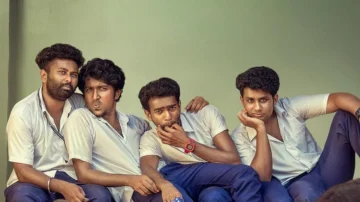
Ajay logs into a dating app seeking research material for his startup. Mathi swipes back, hunting for screenplay authenticity. What begins as mutual deception, two strangers weaponizing romance for professional gain, collapses almost immediately under the weight of its own gimmick, leaving behind a hollow shell dressed in Gen-Z dialect and algorithmic cynicism.
Nee Forever courts disaster by betting everything on a premise that demands edge, timing, and genuine character conflict. Instead, director Ashokkumar Kalaivani delivers a film that mistakes verbal irony for emotional stakes, confusing the audience’s exhaustion with their engagement.

Sudharsan Govind’s Brain-Dead Romance Neutering
Sudharsan Govind inhabits Ajay as a man whose cognition evaporates the moment women enter frame. The performance regression, from functional tech entrepreneur to comedic simpleton, signals a script that views its male lead as a punchline waiting to happen, not a character with interiority.
There’s no recovery arc, no moment where Ajay’s vulnerability reads as earned. He simply exists to stumble through romantic setups, and Govind, without stronger material, cannot manufacture conviction where none is written.
Archenaa Ravi Stranded by Underwritten Mathi
Archenaa Ravi carries the burden of playing Mathi, a character so hollowed out that her deception becomes forgettable rather than compelling. The screenplay refuses her any edge, she’s positioning herself as a screenwriter hunting authenticity, yet the film gives her nothing authentic to do.
Her chemistry with Govind never ignites because neither actor has a foundation to build from. Ravi’s presence suggests capability, but the material crushes any possibility of her making Mathi memorable.
Breezy Comedy That Lands Nowhere
The opening stretch targets Gen-Z romance tropes with a sledgehammer, assuming that naming app obsession equals satirizing it. Dialogue drips with trendy lingo, swiping, matching, unmatching, deployed so frontally that the comedy dies before it germinates.
Supporting players like Y Gee Mahendran and Nizhalgal Ravi are present but undefined, offering no anchor for the film’s tonal chaos. The ensemble never coalesces into a coherent dramatic world.
What critics identified succinctly: “The Gen-Z romance playbook boils down to trendy lingo and an obsession with apps. Nee Forever overdoses on both, and no amount of swiping and slang can disguise a film this empty.” The assessment cuts to the core failure, surface-level mimicry mistaken for substance.
If you’re browsing for Tamil drama and romance reviews, consider more emotionally grounded alternatives that risk genuine vulnerability rather than algorithmic cynicism.
Kalaivani’s Stylistic Indecision Between Satire and Sincerity
Ashokkumar Kalaivani’s direction wavers between satirizing millennial dating culture and earnestly endorsing it, landing confidently in neither territory. The screenplay collapses under its own irony, it wants to mock app-driven romance while simultaneously building a film around that exact mechanic.
The 133-minute runtime compounds the problem. Each scene stretches longer than its emotional content warrants, padding a thin premise with repetitive banter and uninspired setups.
Ensemble Cast Neutralized by Thin Material
Nizhalgal Ravi, Rethika Srinivas, Chella, and Brindha populate the margins without registering as meaningful presences. Their casting suggests Kalaivani understood he needed character texture, yet none of these actors receive the writing to justify their presence.
Y Gee Mahendran fares marginally better, but even his screen time feels purposeless, a supporting turn abandoned by a screenplay too busy with its own cleverness.
There are no documented controversies, no cultural flashpoints that might elevate this beyond its execution failures. What emerges is a film that simply doesn’t work, not because it attempts something risky, but because it executes something safe so poorly that the mediocrity becomes the story itself.
Skip this one. The fake-relationship premise has been mined more honestly elsewhere, and this particular film adds nothing to that conversation. The 2.0 critical rating deserves respect, it reflects a film that mistakes trendy surface for thematic substance, landing with a thud on both counts.
Nee Forever is a Tamil drama that fails to justify its premise, earning a 2.0/5 for mistaking Gen-Z dialect for character depth.
Director Ashokkumar Kalaivani’s tonal uncertainty mirrors the structural misfire seen in Peter review, where premise overrides character work.
Both films suffer from the same trap: Thimmarajupalli TV verdict attempt tonal balance but collapse under uneven screenplay construction.

Ankit Jaiswal is the Chief Author, covering Indian cinema and OTT releases with honest, no-filler criticism. An SEO strategist by background, he brings a research-driven approach to film writing, cutting through hype to tell you exactly what's worth your time.