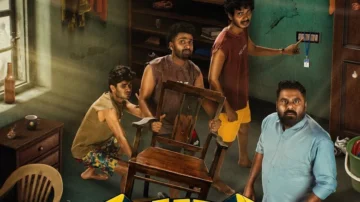
A principled car driver named Selvam watches the gap between his conscience and his rent widen with every passing day, that precise, uncomfortable tension is what Ram Chakri’s Carmeni Selvam dares to build a whole film around. In a Tamil film landscape addicted to spectacle, gambling an entire family entertainer on a driver’s moral arithmetic is either brave or reckless, and the film knows it.

Samuthirakani Carries Selvam’s Burden Without Flinching
Samuthirakani is the film’s spine and its safest bet simultaneously. He has spent years playing characters caught between dignity and desperation, and Selvam fits that register like a worn leather seat, familiar, but not without texture.
One dialogue lands with quiet devastation: “While chasing a livelihood, we often let precious experiences slip away.” In Samuthirakani’s hands, that line isn’t a speech, it’s an exhale from a man who’s been holding his breath too long. I found myself believing every weighted silence he offers far more than any scripted confrontation the film constructs around him.
Ram Chakri Writes With Empathy but Directs With Uneven Hands
Ram Chakri’s screenplay has a genuine feel for domestic friction. The line, “You were the one who wanted to buy a house. Then planted that idea in my head and drove me crazy”, captures middle-class marital tension with the economy of a short story writer. That instinct for lived dialogue is the script’s clearest strength.
The direction, however, struggles to match it. Without specific setpieces or sustained dramatic architecture, the film risks feeling like a series of well-observed scenes in search of a propulsive structure. Yuvaraj Dakshan’s cinematography works within modest means, but Ram Chakri doesn’t always give it anything visually adventurous to chase.
Editing by Jagan R.V. and Dinesh S. carries the weight of whatever pacing choices the screenplay demands, whether that weight becomes momentum or drag will be the film’s central risk in the hall.
A Comedy-Drama That Trusts the Mundane, Sometimes Too Completely
Comedy-dramas live and die on the distance between their funny moments and their honest ones. Carmeni Selvam seems to understand this, the dialogue rhythm suggests a writer who finds humour in argument rather than punchline. The exchange about the house loan, “This is not a loan but alms. We must take a loan!”, has the cadence of genuine domestic comedy.
But a family entertainer needs its emotional turns to feel earned, not merely arrived at. Without a structurally clear Act 2 crisis, the film may coast on warmth where it should be building pressure. The risk Ram Chakri takes here is trusting that the audience’s recognition of ordinary life will substitute for dramatic escalation.
Whether that gamble pays off depends entirely on your patience for films that prefer the texture of Tuesday over the drama of Saturday. For a section of the Tamil audience, that patience exists, and Carmeni Selvam is explicitly written for them.
If Tamil comedy-drama territory interests you beyond a single film, Tamil Drama reviews on this site cover the genre’s wider range across recent releases.
Gautham Vasudev Menon in a Pivotal Role Is a Statement, Not Just Casting
Casting Gautham Vasudev Menon, a filmmaker of considerable auteur reputation, in a pivotal supporting role is an act of deliberate cultural signalling. It tells you Ram Chakri is reaching for a certain class of Tamil cinema credibility, the kind that comes with association rather than just execution.
What Menon brings to the actual scenes remains to be seen on screen, but his presence alone shifts the film’s register. Abhinaya, one of Tamil cinema’s most instinctive performers, rounds out a cast where intent is clearly more ambitious than the available canvas suggests. Lakshmi Priyaa Chandramouli as the female lead grounds the domestic conflict, her character’s pressure on Selvam, implied through the loan dialogue, hints at a performance built on frustration and love in equal parts.
No Controversy, But Plenty of Quiet Audience Risk
Carmeni Selvam arrives without controversy, casting storms, or political flashpoints. Its only real gamble is the one Ram Chakri placed on release day: a PG-13 family film about a car driver’s honesty, releasing theatrically through PVR INOX Pictures, competing against a market that rewards noise.
The film’s Music Cloud Technologies score, operating on a “Music as a Service” model, is an unusual production choice that signals lean economics. Whether the music serves the film’s emotional beats or merely fills them is the kind of detail that will divide audiences more than any controversy ever could.
If you go to Carmeni Selvam expecting kinetic energy or genre fireworks, you will leave disappointed. But if you go looking for a film that genuinely believes a principled man’s small domestic war is worth two hours of your attention, there is something here that earns quiet respect. Catch it in theatres, where its unhurried pace and intimate performances will read better than on a small screen.
Carmeni Selvam is a film worth your consideration, not without its structural hesitations, and Samuthirakani’s restrained, honest work alone justifies a 3 out of 5, making it a modest but meaningful addition to Tamil family cinema in 2026.
Bharath’s performance in Kaalidas 2 review similarly proves how a single committed lead can carry a film past its structural limitations, worth pairing with this one.
Repu Udayam 10 Gantalaku shares this film’s faith in character-first storytelling over spectacle; read more in the Repu Udayam verdict for a sharper look at that risk.

Ankit Jaiswal is the Chief Author, covering Indian cinema and OTT releases with honest, no-filler criticism. An SEO strategist by background, he brings a research-driven approach to film writing, cutting through hype to tell you exactly what's worth your time.