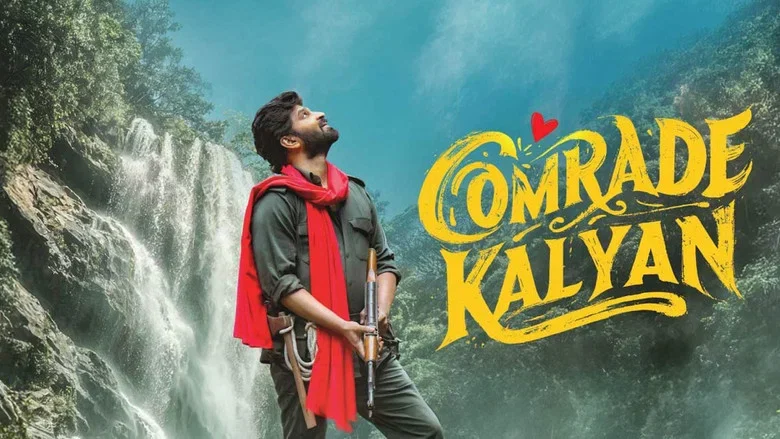
Janakiram Marella opens on a projector’s beam cutting through cigarette smoke in a cramped village hall somewhere along the Andhra–Odisha border, early 1990s. The audience inside isn’t there for ideology; they’re there because R. Narayana Murthy’s films are what plays in this belt, and Sree Vishnu’s Kalyan has figured out that other people’s convictions can be monetized. It’s the sharpest idea in the film: a man whose entire relationship to revolution is box-office arithmetic.
That premise carries real satirical charge. Kalyan doesn’t believe anything except that a full house pays better than an empty one, and Vishnu plays the calculation with a slack, agreeable grin that never quite reaches his eyes. When he leans against the ticket window sizing up a customer, you can see the merchant behind the performer, a small, precise piece of character work that the screenplay will spend the rest of its runtime trying to complicate.
Then Sitara arrives with her parents, and the film’s commercial engine switches tracks. Mahima Nambiar gives her a guarded stillness in the early scenes, hands folded, gaze fixed on middle distance, that reads as a woman already carrying a ledger she hasn’t shown anyone yet.
Debt As Romantic Catalyst, Then As Structural Trapdoor
The film’s smartest move is making love transactional before it becomes anything else. Sitara’s brother has left the family owing money, and the lender’s price is her hand in marriage. Kalyan’s response isn’t poetry; it’s a payment plan. That single choice grounds the romance in economic desperation rather than attraction, and for roughly an hour Marella keeps the tone steady on that footing.
Where the film starts to slip is in how it handles the leap from that plan to armed insurgency. The screenplay treats Kalyan’s absorption into Naxal activity as an inevitability of proximity rather than a decision, and the intermediate psychological steps, the moment a man who faked commitment starts to be hunted as the thing he pretended to be, are compressed into montage and implication. Whether a more patient script could have sold that transition is the film’s central unanswered question.
It’s a limitation that echoes the structural impatience of The Third Murder, another recent theatrical release that mistakes thematic ambition for dramaturgical follow-through. Both films want to interrogate the gap between performance and belief; only one of them does the unglamorous work of showing the bridge.
Shine Tom Chacko Brings The Only Real Pressure
Against the film’s diffuse antagonists, lenders, political fixers, rival factions, Shine Tom Chacko’s IPS officer arrives like a change in air pressure. He doesn’t speechify. He stands very still during interrogations, lets silences run a beat past comfortable, and speaks in a low register that never rises even when the content turns threatening. It’s the most disciplined work in the film, and it exposes how loosely everyone else is being directed.
Radhika Sarathkumar’s mother character, by contrast, is handed the film’s weakest material: a running gag about petty litigation and neighborhood disputes that keeps interrupting the plot rather than tightening it. She’s a fine performer working with a device, not a character, a pressure valve the screenplay opens whenever the political material gets too heavy.
The romantic register fares better. There’s a sequence where Kalyan counts out cash for Sitara’s debt while she watches from across a room, and Nambiar does something quietly devastating with her posture, shoulders dropping half an inch, as if relief and humiliation arrived in the same breath. Vishnu, meanwhile, keeps his expression carefully blank, refusing to let the gesture read as heroism. The restrained exhaustion he brings to that moment recalls the psychological weight of his turn in Izhakalkkappuram, where similar stillness did more narrative work than any monologue.
Where The Camera Stops Helping
Vijay Bulganin’s score is the film’s most reliable ally in the first hour, playing the theatre scenes with a brassy, slightly ironic warmth that matches Kalyan’s opportunism. In the second half, the music turns generically portentous, sustained strings, low percussion, and the shift is too abrupt to feel earned. The score starts insisting on gravity the screenplay hasn’t built.
Marella’s staging is at its best in confined spaces: the projection booth, the lender’s cluttered front room, the back of a jeep. When the film moves into open terrain for its insurgency material, the framing loosens and the geography becomes vague, you stop being able to tell which faction controls which road, and the tension leaks out of scenes that should be tightening.
The editing compounds this. The first half moves at a patient, character-led clip. The second half accelerates into incident after incident, police sweeps, factional meetings, the kidnapping itself, without giving any single beat room to land. By the time the political crisis peaks, the film has spent so much energy on plot mechanics that the emotional stakes around Sitara’s family have gone quiet.
It’s a problem the film shares with other recent regional hybrids that mistake escalation for drama. The same tonal instability that undermines the climax here is visible in Hushar Pittalu, where a familiar romantic template was also asked to carry weight it was never built to hold.
The Comrade He Never Meant To Become
What the film gets right, and it’s worth saying plainly, is the central irony. Kalyan spends the first act performing communist affiliation for ticket sales, and the second act punishing him for it. The title isn’t a celebration; it’s a sentence. By the time he’s associated with an actual kidnapping, the film has made its point about how easily a man can be absorbed into the story he was only pretending to tell.
But the film doesn’t trust that irony enough to sit with it. Instead of letting Kalyan reckon with what he’s become, the screenplay keeps adding complications, more factions, more pursuers, more misunderstandings, as if afraid the audience will get bored without a new crisis every ten minutes. The result is a film that knows what it’s about but keeps flinching away from its own conclusion.
For a period piece set against such specific political texture, this signals a broader hesitation across contemporary Telugu dramas, a reluctance to let a character’s moral reckoning carry a third act without constant plot reinforcement. Marella has the instincts of a satirist and the pacing of a crowd-pleaser, and those two impulses never quite reconcile here.
A Promising Film That Refuses Its Own Best Idea
The final stretch gestures toward resolution without earning it. Kalyan’s arc closes on a note of ambiguous consequence, which is the right instinct, but the surrounding plot machinery, the police pursuit, the factional politics, the debt that started everything, gets tidied away with a haste that undercuts the ambiguity. You leave the theatre unsure whether the film wants you to feel relief or unease, and that uncertainty reads as indecision rather than design.
Sree Vishnu remains the reason to see it. He plays Kalyan as a man who never quite becomes a hero, and his refusal to inflate the character is what keeps the film watchable through its messier stretches. It’s a more interesting performance than the script deserves.
What we’re left with is a film with a genuinely sharp premise, one excellent antagonist performance, and a second half that loses faith in its own ideas. Marella has made something worth arguing about, which is more than most period comedies manage, but the argument he’s staging is better than the one he delivers.
Rating: 2.5 / 5
The tragedy of Kalyan isn’t that he became a comrade. It’s that he never got to be just a man who sold tickets.

Ankit Jaiswal is the Chief Author, covering Indian cinema and OTT releases with honest, no-filler criticism. An SEO strategist by background, he brings a research-driven approach to film writing, cutting through hype to tell you exactly what's worth your time.