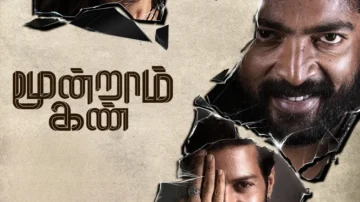
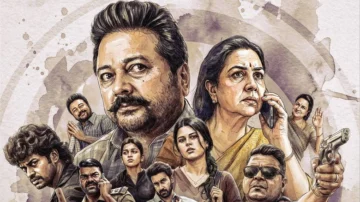
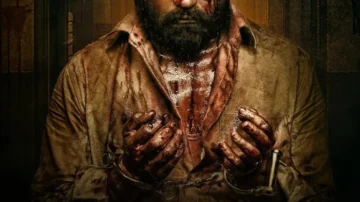
Sunil Ibrahim opens The Third Murder with a corpse that refuses to stay singular. Businessman Boban is found dead in precisely the manner of drug peddler Justin, and within minutes the film announces its intentions: this is not a whodunit but a countdown. The mirroring is efficient, almost clinical, and it establishes the central engine before a single character has been properly introduced.
That efficiency is both the film’s sharpest asset and the first sign of its limitations. A patterned killer demands escalation, and the screenplay by M.S. Faisal Khan understands the mechanics of dread without always locating its pulse. The opening works because it withholds; the question is whether the remaining two hours know what to do with that restraint.
Saiju Kurup’s Investigator Carries Weight the Script Won’t Share
Saiju Kurup plays Christy, the officer tasked with threading the needle between procedure and psychology. It is a performance built on stillness, Kurup holds interrogations with a leveled gaze and a voice that rarely rises above conversational register, which makes his occasional flashes of frustration land harder than any outburst could. He is doing the work the screenplay sometimes forgets to assign him.
The actor has spent recent years oscillating between comic relief and character roles, and this is his most sustained attempt at dramatic anchoring. He mostly succeeds, though the film’s refusal to give Christy a private life or interior fracture leaves him performing competence rather than conflict. Compare this to his work in Izhakalkkappuram, where the chamber setting forced a different kind of pressure. Here, the city is the chamber, and it is too vast for the script to fill.
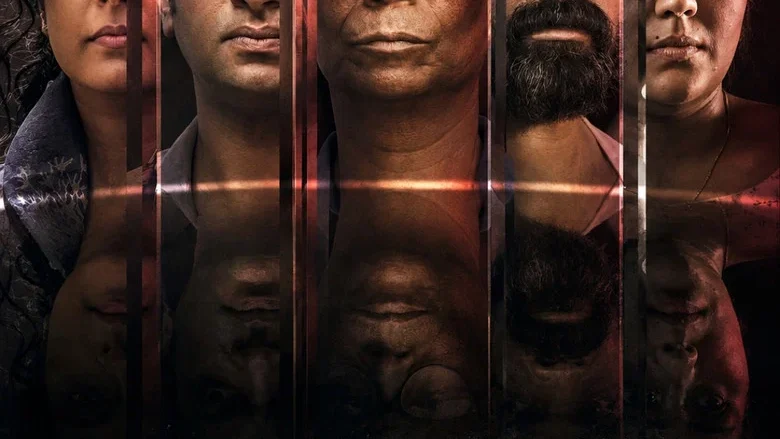
Indrans and the Ex-Cop Who Shifts the Temperature
The introduction of Swamy, a former officer brought in for his serial-killer expertise, is the film’s most deliberate tonal pivot. Indrans plays him with a weary precision, shoulders slightly hunched, eyes that track movement before words arrive, a habit of pausing before answering that suggests he is translating thought into language rather than simply speaking. It is a supporting turn that does more with silence than most of the dialogue manages.
Vinay Forrt appears in a role that should carry more weight than it ultimately does, his character orbiting the investigation without ever quite penetrating its center. The ensemble is deep, but the screenplay treats several of its members as furniture, present, functional, unexamined. That is not a casting failure. It is a structural one.
The Domestic Pressure-Cooker That Almost Works
When the investigation leads to Aditya, a troubled teenager locked in conflict with his eccentric father, the film shifts registers. The middle section becomes a domestic thriller, with family friction staged as the source of danger rather than a subplot. It is the most ambitious stretch of the film, and for a while it works, the father’s erratic behavior, the son’s coiled resentment, the sense that violence is being passed between generations like an inheritance.
But Ibrahim never fully commits to the psychological excavation the premise demands. The film gestures at trauma and instability without drilling into either, content to let hidden motives remain hidden rather than revealed. The result is a middle act that generates tension through withholding rather than understanding, which is a cheaper trick than it sounds.
A Race to Stop the Third Murder That Arrives Too Late
The climax pivots to prevention, the race to stop a third killing, and the film’s pacing finally accelerates. But the escalation feels mechanical rather than inevitable, because the emotional groundwork for the final confrontation was never properly laid. The threat is real, the stakes are clear, but the investment is intellectual rather than visceral.
Mejo Joseph’s score does what it can, pushing tension in the absence of dramatic weight, and the editing tightens the noose in the final thirty minutes. But a thriller’s climax is only as effective as the psychological architecture beneath it, and The Third Murder has built its house on sand. The resolution lands, but it doesn’t linger.
Where the Film’s Ambition Outpaces Its Execution
Ibrahim’s direction favors restraint, longer takes, minimal camera movement, a preference for faces over spectacle. It is a deliberate choice, and it suits the material better than a more frantic approach would. But restraint only works when the writing beneath it is dense enough to justify the stillness. Here, the quiet often feels like emptiness rather than tension.
The film’s central thesis, that violence is a human and psychological condition rather than merely a crime to be solved, is stated more than dramatized. The Aditya-father strand is the clearest attempt to embody that idea, but it never reaches the operatic pitch the material requires. The gap between intention and execution is the film’s defining characteristic, as we frequently track across our film desk's ongoing coverage of Malayalam cinema’s recent psychological turn.
The Verdict: A Competent Procedural That Mistakes Restraint for Depth
The Third Murder is a film that understands the grammar of the psychological thriller without fully mastering its syntax. The premise is strong, the cast is capable, and the direction is controlled. But control without revelation becomes monotony, and the film’s refusal to truly excavate its characters’ interiors leaves the whole enterprise feeling curiously weightless.
Saiju Kurup and Indrans deserve better material, they are doing the work of suggesting depths the screenplay never bothers to plumb. Audiences seeking a tense, well-mounted procedural will find enough to hold their attention. Those hoping for the psychological reckoning the title promises will leave wanting. The third murder is stopped. The question that lingers is whether anyone involved understood why it was happening in the first place.
Rating: 2.5 / 5

Ankit Jaiswal is the Chief Author, covering Indian cinema and OTT releases with honest, no-filler criticism. An SEO strategist by background, he brings a research-driven approach to film writing, cutting through hype to tell you exactly what's worth your time.