The first image that lands is not a face but a room full of strangers learning a song in a language that isn’t theirs. Seetha, a Malayali research student, has crossed the country to Santiniketan to study Baul music, and the film’s early passages sit inside that discomfort, a woman listening hard, notebook open, trying to earn her way into someone else’s tradition. It is the most alive the film ever feels.
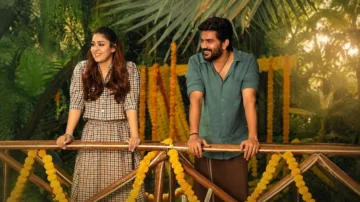
What follows is a romance built on shared curiosity rather than shared circumstance. She meets Sam, a freelance photographer drifting through the same artistic circuit, and the attraction is pitched as intellectual recognition: two people who make their living by paying attention to things other people walk past. For a while, that’s enough.
A Love Story That Refuses To Give Its Disappearance A Cause
The middle stretch is where Chiram makes its riskiest bet. Sam vanishes into the Mahananda forests, and the film treats that vanishing as weather rather than event, something that happens to the characters rather than something they investigate. There is no antagonist here, no rival, no betrayal to pin it on. The pressure comes entirely from distance, responsibility, and the slow divergence of two lives that once ran parallel.
This is a defensible choice in theory. In practice, it leaves an enormous hole where the film’s engine should be. A disappearance without a mechanism isn’t mystery, it’s absence, and absence has to be filled by something. The screenplay reaches for Seetha’s later life, her ties to a tribal community in Kerala, her search for identity, but it never quite fills the vacuum. The film asks us to mourn a loss it hasn’t fully dramatized.
The tonal patience on display here has precedent in recent Malayalam storytelling, though the comparison cuts both ways. Where Izhakalkkappuram used its chamber scale to compress pressure until something had to break, Chiram uses its geographical sprawl to let pressure dissipate. One film traps you in a room. The other lets you wander.
Koroth Carries The Film’s Entire Emotional Ledger On Her Shoulders
Aishwarya Midhun Koroth has the hardest job in the production. She has to play a woman across what amounts to two separate lives, the student who arrives at Visva-Bharati with a research grant and no emotional armour, and the woman years later who has been reshaped by loss, land, and obligation. The transition is the whole film, and she commits to it physically.
Watch her in the early Santiniketan scenes: the slight forward lean when she’s listening to a Baul singer, the way she keeps her hands busy with a pen even when she isn’t writing. It’s a performance built on attention, on the small mechanics of a person trying to absorb a culture without appropriating it. That restraint pays off later, when the same body language returns with different weight, stillness instead of curiosity, a woman waiting rather than reaching.
Anoop Menon’s Sam is the looser, easier half of the equation, and that’s by design. He plays the photographer as someone who belongs everywhere and commits nowhere, and the performance works precisely because it doesn’t announce its own elusiveness. His scenes with Koroth have a relaxed, unhurried quality that makes the eventual separation land harder than the script probably earns.
The supporting ensemble is harder to assess because the film doesn’t give them much to do. Sreekanth Murali and Shelly Kishore appear in the kind of roles that exist to populate a world rather than complicate it, faces in a courtyard, voices at a gathering. There’s no supporting performance here that redirects the film’s energy, and after two hours, that absence registers as a structural decision rather than an oversight.
Where The Co-Direction Holds And Where It Slips
Sindhu Paradayil and N. Sudheer have built a film around movement, Kolkata to Rishikesh to Palakkad to Vagamon, university corridors to forest trails to Kerala soil. Cinematographer Anand J. Balakrishnan shoots the cultural sequences with a documentary plainness that suits the research premise, letting faces and instruments carry the frame rather than imposing visual flourish.
But the film’s second half loses the thread of its own geography. The jump to “years later” is handled without a clear visual or rhythmic marker, and the Kerala and Mahananda sections never quite cohere into a single emotional argument. The editing by C. V. Sajayan favours a gentle, associative flow that works in the romance but flattens the later search into something closer to a travelogue than a reckoning.
M. Jayachandran and Girish Narayanan’s music is the film’s most reliable asset. The released song “Chanthare” carries the romantic identity the marketing promised, and the background score stays out of the way in the dramatic passages, which is the correct instinct, even if the film could have used more silence in its final act.
Where Selvi understood that a woman’s interior life can hold a film together without external threat, Chiram keeps looking outward for its stakes, to forests, to cities, to years. The result is a film that is often beautiful and rarely urgent.
The Ending Chooses Memory Over Resolution, And That’s The Problem
The final movement sends Seetha looking for Sam and, implicitly, for the version of herself she left behind in Santiniketan. The film doesn’t resolve the search so much as dissolve it into atmosphere, a choice that reads as intentional but lands as evasive. There’s a difference between ambiguity that deepens meaning and ambiguity that replaces it, and Chiram sits uncomfortably on that line.
What saves the ending from feeling like a cop-out is Koroth. Her final scenes carry a weariness that the script hasn’t fully earned, and she plays it without begging for sympathy. If the film had trusted her more and explained less, it might have been something closer to the quiet, devastating romance it clearly wants to be.
Instead, we get a film that gestures at the emotional register of Comrade Kalyan without the tonal fracture that made that film interesting, a period piece that never quite commits to being about its period, a love story that never quite commits to being about its love.
The broader landscape of contemporary Malayalam dramas has been moving toward exactly this kind of literary, place-rooted storytelling, and Chiram arrives as a sincere entry in that movement. Sincere, but not yet sharp. It has the ingredients, a compelling lead, a culturally specific world, a genuinely unusual premise, and it uses them with a caution that keeps the film at arm’s length.
What lingers is not the search or the disappearance or even the love story. It’s Koroth’s face in the early Baul scenes, listening to something she doesn’t yet understand. That’s the film Chiram could have been: a study of a woman learning to hear. Instead it becomes a study of a woman learning to wait, and waiting is much harder to make cinematic.
Rating: 2.5 / 5

Ankit Jaiswal is the Chief Author, covering Indian cinema and OTT releases with honest, no-filler criticism. An SEO strategist by background, he brings a research-driven approach to film writing, cutting through hype to tell you exactly what's worth your time.