The ancestral house in Izhakalkkappuram has the acoustics of a confession booth. Every footstep on its red-oxide floor carries, every pause between father and daughter stretches a beat too long, and Venu Nair, writer, director, producer, sound designer, and composer, because apparently one job was not enough, stages his entire film inside that echo. This is a movie that begins with an argument and ends with the same argument, merely older. Whether that circularity reads as wisdom or as a snake eating its tail depends entirely on your tolerance for chamber drama that mistakes stillness for depth.
The Gandhian And The Documentarian: A Debate With Only Two Participants
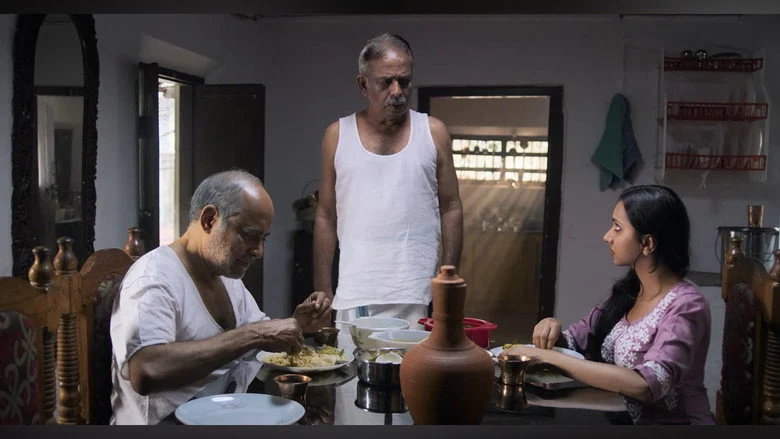
Dinesh Panicker plays Dr. Ananth Sivan, a Gandhian scholar whose convictions have calcified into furniture, immovable, load-bearing, and impossible to argue with. Gautami Karthi is his daughter Karthi, a documentary filmmaker who has spent her adult life recording other people’s truths and has now turned the lens on her own father’s. The premise, as the film’s own publicity materials put it, follows how “ideological convictions intersect with personal relationships, ” and Nair commits to that intersection with the discipline of a man who has read his Bazin.
The problem is arithmetic. Two people, one house, ninety-six minutes (or a hundred and twenty-three, depending on which listing you trust, the metadata for this film is as unsettled as its characters). A chamber drama lives or dies on the pressure it can generate inside a sealed room, and Izhakalkkappuram generates plenty of pressure in its first act. Ananth corrects Karthi’s grammar mid-sentence. Karthi films him without asking. These are small violences, and Nair films them small, Pushpan Divakaran’s camera holds wide, letting the house’s emptiness do the emotional labor. It works. For a while.
What The Film Gets Right: Performance As Restraint
Panicker’s performance is the film’s spine, and he understands that a Gandhian scholar’s power lies in what he refuses to do. Watch his hands. In the early scenes, they rest on his knees like two trained animals. He never gestures when a pause will do. When Karthi challenges him on a point of principle, the film’s central recurring argument, staged at the same dining table three times across the runtime, Panicker’s Ananth does not raise his voice. He lowers it. The effect is genuinely unnerving, and it is the closest the film comes to genuine dramatic combustion.
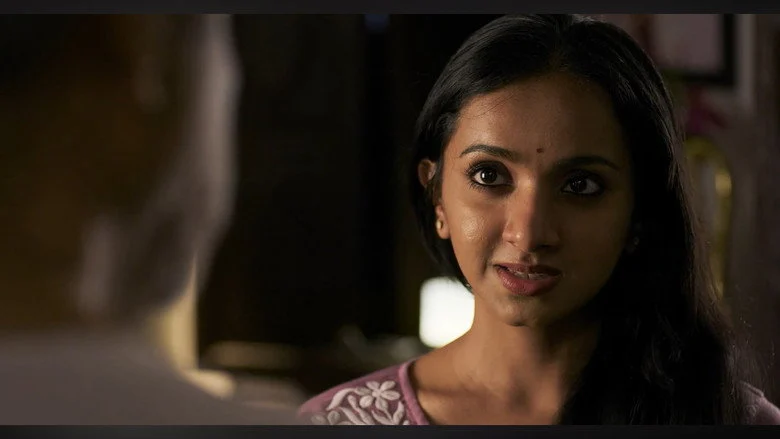
Gautami Karthi matches him in the quieter registers. Her Karthi is a woman who has learned to argue by asking questions she already knows the answers to, and the performance carries a weariness that suggests this debate predates the film’s first frame. Together, they make the film’s central relationship credible. What they cannot do is make it surprising.
For a sharper example of how a single-relationship drama can generate genuine unpredictability, our review desk’s take on Mr Bhaarath review is worth revisiting, a film that understands charm requires friction. Izhakalkkappuram has friction. What it lacks is the courage to let that friction spark into something irreversible.
The Third Act Problem: A Film That Refuses To Break Its Own Furniture
Here is where the chamber drama’s discipline becomes its cage. The film’s structure is linear and dialogue-driven, which is fine, Bresson built a career on it. But Nair’s screenplay treats every ideological disagreement as a round in a debate competition, complete with opening statements and closing summaries. By the third iteration of the dining-table argument, the audience has learned the choreography. We know when Ananth will invoke Gandhi. We know when Karthi will invoke the documentary she is making. We know, with the dull certainty of a metronome, that neither will move.
The supporting cast offers no escape hatch. Vanchiyoor Praveen Kumar’s Jagadeesh is described in the film’s materials as playing a “pivotal role, ” but the character exists primarily to absorb exposition and occasionally remind the audience that a world exists outside the house. This is a structural flaw, not a performance one, Praveen Kumar does what he can with a role that functions as furniture.
What the film needed, and what it never quite finds, is a moment where the ideological debate becomes physical, or financial, or irreversible. A Gandhian scholar’s convictions are only interesting when they cost him something he cannot afford. Izhakalkkappuram gestures at this cost, Karthi’s documentary, presumably, threatens to expose something, but it never lands the blow. The film’s runtime inconsistencies across listings (JustWatch says 96 minutes; others say 123) suggest a post-production identity crisis, and watching the finished product, you can feel the missing twenty-seven minutes. They are the minutes where something was supposed to happen.
A Note On Craft: The Auteur As One-Man Band
Venu Nair’s decision to write, direct, produce, compose, and design sound for his own film is either heroic or hubristic, and the result suggests a little of both. The sound design is genuinely accomplished, the house’s creaks and silences are mixed with real intelligence, and the background score (also Nair) knows when to vanish entirely. But a film with one authorial voice and no external editor is a film that never has to defend its choices. The dialogue in Izhakalkkappuram is literate and precise, but it is never interrogated. Nobody in the room is asking if the third dining-table scene needs to exist. Nobody is asking if the film’s central argument has an actual resolution or merely a stopping point.
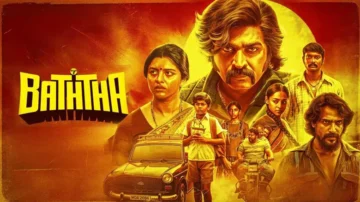
This is the paradox of the micro-budget auteur: total control produces total coherence, but coherence is not the same as drama. Compare the film to something like Baththa verdict, which also traps its protagonist in a confined space, and which understands that confinement is only interesting when the walls are closing in. Nair’s walls are stable. His characters are stable. His film is stable. Stability, in drama, is a form of death.
Verdict: A Thoughtful Film That Mistakes Thinking For Feeling
Izhakalkkappuram is not a bad film. It is a well-acted, intelligently written, technically accomplished chamber drama about the cost of conviction, and it is also a film that never quite justifies its own existence as cinema rather than as a stage play with better lighting. Panicker and Karthi deserve a better vehicle, or at least a vehicle that lets them crash. What we get instead is two excellent performances circling each other with perfect manners, in a house that never quite catches fire.
Who should watch: Patient viewers who genuinely enjoy dialogue-driven Malayalam chamber dramas, fans of restrained performance work, and anyone who has ever wanted to argue with their father about Gandhi and gotten nowhere. Who should avoid: Anyone expecting plot momentum, catharsis, or a third act that changes the terms of the debate.
Rating: 2.5/5, A film of real intelligence and real limitations, caught between the stage and the screen, never quite committing to either. For more of our coverage of Malayalam cinema’s ongoing experiments with intimacy and scale, see Malayalam Drama reviews.

Ankit Jaiswal is the Chief Author, covering Indian cinema and OTT releases with honest, no-filler criticism. An SEO strategist by background, he brings a research-driven approach to film writing, cutting through hype to tell you exactly what's worth your time.