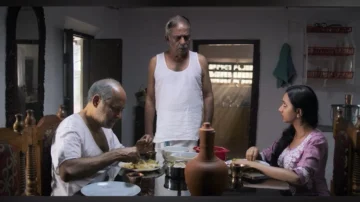
The first sound in Selvi is not a scream or a score cue. It is a doorbell. Then another. Then another, threaded across a corridor of wealthy homes that our protagonist enters the way other people enter rooms, through service, not through invitation. Sailesh Rathnakumar’s debut feature opens inside a world of polished floors and elderly patients, and its heroine is a migrant home-care nurse who has learned to read a household’s mood before she has removed her sandals. Within ten minutes, the film has already established its governing pressure: a workday that can stretch from twelve hours to seventy-two, and a woman whose entire life has been quietly restructured around other people’s needs.

A Woman Who Measures Her Existence in Other People’s Shifts
Anjali Patil plays Selvi with a stillness that is not serenity but depletion, the flat, careful voice of someone who has learned that visible exhaustion costs money. Watch her posture in the early household scenes: shoulders angled slightly forward, hands always working, eyes scanning a room for the next task before the current one is finished. She does not perform suffering. She performs competence, and the film is smart enough to let that competence become the source of dread.
The premise is deceptively simple. Selvi cares for the elderly inside affluent homes that treat her presence as furniture. When her close friend and fellow caregiver Kavitha collapses without warning, Selvi absorbs her shifts on top of her own. The arithmetic is brutal and the screenplay never softens it: more hours, less sleep, no room to grieve, no room to think. The film’s structural intelligence lies in how it converts this time pressure into psychological suspense. Every additional shift is a step deeper into a life she cannot fully control, and, eventually, a past she cannot fully contain.
The Social Drama That Refuses to Stay in Its Lane
For its first hour, Selvi functions as a labour drama with unusually precise texture. The 12-to-72-hour framework is not decorative. It is the engine. Rathnakumar and co-writer Bargav Sridhar treat the shift schedule as a countdown device, and the repetition of domestic routines, lifting a patient, preparing food, washing utensils, waiting for a family member to return, accumulates into something close to claustrophobia. The wealthy interiors are lit with a warm, comfortable glow that Selvi herself never quite occupies. She is inside the frame but outside the light.
Where the film takes a genuine risk is in its refusal to remain a straightforward social-realist portrait. Fragments of an incident from Selvi’s past begin surfacing, not in flashback-as-explanation, but as intrusive, incomplete images that the present-day narrative cannot fully absorb. The shift is gradual, and that is both the film’s boldest choice and its most unstable one. The thriller element does not arrive as a genre turn; it arrives as a symptom. The question is whether that symptom is diagnosed with enough clarity by the time the credits roll.
Anjali Patil’s Face Is the Film’s Best Special Effect
Patil, who also serves as a producer here, gives the kind of performance that resists easy quotation. There is a moment in the middle section, a long, unbroken shot of her standing in a kitchen doorway after a patient has been put to bed, where her face does almost nothing, and the film’s entire thesis about invisible labour lands in that nothing. She is not crying. She is not raging. She is calculating whether she can afford to sit down. That is the register she sustains for ninety-seven minutes: a woman perpetually performing the version of herself that will keep her employed.
Swathy Krishnan’s Kavitha is the film’s emotional anchor in its opening act, and her collapse lands with real weight because Krishnan plays her as Selvi’s mirror rather than her contrast, two women who have built a fragile mutual-support system inside a system that does not support them. Vinoth Kishan’s Purushothaman occupies a more ambiguous space in the surrounding interpersonal network; the screenplay gives him just enough presence to register as part of Selvi’s working world without ever clarifying whether he is a threat, a witness, or simply another exhausted participant in the same economic machinery. The restrained physical exhaustion Kishan brings to his scenes recalls the psychological weight of his turn in Double Occupancy, where he similarly played a man negotiating a version of himself that others refuse to see clearly.
The Thriller That Grows from the Floorboards, Not the Ceiling
What distinguishes Selvi from a conventional psychological thriller is that its suspense is not manufactured by a villain. There is no named antagonist here. The pressure comes from employers who control Selvi’s time, from the economic vulnerability of migrant care work, from the consequences of Kavitha’s collapse, and from Selvi’s own unresolved past. The film understands that the most terrifying thing in a caregiver’s life is not a masked figure in the corridor, it is the possibility that she will lose the job that keeps her alive.
This structural choice is also where the film’s ambition risks outrunning its execution. The transition from social drama to psychological suspense is handled with restraint, but the withheld information about Selvi’s past begins to feel less like organic mystery and more like narrative withholding. The reveal, when it arrives, is not unearned, the film has laid careful groundwork in its fragmentary images and Patil’s guarded physicality, but it does not fully resolve the tonal tension between the film’s documentary instincts and its genre obligations. The screenplay occasionally reaches for suspense when the social realism was already doing the work.
Rathnakumar’s direction is at its strongest in the film’s quietest passages. He favours medium shots that keep Selvi’s body in frame, her hands, her posture, her position relative to doorways and beds, and he resists the temptation to cut away from discomfort. The visual grammar is consistent: warm interiors, cool corridors, and a protagonist who is always slightly too large for the spaces she is asked to occupy. Suren Vikhash’s score, used sparingly, does not oversell the thriller beats. The film’s most effective suspense sequence involves nothing more than a phone call and a closed door, and it works because the camera holds on Patil’s face rather than cutting to what she is afraid of.
Where the film stumbles is in its final movement. The darker turn is thematically coherent, Selvi’s concealed past becomes central to her choices, but the pacing accelerates in a way that feels less like escalation and more like compression. The screenplay has spent an hour establishing the rhythms of care work, and the climax asks us to accept a shift in register that the film has not entirely prepared us for. The ending is not a betrayal of the premise, but it is a narrower resolution than the film’s social scope seemed to promise.
A Festival Drama That Trusts Its Actress More Than Its Genre
It is worth noting how much of Selvi is carried by Patil’s presence rather than by plot mechanics. The film’s Busan premiere and its Red Sea Fund backing place it firmly in the festival-drama ecosystem, and its closest tonal relative in recent Tamil cinema is not a thriller but a character study. The film’s interest in female friendship, migration, and the invisible architecture of care work places it alongside other contemporary Tamil dramas that have chosen interiority over incident. Just as Comrade Kalyan struggled to reconcile its political comedy with its tonal shifts, Selvi occasionally wobbles between social realism and genre suspense, but where that film lost its footing, this one keeps its balance through the sheer discipline of its lead performance.
The supporting cast is used sparingly, and in some cases, too sparingly. Kitty appears in a principal credit, but the film never gives his character enough dramatic function to justify the weight of his presence. The same is true of several of the household figures who populate Selvi’s working life: they are sketched as types, the demanding daughter, the indifferent son, the patient who cannot speak, and the film relies on Patil to generate the emotional friction that the screenplay does not always provide. This is not a fatal flaw in a performance-led drama, but it does mean that the film’s world feels narrower than its themes require.
What the film does exceptionally well is refuse to sentimentalise care work. There is no inspirational montage, no moment where Selvi’s labour is recognised and rewarded. The film’s most radical gesture is its insistence that Selvi’s survival is not a triumph but a continuation, a daily negotiation with forces that will never fully acknowledge her. That refusal to console is what makes the ending land with the weight it does, even if the path to it is not always smooth.
In a landscape where contemporary Tamil dramas are increasingly willing to centre women’s interior lives without reducing them to victimhood or heroism, Selvi is a welcome addition. It is not a perfect film. Its thriller mechanics are less assured than its social observations, and its final act trades some of its hard-won intimacy for narrative momentum. But it is a film that trusts its actress, trusts its audience, and trusts that the most frightening thing in the world is a woman with no time left.
Rating: 3.5 / 5
The film’s final image, Selvi moving through another doorway, into another home, carrying the same silence she arrived with, is not a resolution but a continuation. It is the sound of a doorbell ringing in a house that will never be hers, and it lingers longer than any conventional thriller climax could.

Ankit Jaiswal is the Chief Author, covering Indian cinema and OTT releases with honest, no-filler criticism. An SEO strategist by background, he brings a research-driven approach to film writing, cutting through hype to tell you exactly what's worth your time.