Balaji Tharaneetharan has spent his career building comedies out of people who cannot get out of their own way. In Baththa, he finally builds one out of a man who cannot get out of a room. The image is blunt and beautiful: 1986 Madras, a feared don, a deserted school restroom, and an eight-year-old boy who simply closes the door and walks away. No gang war ignites the plot. No rival clan draws first blood. A latch clicks, and the most dangerous man in North Madras is reduced to a man who needs to urinate and cannot.
That is a genuinely audacious premise for a 170-minute Tamil action drama, and it is also the film’s central risk. Baththa bets everything on the idea that a gangster’s authority is a costume, and that stripping it away in a tiled cubicle will reveal something worth watching. For long stretches, it does.
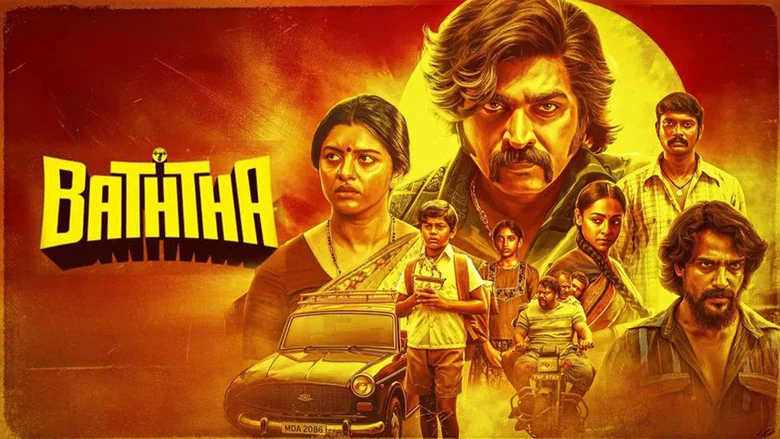
Vijay Sethupathi, Stripped Of Swagger
The performance is the reason to buy the ticket, and it operates on a very specific two-register system. In the film’s public register, the vintage North Madras streets, the slow walk, the silence that makes grown men look at their feet, Sethupathi plays the don as a man who has learned that stillness reads as threat. It is a restrained, almost minimalist piece of intimidation work, all jaw and patience.
The second register is where the film lives. Trapped, hungry, humiliated, he begins to negotiate. And the negotiation is not with a villain, there is no named antagonist here, which is either the screenplay’s smartest decision or its most convenient escape hatch. His opponent is a locked door, an empty stomach, and eventually his own conscience. Watch how Sethupathi handles the moment the boy returns: the don does not threaten, does not bargain from strength. He asks. The voice drops its floor, the shoulders lose their set, and for the first time the man’s body stops performing authority. It is a small, unglamorous piece of acting, and it is the film’s whole thesis in one gesture.
The trailer’s most-quoted contrast, feared outside, gentle at home, is not merely a marketing hook. It is the structural spine. The confinement does not soften the character so much as expose a softness that was always there, waiting for a locked door to let it out.
The Boy, The Hunger, And The Long Second Hour
The child actor carries an unreasonable share of the film’s emotional load, and the staging around him is deliberately un-cute. Tharaneetharan shoots the boy at eye level, never condescends to him, and lets silences between the two run longer than a commercial Tamil film would normally permit. The early stretches, the accidental imprisonment, the discovery that nobody is coming, are the film’s finest hour, precisely because they trust the audience to sit in discomfort.
Where the film strains is in the middle. A single-location psychological premise has a natural ceiling, and Baththa spends a great deal of its 2h 45m runtime testing that ceiling with flashbacks, family-track digressions, and period texture that occasionally feels like padding rather than pressure. The emotional architecture is sound; the editing discipline is not always. By the time the film reaches its final act, the central device has been asked to carry more thematic weight than a restroom can reasonably hold.
It is worth noting how much of this rests on period recreation. The 1980s North Madras world is rendered with real care, the signage, the texture, the way the streets feel pre-air-conditioned, and that craft does a lot of work the screenplay occasionally refuses to. For a comparison point on how visual world-building can outrun a script’s voice, our take on Poovellaam Kettuppaar verdict covers similar terrain. And for another recent Tamil release that wrestled with a third-act structural problem, see our review of Aasha review.
Genre Machinery That Refuses To Fire On Cue
Baththa is marketed as action, drama, mystery and thriller, and it is honestly none of them in the conventional sense. The action is sparse and mostly implied. The mystery is the premise itself, resolved early. What remains is a character study wearing a gangster film’s clothes, and audiences who arrive expecting the rhythm of a mass entertainer will feel the mismatch within the first half hour.
That is not a flaw in ambition. It is a flaw in calibration. Tharaneetharan’s instinct for human comedy and quiet observation is intact, but the film never fully decides whether the confinement is a punchline, a metaphor, or a crisis, and so it occasionally plays as all three at once, muddying its own tone. Lijomol Jose’s presence in the family track is welcome and grounded, but the screenplay gives her devotion more than it gives her agency.
Verdict: A Strong Idea Held Together By One Great Performance
Baththa is not the gangster epic its marketing suggests, and it is better for it, but it is also longer and looser than its central idea can sustain. What holds it upright is Vijay Sethupathi, working in a register of quiet, unshowy vulnerability that Tamil commercial cinema rarely asks of its biggest stars. If you come for the actor, you will leave satisfied. If you come for the action, you will leave checking your watch.
Rating: 3/5
Watch it if: you are a Vijay Sethupathi completist, or you want a Tamil film that trusts silence and period detail over spectacle.
Skip it if: you want a conventional gangster actioner, or you struggle with a 170-minute runtime built on a single-room premise.
For more of our Tamil cinema coverage and reviews, browse Tamil Thriller reviews.

Ankit Jaiswal is the Chief Author, covering Indian cinema and OTT releases with honest, no-filler criticism. An SEO strategist by background, he brings a research-driven approach to film writing, cutting through hype to tell you exactly what's worth your time.