A hero who cannot speak, not as metaphor, but as literal condition, walks into an action-romance, and the entire weight of the film rests on what his body can say. Mahesh Uppala’s debut feature Itlu Arjuna stakes everything on that wager, and whether the gamble pays off says everything about this lean, 90-minute Telugu experiment.
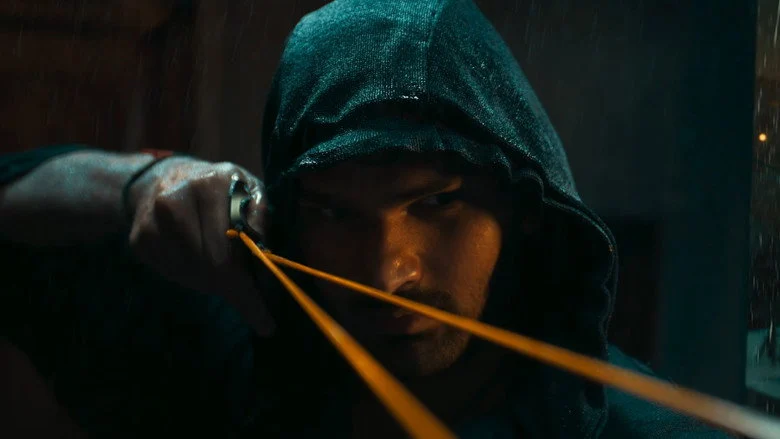
Aniesh Carries the Film on His Shoulders, Not His Tongue
Playing Arjuna as a mute character is an audacious casting choice for a debut lead. Aniesh must sell conflict, desire, and menace without a single line of dialogue. That constraint either reveals an actor or exposes him, there is no middle ground in a role this unforgiving.
I find this kind of physical-performance gamble genuinely compelling when filmmakers commit fully, but it demands choreography, close-up precision, and editorial confidence working in near-perfect alignment.
Nagarjuna’s Voice Fills the Silence, But Should It?
Bringing Nagarjuna in as voiceover is a pointed creative decision. It adds gravitas the lead might not yet command alone. But it also raises a structural question: if Arjuna cannot speak, whose interiority is the voiceover really serving, the character’s, or the audience’s comfort?
This is where Uppala’s screenplay instinct will either be vindicated or questioned. A voiceover can illuminate silence beautifully. It can also undercut the very risk the casting was meant to take.
Uppala Frames Romance and Violence With Compositional Discipline
Cinematographer Raja Mahendran fuses romance and grit with what can only be called compositional grace. The frames carry a polished, sophisticated appeal that is unusually assured for a debutant production. Light and framing seem to do the emotional heavy lifting that dialogue ordinarily would.
S Thaman’s background score breathes life into the pauses, which, in a film about a mute protagonist, are structurally central, not incidental. His work on the love portions reportedly elevates what could have been awkward silence into something textured. That is not a small achievement in an action-romance.
The editing reportedly keeps momentum brisk without losing emotional nuance. At 90 minutes, Itlu Arjuna refuses to overstay its welcome. Whether the tightness comes from confidence or from a story that simply has less to say remains the film’s central ambiguity.
If you follow Telugu action reviews with a sharp eye for craft-forward risks, this film sits in an interesting corner of recent Telugu production.
Anaswara Rajan Steps Into Unfamiliar Telugu Territory
Anaswara Rajan, primarily known from Malayalam cinema, is an intriguing choice as the female lead. Her casting signals that the film is reaching for emotional intelligence over spectacle. A lead who cannot speak demands a co-lead who can carry scenes with presence and reaction rather than verbal chemistry.
How Rajan navigates that dynamic, whether she anchors the romance or merely complements it, will define whether the film’s central relationship lands or floats adrift.
What Next Entertainments Takes a Swing Without a Safety Net
No controversies surround Itlu Arjuna, which in today’s climate is itself notable. The film arrived without political noise, casting drama, or censor friction. What it does carry is the quiet pressure of a debut director, a debut lead, and a structurally unconventional premise arriving simultaneously.
That combination is either the sign of a production that trusted its instincts completely, or one that hadn’t fully considered the risk. Producer Venky Kudumula and What Next Entertainments have essentially placed a high-concept bet on a team with no proven track record. The market will be unforgiving if the execution wobbles.
For audiences willing to sit with a Telugu film that strips dialogue away from its hero and asks visual and sonic craft to compensate, Itlu Arjuna may offer something genuinely different. Go in expecting a conventional masala action-romance and you will likely leave dissatisfied. Go in curious about what a mute protagonist demands from every other element of filmmaking, and the 90 minutes have a chance to reward that attention.
If Thaman’s score and Mahendran’s cinematography hold the architecture together, this is best experienced in a theatre where the sound design can do its work properly.
The similar risk-first instinct behind Itlu Arjuna echoes the approach taken in Manithan Deivamagalam review, where an unknown lead was similarly positioned as the film’s central wager.
Itlu Arjuna (2026) is a film worth cautious recommendation for the analytically inclined viewer, a structural risk that earns a 2.75 out of 5, contingent on whether its ambition survives its execution.
Fans of Malayalam cinema’s quieter character-driven register may find a parallel curiosity in the ensemble dynamics explored in Bharathanatyam 2 verdict, where familiar casting is used to manage audience expectations in a similar way.

Ankit Jaiswal is the Chief Author, covering Indian cinema and OTT releases with honest, no-filler criticism. An SEO strategist by background, he brings a research-driven approach to film writing, cutting through hype to tell you exactly what's worth your time.