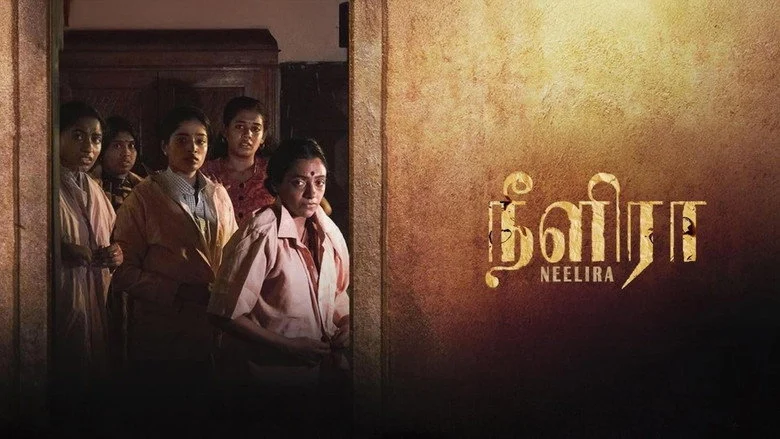
A young man and boy slip through a 1988 Sri Lankan street where IPKF soldiers parade religious procession members. By nightfall, those same soldiers, needing refuge, will barricade themselves inside a family home, and Tamil rebels will close in from outside. What begins as logistics becomes a locked-room nightmare where nobody moves without someone else bleeding.
Someetharan’s debut feature understands that the best hostage films don’t need explosions; they need a room, a locked door, and people who can’t afford to blink. What it doesn’t entirely grasp is how to thread the needle between suffocation and politics without letting one strangle the other.
Naveen Chandra’s Captain Carries the Moral Weight Alone
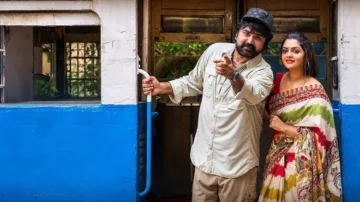
Naveen Chandra as the Captain makes the call to hold the family and fortify the house after radio confirmation of no backup until dawn. He shoulders the film’s spine: a soldier trapped between orders and impossible choices, occupying a civilian home that becomes his bunker. The performance works because Chandra doesn’t reach for heroism, he reaches for exhaustion instead, a man operating on protocol when protocol has already failed.
Someetharan’s Tight Direction Suffocates But Frustrates
The director turns a single night into a quagmire without wasting a frame. Tautness is the calling card here, 122 minutes that refuse to breathe, a linear structure that corrals everyone into one space where tension calcifies. Yet this same austerity becomes a ceiling: by insisting on chamber-piece minimalism, Someetharan empties the film of political architecture, leaving only cultural details and survival mechanics where ideology should haunt the margins.
The Thriller Mechanics Work Until They Become a Trap
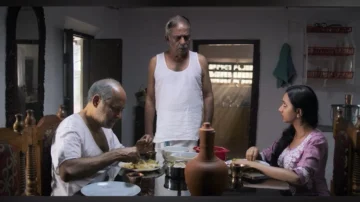
The genre setup is clean: three-way standoff with no clean moves. IPKF soldiers occupy. Tamil rebels detect presence. A family watches their home become a three-cornered negotiation table where surrender means death regardless of which side wins. The radio confirmation that seals everyone inside is the moment the room stops being a room and becomes a pressure chamber.
Someetharan builds the standoff with discipline, letting geography do the talking. Rebels catching the scent of soldiers outside amplifies the suffocation, every window is a weakness, every corner a potential kill zone. The mechanics crackle because the stakes are genuinely asymmetrical: soldiers need to survive until dawn, rebels need to eliminate a presence, and the family simply needs to not become collateral damage in a war that’s using their living room as a chess board.
What feels missing is the breathing room that great thrillers carve between set pieces. The finale, described as the most disturbing moment, pivots away from the three-way standoff entirely, suggesting Someetharan wanted to say something about what war steals from its youngest witnesses. The film’s end note following one character’s journey from Sri Lanka to Europe hints at scars that the overnight hostage nightmare only catalyzed. That thematic ambition deserves more room than the chamber allows.
For Tamil film enthusiasts and thriller aficionados, the minimalist architecture of Neelira recalls a specific school of filmmaking, one that trusts constraint over spectacle. Exploring how Tamil cinema has approached domestic confinement under external threat reveals patterns worth tracking further.
Tamil Thriller reviews on this site examine similar single-space survival narratives and their varying approaches to political subtext.
The Supporting Cast Dissolves Into Collective Anxiety
Roopa Koduvayur as a family member, Rohit Kokate, and the ensemble including Karthik Subbaraj and Rana Daggubati fill the frame without becoming distinct presences. That flattening is intentional, Someetharan treats them as furniture in the hostage equation rather than individuals with interior lives. The choice signals a filmmaker more interested in systems than psychology, which is both the film’s discipline and its limitation. We sense their fear, not their specificity.
War’s Cost Speaks Louder Than Politics
No explicit controversies surround the film’s production or release. Its impact rests instead on how audiences receive its anti-war stance. The film refuses to glorify any faction, soldiers, rebels, or the machinery that forces families to choose which ideology bleeds first. Critics and viewers alike praise it as a minimalistic, impactful piece that captures what surviving war times actually feels like: not dramatic, just trapped. Times of India awarded it 3.5 out of 5 stars, acknowledging its taut construction while leaving room for its frustrating refusal to resolve political questions it raises.
This is precisely what makes Neelira worth watching in a theatrical setting, where the room becomes a pressure cooker and silence becomes weaponized. The film demands seats where you can’t leave when tension peaks. Watch it there, not at home, where escape feels too easy and the locked door becomes invisible.
Someetharan’s debut proves he can engineer suffocation without melodrama, a craft skill that deserves respect even when the thematic ambition exceeds the chamber’s grip. Neelira is a disciplined, tense hostage thriller that trades politics for pure survival mechanics; it’s worth experiencing for its minimalist craft, though its refusal to excavate ideology beneath the procedural costs it dearly, 3.5 out of 5.
For explorations of how recent Tamil cinema wrestles with war’s intimate brutality, Oru Durooha review offers a sharp counterpoint in performance register.
Both Neelira and Vaazha II verdict show how Tamil directors are rethinking domestic spaces as war zones.

Ankit Jaiswal is the Chief Author, covering Indian cinema and OTT releases with honest, no-filler criticism. An SEO strategist by background, he brings a research-driven approach to film writing, cutting through hype to tell you exactly what's worth your time.