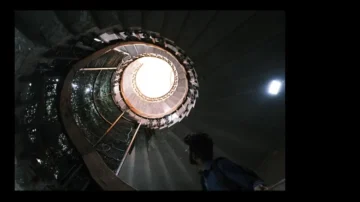
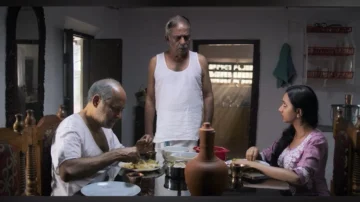
The frame opens wide, anamorphic and uncommonly patient, as Sathya, a PhD scholar, and her assistant Karthikeyan drive toward a fieldwork meeting that will unravel their certainties. Their destination is Maaran, an acquitted man whose criminal past exists only in legal ambiguity, and in the isolated world he shares with Nathiya, where conversation itself becomes a psychological battleground.
This Malaysian Tamil production, directed by Karthik Shamalan, is not built for casual viewing. It is a thriller that trades chase sequences for the slow erosion of trust, and it demands a viewer willing to sit inside that discomfort.
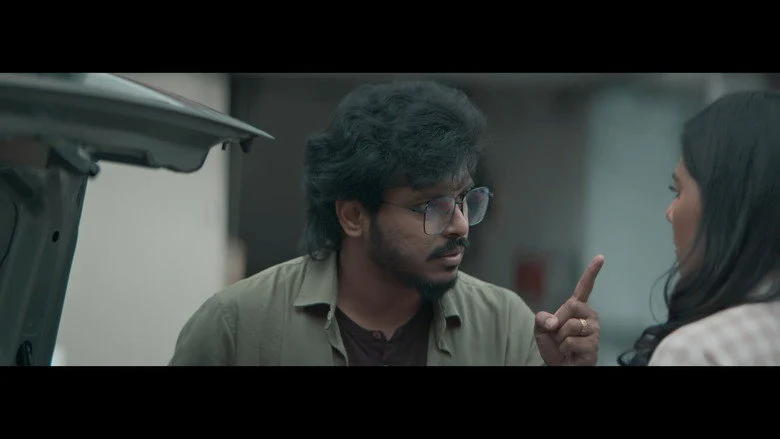
Shaila Nair’s Sathya Anchors a Narrative of Shifting Ground
Datin Shaila Nair plays Sathya with a controlled restraint that suits the film’s intellectual premise. Her character functions as the audience’s entry point, and Nair wisely avoids broad emotional gestures, keeping Sathya’s reactions calibrated as the investigation turns personal.
The role requires a performer who can hold stillness while the world around her destabilizes. Nair delivers that, grounding the film’s more abstract philosophical ambitions in a recognizably human perspective.

Yuvaraj Krishnasamy and the Practical Counterweight
As Karthikeyan, Yuvaraj Krishnasamy provides the necessary friction to Sathya’s academic detachment. His presence signals a more pragmatic approach to the mystery, one that questions the value of perception when evidence has already failed once.
Krishnasamy’s casting suggests the film understands its own dynamic: the researcher seeks truth, but the assistant seeks resolution. That push-and-pull gives the middle sections their momentum.
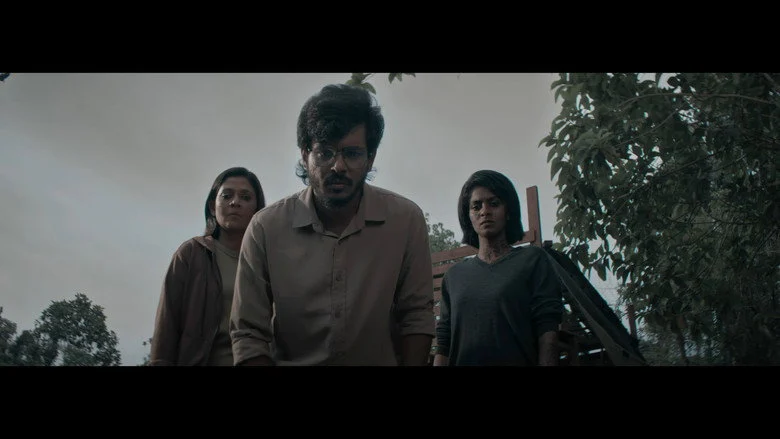
Magendran Vikadakavi’s Ambiguity Is the Film’s Engine
Magendran Vikadakavi plays Maaran not as a conventional villain but as a question mark in human form. The performance leans into ambiguity, refusing to clarify whether the character is manipulative, misunderstood, or genuinely unwell.
That ambiguity is the thriller’s core mechanism. Vikadakavi understands that the most unsettling presence is one that never commits to a single readable emotion, and he sustains that unease across the runtime.
The film’s suspense is built through investigation rather than action. Conversations inside Maaran and Nathiya’s world replace set pieces, and the narrative relies on the tension between evidence and perception to keep the viewer engaged.
Visually, the anamorphic format does heavy lifting, creating a texture that feels unusual for Malaysian Tamil cinema. The compositions support the psychological unease, making the frame itself feel slightly off-kilter, as if the image cannot fully be trusted.
The payoff arrives in a final conversation that reportedly changes the lives of the central characters. It is a climax of words rather than violence, which will frustrate viewers expecting conventional thriller resolution but reward those invested in the film’s truth-versus-illusion thesis.
Supporting Cast and the Weight of Local Identity
Veronica Thomas, KS Maniam, and Thashrra Aghonderan round out the cast, though available coverage offers limited scene-specific detail on their contributions. Their inclusion, however, signals a production committed to building a distinctly Malaysian Tamil ensemble rather than importing familiar faces.
That local identity is the film’s quiet strength. It positions Poovellaam Kettuppaar as a different kind of regional cinema, one that prioritizes psychological texture over commercial formula, even if that choice narrows its audience appeal.
The film’s thematic focus on mental fragility and the collision of memory with reality gives it a distinct edge when compared to similar local productions like C4 Cinta or Adai Mazhai Kaalam. It is less concerned with plot mechanics than with how truth becomes a casualty of perception.
For viewers who enjoy psychological-drama and thriller structures, this is a deliberate, atmospheric watch. Those expecting action-heavy commercial pacing or light family entertainment will find the film’s measured approach challenging rather than engaging.
For more Tamil thriller reviews, browse 5movieruiz.net.in.
In the absence of an aggregated critical consensus, the film’s reception rests heavily on its technical execution and its willingness to trust its audience with ambiguity. I found myself more persuaded by the film’s visual confidence than by its narrative clarity, which occasionally gets lost in its own philosophical fog.
Watch this in a regular theater if you can, the anamorphic framing deserves that attention, but OTT viewing will serve those primarily invested in plot and atmosphere. It is a film that rewards patience but punishes distraction.
Poovellaam Kettuppaar is a visually ambitious, thematically dense thriller that earns a 3/5 for its craft, even when its storytelling tests your patience.
For a similar exploration of memory and perception, see Hushar Pittalu’s familiar village romance.
If you prefer romance anchored by strong lead chemistry, Hi verdict offers a different register.

Ankit Jaiswal is the Chief Author, covering Indian cinema and OTT releases with honest, no-filler criticism. An SEO strategist by background, he brings a research-driven approach to film writing, cutting through hype to tell you exactly what's worth your time.