The opening shot doesn’t cut away. It holds on the mouth of a well, dark and still, until something shifts in the water. SI Ajeeb (Roshan Mathew) peers into the abyss, and we are already inside his uncertainty, a probationary officer staring down a case that will hollow him out. This is not a whodunit launched with a bang, but with a quiet, suffocating dread.
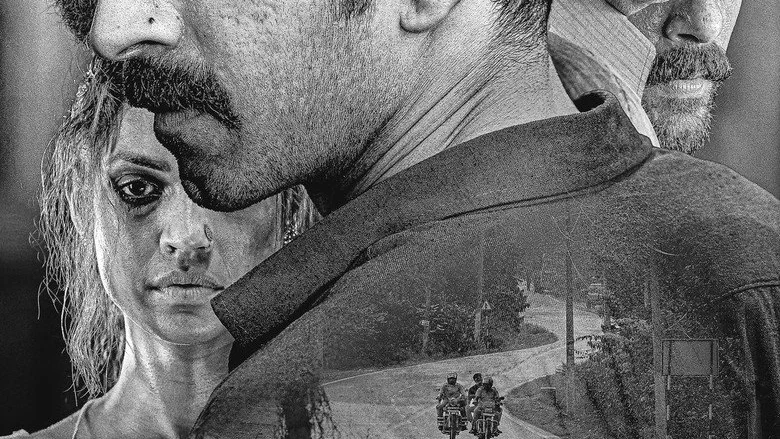
Roshan Mathew: Wearing the Investigation Like a Scar
Mathew doesn’t perform Ajeeb’s psychological unraveling; he inhabits it like a second skin. His internal monologue about his own struggles lands with a rare, uncomfortable intimacy, this is a man fighting the system and his own mind simultaneously. His confrontation with the antagonist in the climax is less a fistfight and more a collapse, where words carry more weight than action.
It is in the smaller beats, a glance at a discarded shoe, the hesitation before speaking to a senior, that Mathew anchors the film. His performance suggests that justice, in this world, is less a reward than a wound.
M. Padmakumar: Precision Over Emotion
Padmakumar’s direction is methodical to a fault. He maps the investigation across Kannur, Thalassery, Mumbai, and Palakkad with a cartographer’s eye, turning geography into dread. The tonal clarity never wavers: this is a procedural, not a melodrama, and he respects that constraint.
Yet the screenplay, co-written by Shaji Marad and Nikhil K. Menon, struggles with transitions. The leap from one location to the next often feels dictated by plot convenience rather than organic cause, leaving the middle act to drift where it should tighten.
Crime Thriller Craft: Where the Film Finds Its Voice
The genre demands patience, and Padmakumar delivers. The discovery sequence of the decomposed body is a clinic in restrained horror, no jump scares, no manipulative score, just the sickening realism of rot and official silence. The filmmakers understand that suspense lives in gaps, not in speed.
What sets Uyir apart from similar Malayalam investigations is its refusal to romanticize the detective. Ajeeb is not a brilliant eccentric; he is a borderline competent officer who is also fraying at the edges. The psychological depth inserted into the procedural frame elevates the craft above the standard thriller template.
If there is a weakness, it lies in the antagonist’s under-written backstory. Nikhil K. Menon’s presence in the climax generates real tension, but the film never earns that confrontation with enough groundwork. The payoff works in the moment but feels narratively borrowed rather than earned.
Baiju Santhosh and the Supporting Void
Baiju Santhosh, as ASI Joy, brings a weary decency to the investigation. His silent support of Ajeeb, a nod, a shared cigarette, carries more humanity than most roles written with dialogue. Joy is the film’s moral thermometer, measuring how far Ajeeb has fallen by remaining steady himself.
Vinod Sagar and Shruthi Menon add texture to the margins, but the screenplay denies them arcs. Their casting signals an intention to build an ensemble, yet the film remains stubbornly singular in focus. Divya M. Nair and Santhosh Thiruvikraman appear in functional roles that feel sketched rather than written.
Audience Reception: A Slow Burn That Divides
Early responses praise the film’s realistic depiction of police work and the emotional gravity Mathew brings to an otherwise clinical procedure. Critics have noted the gripping realism of the well sequence as the film’s most accomplished setpiece. However, some viewers have pointed to pacing issues in the middle section, where the multi-location structure begins to feel more like a checklist than an escalation.
The film bears the DNA of Padmakumar’s earlier works, Joseph and Vargam, but leans harder into psychological territory than either. It is a narrower film, less interested in plot mechanics than in the cost of knowing the truth. Whether you find that rewarding or frustrating will depend entirely on your appetite for gloom.
For those who want to explore more Malayalam crime thrillers built around similar craft traditions, a wealth of Malayalam Thriller reviews offers a deeper dive into the genre’s evolving language.
If you are chasing light entertainment or action-fueled resolution, this is not your night. Uyir is a film designed for the class audience, those who will sit in silence through the end credits, thinking about the weight of a single case on a single man. Watch it in a quiet theater, preferably on a day you have no plans after.
For a film that calls itself Uyir (life), it is curiously fixated on the living dead. I give it 3.5 out of 5, a formally intelligent thriller that earns its grief, even if it occasionally misplaces its energy.
If the protagonist’s psychological fracture here intrigued you, the Suitcased verdict Suitcased operates in a similarly destabilized register.

Ankit Jaiswal is the Chief Author, covering Indian cinema and OTT releases with honest, no-filler criticism. An SEO strategist by background, he brings a research-driven approach to film writing, cutting through hype to tell you exactly what's worth your time.