The opening scene of Ananthan Kaadu finds its protagonist making a desperate choice in the shadows of a 1980s town, his face half-lit by a flickering streetlamp. The weight of that moment, captured in Jiyen Krishnakumar’s tightly framed shot, signals immediately that this is a film more interested in consequence than spectacle.
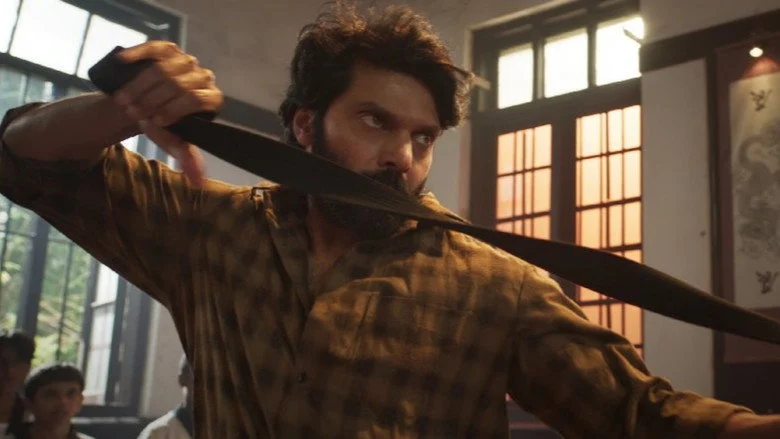
Arya brings lived-in anguish to a man haunted by ambition
Arya’s Ananthan is no superhero. In the opening scene, his micro-expressions shift from cocky confidence to quiet dread as he realizes his rash decision has crossed an invisible line. The actor sustains this tension through the rain-soaked forest confrontation, where every line of his body suggests a man cornered by his own past.
His emotional register in the climax, rage mixed with exhaustion, gives the film its moral weight. Without Arya’s gravitas, the karma-driven narrative would feel like a lecture.
Jiyen Krishnakumar’s direction sees the blood in the soil
Krishnakumar frames the 1980s–1990s socio-political landscape with a documentarian’s eye, never letting the period dressing become a distraction. The linear screenplay by Murali Gopy builds tension methodically, each scene tightening the rope around Ananthan’s neck.
But the structure has blind spots. Dev Mohan’s antagonist enters late with menace, yet his underdeveloped backstory reduces a potentially layered foil to a single-note pursuer. The screenplay’s refusal to humanize him weakens the very karmic cycle it preaches.
The political thriller finds its pulse in atmosphere, not action volume
This is not a bullet-riddled gangster saga. Krishnakumar trusts the power of silence and shadow. The rain-soaked forest confrontation, already the most discussed scene in early word, uses wind and water as antagonists; every droplet on Arya’s face feels deliberate, a measure of time running out.
The genre’s tension here comes from moral clarity: each desperate choice is shown, not just mentioned. Ananthan’s arc moves from agency to entrapment, and the film’s escalating violence feels earned precisely because the screenplay refuses to glamorize it.
Where other political thrillers rush toward a cathartic explosion, Ananthan Kaadu slows down for the quiet aftermath. That patience, rare in mainstream Tamil-Malayalam bilinguals, gives the drama its haunting residue.
Regina Cassandra and Nikhila Vimal ground the emotional body count
Regina Cassandra, playing Meera, registers as the story’s moral compass without dialing up melodrama. In a key scene where she confronts Ananthan about his escalating violence, she lets her silence do more work than any monologue could. Nikhila Vimal’s Lakshmi, though given smaller room, marks her presence in a quiet moment of care that humanizes the otherwise hard-edged narrative.
Among the veteran ensemble, Indrans and Vijayaraghavan bring their trademark lived-in credibility. Sunil and Siddique serve as weather vanes for shifting alliances, their performances calibrating suspicion and loyalty without overstatement. Dev Mohan, despite the thin writing, channels a cold physicality that works in the forest confrontation but evaporates whenever he speaks exposition.
Audience reception reveals a hunger for serious political drama
Early audiences have rallied around Arya’s performance and the film’s refusal to soften its socio-political edges, a stark contrast to the season’s lighter offerings. Though missing runtime and certificate details have frustrated a section of viewers, the word-of-mouth has focused on the authenticity of the 1980s–1990s world and the sticky power of its climax. One critical observation that has surfaced repeatedly: the antagonist’s thin backstory saps momentum from an otherwise taut structure. Ananthan Kaadu earns its moral heaviness, but its own weapon (karma) demands a fuller villain to truly land.
If tracking data from trade sources holds, this bilingual may find its strongest legs among class audiences who value craft over star spectacle.
For readers interested in more such storytelling, our collection of Malayalam Thriller reviews covers films that similarly trust atmosphere over bombast.
Ananthan Kaadu is a film to watch in a darkened theater where its shadows can breathe. Skip the streaming-first viewing, this one needs landscape. It is imperfect, occasionally frustrating in its gaps, but it grabs your collar and does not let go until the final frame. I found myself returning to the forest scene days later, its rain still ringing in my ears.
Arya gives a career-besting performance that earns Ananthan Kaadu a solid 3.5 out of 5, a flawed but fiercely committed political thriller that trusts its audience to feel the weight of every choice.
If Arya’s raw performance here moved you, Main Vaapas review explores a similar register of a man trapped by consequence.
For a gentler but equally risk-filled two-hander, Chinna Chinna verdict offers a quieter meditation on choice and fate.

Ankit Jaiswal is the Chief Author, covering Indian cinema and OTT releases with honest, no-filler criticism. An SEO strategist by background, he brings a research-driven approach to film writing, cutting through hype to tell you exactly what's worth your time.