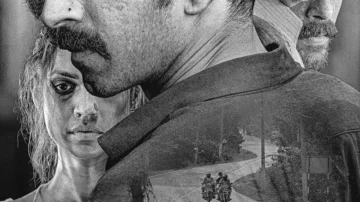
Bhushan opens Manduka on a girl mid-hallucination, her eyes tracking phantoms across a room the audience can’t yet read. Within minutes she stumbles into four criminals, and the film’s real subject announces itself: not the crime, but the unreliable witness standing at its center.
The premise is genuinely promising. A schizophrenic protagonist whose testimony no one can trust, wedged between a criminal gang and a police dragnet, should generate unbearable dramatic pressure. What Bhushan builds instead is a thriller that mistakes confusion for complexity.
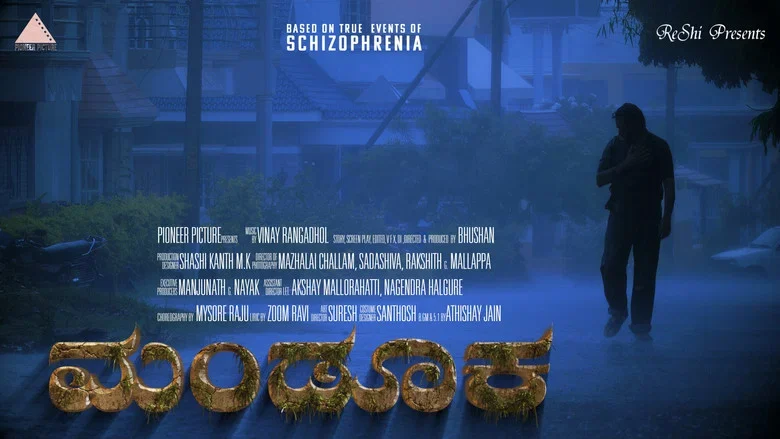
When The Unreliable Narrator Becomes The Unreliable Screenplay
The film’s smartest instinct is structural. By placing a woman with schizophrenia at the collision point between four criminals and the police, Bhushan engineers a scenario where every account of events is contestable.
But the screenplay never commits to a governing point of view. We drift between the girl’s fractured perception, the gang’s panic, and the investigators’ procedural logic without a stable anchor. Uncertainty should be the engine; here it becomes the exhaust.
Anjala, tasked with carrying that instability, gets fragments rather than an arc. She has a moment in an early interrogation where she repeats a question back at her interviewer, her voice flattening into a register that unsettles the room. It’s the film’s clearest glimpse of a performance strategy.
Then the script abandons her to the mechanics of hide-and-seek. The four criminals, Bhushan himself among them, alongside Mysore Raju and Manikanta, function as a single agitated organism rather than four distinct men with competing motives.
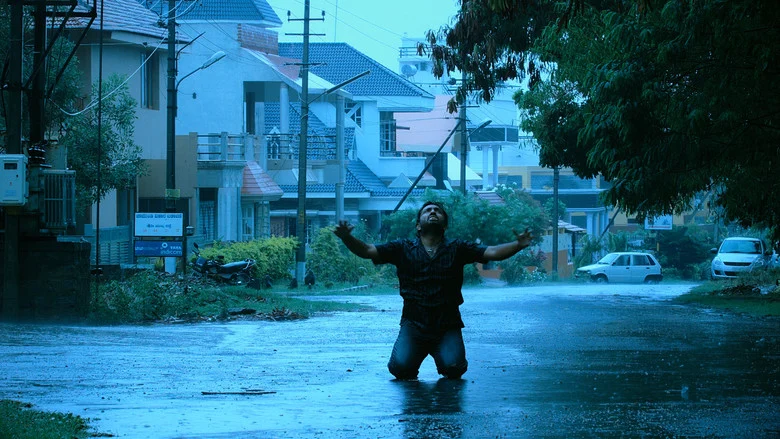
Four Villains, One Voice, Zero Friction
A multi-antagonist crime thriller lives or dies on internal friction. Manduka assembles four criminals and then lets them move as a chorus, their disagreements never escalating into the betrayals the premise promises.
The police pursuit, meanwhile, supplies motion without momentum. Manjunath Mirle’s investigator arrives with procedural purpose but no defining texture, no obsession, no compromise, no cost. The chase advances because the runtime demands it, not because anyone on screen wants something badly enough to bleed for it.
This is where the film most sharply diverges from its contemporaries. Where Detective Teekshanaa weaponized investigative intelligence as its central pleasure, Manduka treats detection as connective tissue between set pieces. The brains-over-brawn discipline that defines the better Kannada thrillers this season is precisely what’s missing here.
Bhushan’s dual role as writer-director-villain should, in theory, produce unified intent. In practice it produces a film with no dissenting voice in the room, no collaborator to ask why the girl’s condition matters to the plot beyond convenience.
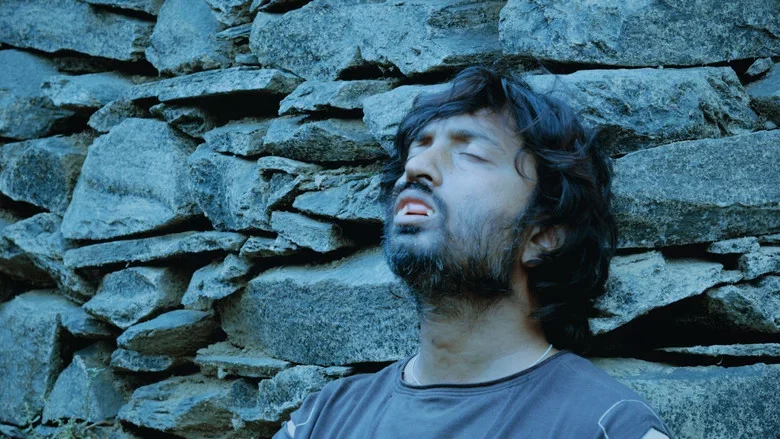
The Stillness That Should Have Manufactured Pressure
The film’s visual grammar leans on close-ups of Anjala’s face, held a beat past comfort. It’s the right instinct for a psychological thriller, and occasionally it works, a shot of her hands folding and unfolding in her lap while dialogue happens off-screen carries more dread than any chase sequence.
But the camera rarely varies its distance. Without wider frames to establish geography, the hide-and-seek climax loses spatial logic; we never understand the building, the streets, or the trap closing around anyone. Tension requires a map. Manduka withholds one.
The supporting ensemble suffers similarly. Mahadevmuurthy’s doctor appears to deliver exposition and vanish; the character’s function is purely mechanical. When a film’s medical professional exists only to explain the heroine’s condition to the audience, the screenplay has stopped trusting its own performances.
The comparison to #Cult is instructive: that film also lost its pulse by mistaking mood for momentum, letting atmosphere substitute for dramatic escalation. Manduka repeats the error in a harder genre, where the cost is steeper.
A 104-Minute Runtime That Feels Like a Reprieve
At just over an hour and three-quarters, the film’s brevity is its mercy. Bhushan’s editing instincts favor propulsion over contemplation, and the middle stretch, all pursuit, minimal revelation, moves briskly enough to mask the absence of a real mystery.
Because that’s the film’s deepest problem: there is no puzzle to solve. The girl’s encounter with the criminals is accidental, the police pursuit is reactive, and the resolution arrives without the satisfaction of a question finally answered. A crime mystery without a mystery is just a crime.
The film’s peer in this respect is KillR, another recent release that built an identity puzzle and then tripped over its own conceptual ambition. Both films share a fatal confidence that a provocative premise can carry a screenplay that never earns its revelations.
The Box-Office Arithmetic Of A Small Kannada Thriller
With an estimated budget in the range of ₹75 lakh, Manduka is operating at the margins of the Kannada exhibition market, a scale where a strong opening weekend in Mysuru and Bengaluru multiplexes can determine profitability before word-of-mouth even forms.
The film’s commercial fate rests on Anjala’s drawing power in a market increasingly saturated with crime thrillers. Without a franchise hook or a star whose name alone sells tickets, Manduka needs critical traction it is unlikely to generate.
The broader lesson for contemporary Kannada thrillers is uncomfortable: compact runtimes and psychological premises are not substitutes for dramaturgical rigor. The genre’s recent successes have been built on scripts that respect their own mysteries.
The Verdict: A Premise Betrayed By Its Own Concealment
Manduka ends, as far as its structure allows, without resolving the question it spent 104 minutes posing. The girl’s perception remains unverified, the criminals’ fates blur together, and the police investigation closes on a note of administrative exhaustion rather than moral reckoning.
That ambiguity might have been devastating in a film that earned it. Here it reads as evasion, the screenplay retreating from the confrontation it lacked the discipline to stage.
Bhushan has made a thriller about a woman no one believes, and then asked the audience to extend her the same courtesy.
The film’s final image, Anjala alone, her gaze fixed on something we cannot see, is the only moment where Manduka achieves the dislocation it was reaching for all along. Everything before it is a rehearsal for a film that never quite arrives.

Ankit Jaiswal is the Chief Author, covering Indian cinema and OTT releases with honest, no-filler criticism. An SEO strategist by background, he brings a research-driven approach to film writing, cutting through hype to tell you exactly what's worth your time.