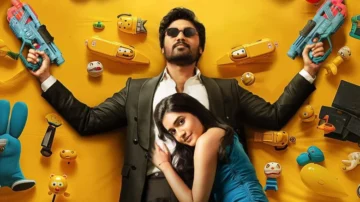
R. Raghav Mirdath’s debut feature opens with a drone hovering over a locked-down mansion, its camera lens catching a woman who will detonate the lives of three suspended college students. What follows is less a horror film than a collision of incompatible genres, each one fighting for dominance across a runtime that never quite finds its center.
A Drone as Narrative Device, Not Merely a Gadget
The film’s smartest structural gambit arrives early: Kish (Dravid Selvam) hijacks a household drone named Sampangi and uses it to spy on Prakruthi (Siddhi Idnani), a miniature artist living in a mysterious old mansion. This isn’t technology as decoration. The drone becomes the film’s central metaphor, observation without intimacy, desire mediated through a lens.
Mirdath stages this discovery sequence with genuine visual wit. The camera alternates between Kish’s sweaty palms on the controller and the drone’s sterile aerial perspective, creating a tension between technological control and romantic helplessness. It’s the kind of formal intelligence that suggests a filmmaker who understands how to translate theme into image.
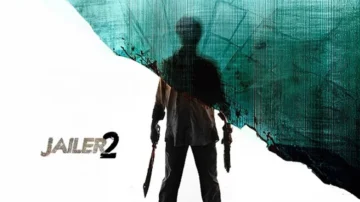
Yet this precision doesn’t hold. Where the setup promises a contained supernatural thriller, the screenplay soon spirals into a cacophony of subplots. The comparison to Jailer 2 is instructive, both films buckle under the weight of their own ambition, mistaking accumulation for complexity.
The Courtship Ritual: Repetition as Comedy, Repetition as Exhaustion
Men who encounter Prakruthi fall instantly, almost mechanically, into the same courtship script. A poem. A doll. A ring. A promise to love her “even when her hair turns white as cotton candy.” The repetition is clearly designed as comic rhythm, a satirical jab at performative romance.
But the gag wears thin by the third iteration. What begins as pointed commentary on the homogeneity of male desire becomes narrative stasis, the film spinning its wheels while more interesting threads dangle unresolved. Padmanaban (Kuraishi), the eccentric scientist nicknamed “Black Hole, ” builds a made-to-order girlfriend in his basement laboratory. The bachelor Inspector (Cinemawala Sathish) fears that any sincere “I love you” will kill the woman he addresses.
These are promising comic premises. They’re also competing for oxygen in a film that refuses to commit to any single one. The middle stretch doesn’t so much build momentum as pile complications atop complications, each new device diluting the impact of the last.
Devadarshini’s Witch and the Physicality of Supernatural Menace
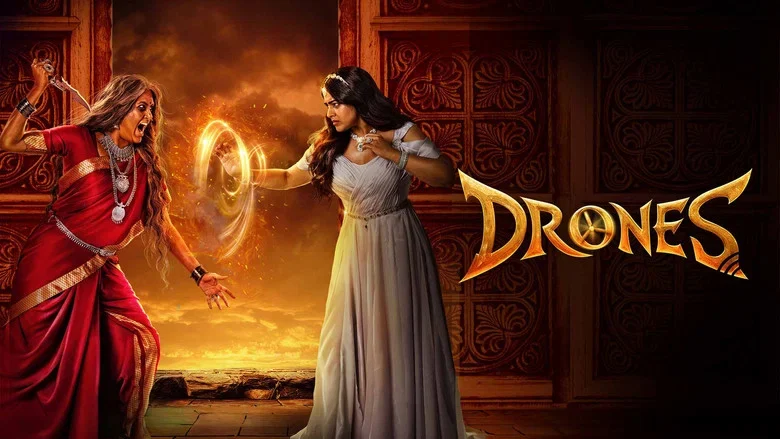
The film’s antagonist, played by Devadarshini, lives with Prakruthi in the old mansion and turns men into dolls, a literalization of the way romantic obsession reduces people to objects. It’s a clever conceit, and Devadarshini brings a coiled stillness to the role that makes her genuinely unsettling.
Watch her in the scenes where she observes the men courting Prakruthi. She doesn’t speak. She barely moves. Her eyes track their gestures with the patience of a predator who has seen this performance before. When she finally erupts into confrontation, the shift is earned by that earlier restraint, a physical discipline that recalls the controlled intensity of AAKHRI MULAQAT, where silence functions as its own form of threat.
Anjali Nair’s Rush, however, gets the film’s most substantial scene. When she confronts the witch directly, challenging the damage caused by society’s narrow beauty standards, the film briefly becomes what it should have been all along: a supernatural argument about human worth. Rush doesn’t just fight the witch. She indicts the culture that created her.
It’s the strongest moment in the film. It’s also the only moment where the social commentary feels organic rather than inserted.
Where the Score and Camera Betray the Tension
Mirdath’s visual approach favors the two spaces that define the film’s geography: the locked-down “Black Hole” house and the old mansion viewed through Sampangi’s lens. The drone sequences have a clinical, almost surveillance-camera quality that contrasts effectively with the mansion’s gothic interiors.
But the editing in the second half betrays this visual intelligence. The film cuts between the mansion, the Inspector’s romantic misadventures, and Padmanaban’s laboratory experiments with little rhythm or escalation. Each thread seems to exist in its own tonal universe, comedy, horror, romance, without a unifying score or editing pattern to bind them.
The horror-comedy hybrid is a notoriously difficult balance, as evidenced by the tonal chaos that undermined Karakkam. Drones suffers from a similar identity crisis, unsure whether it wants to scare its audience or merely amuse them. The witch’s doll-transformation power could be genuinely disturbing. Instead, it’s played for laughs that never quite land.
The Commercial Gamble of Hybrid Genre Filmmaking
Producer GM Morgan has positioned Drones as a Tamil horror-comedy with crossover appeal, the kind of film that can attract both genre enthusiasts and family audiences. It’s a calculated bet on the continued appetite for supernatural content in the Tamil market.
But the film’s inability to commit to a single tone may limit its theatrical reach. Horror-comedy works when the two genres are in conversation, when the laughter makes the scares more effective, or vice versa. Drones often feels like two different films competing for the same runtime, neither one willing to yield.
The Tamil horror space is crowded, and audiences have shown they’ll reward films that understand their own identity. This one doesn’t yet know what it wants to be. That uncertainty signals a broader hesitation across contemporary Tamil horrors, where ambition often outpaces execution.
A Final Confrontation That Almost Justifies the Chaos
The film’s climax hinges on Rush’s confrontation with the witch, a scene that finally articulates what the film has been fumbling toward. The argument isn’t about defeating a monster. It’s about the violence of beauty standards, the way desire can curdle into possession, the dolls that men become when they reduce women to objects.
It’s a genuinely resonant ending. It’s also frustrating, because it reveals the film that Drones could have been if it had trusted its own ideas rather than burying them under subplot after subplot.
Mirdath has talent. The drone sequences, the witch’s physical stillness, the Rush confrontation, these are the work of a filmmaker with genuine instincts. What he lacks is discipline, the willingness to kill his darlings and commit to a single, coherent vision.
Drones doesn’t fail because it’s ambitious. It fails because it’s afraid to be one thing. In trying to be everything, horror, comedy, romance, science fiction, social satire, it becomes nothing in particular. The witch turns men into dolls, but the film can’t decide what it wants to turn its audience into: frightened, amused, or moved. It settles for mildly entertained, which may be the worst fate of all.

Ankit Jaiswal is the Chief Author, covering Indian cinema and OTT releases with honest, no-filler criticism. An SEO strategist by background, he brings a research-driven approach to film writing, cutting through hype to tell you exactly what's worth your time.