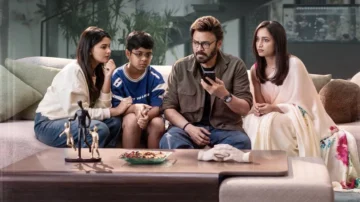
The child is gone before the first act has finished clearing its throat. Tetsuya Mariko does not linger on the moment of vanishing, no screeching score, no slow-motion turn of a head in a crowd. The camera simply holds on an empty stretch of sidewalk, and the film’s real subject announces itself: not the search, but the marriage that made the search inevitable.

A Kidnapping That Refuses To Be The Main Event
Kenji, a Japanese man living in New York, and Chin, his Chinese-American wife, occupy a domestic space that looks like tenderness and behaves like surveillance. Mariko shoots their early scenes with a clinical patience that borders on the suffocating, hands that hover too long over a shoulder, a shared glance that lands half a beat late. The screenplay treats affection as a language both partners have learned to counterfeit.
When the abduction arrives, it functions less as a plot detonation than as a pressure valve finally releasing years of unspoken resentment. The investigation is present, but it runs parallel to something far more corrosive: two people discovering that they have been lying to each other with the fluency of long practice. This is a crime drama in which the crime is almost incidental to the rot it exposes.
Nishijima Builds A Man Out Of Withheld Motion
Hidetoshi Nishijima plays Kenji with the same economy of gesture that has defined his finest work, a jaw that tightens before a sentence, eyes that track his wife’s movements without ever quite meeting them. There is a scene in the second act where he stands in a doorway and simply does not enter the room. The stillness carries more menace than any raised voice could.
The role demands a slow unmasking, and Nishijima calibrates it with almost surgical restraint, letting cracks appear in the posture before they reach the dialogue. It is a performance built on the assumption that the audience is watching closely enough to catch what he refuses to show.
Gwei Lun-mei Holds The Frame With Quiet Defiance
Gwei Lun-mei’s Chin is the film’s structural counterweight, a woman whose composure reads as armor rather than peace. In the scenes following the disappearance, she moves through the apartment with a deliberateness that suggests she has already rehearsed this crisis. Her best moments come when she is doing nothing at all: sitting at a kitchen table, hands flat, staring at a wall as if waiting for it to confess.
The dynamic between the two leads is less a battle than a stalemate, and Mariko stages it with a spatial intelligence that recalls the tonal discipline of Manithee, where atmosphere was allowed to do the work that dialogue could not. Here, the silence between Kenji and Chin is the third character in every scene.
The Script Withholds Too Much, Then Withholds Some More
Mariko’s screenplay, co-written with his collaborators, adopts a crisis-driven structure that moves from domestic unease to abduction to confrontation with a linearity that occasionally feels like evasion. The film is so committed to restraint that it sometimes forgets to give the audience a handhold, entire stretches of the middle act unfold without a clear sense of what the investigation has uncovered or why certain characters behave as they do.
This is not ambiguity in service of depth; it is ambiguity as a default setting. The result is a film that trusts its performers completely and its audience only partially, leaving key emotional beats to be inferred rather than felt.
The Camera Watches, But Rarely Participates
Mariko’s visual approach is austere to the point of asceticism. The New York of this film is not the city of sweeping skylines but of narrow hallways, dimly lit kitchens, and windows that frame nothing but brick. The camera stays close, often at eye level, refusing the kind of formal flourishes that would signal authorial presence.
This restraint works when the tension is internal, but it falters during the investigative passages, where the absence of visual escalation makes the procedural elements feel inert. A thriller needs a pulse, and Mariko seems suspicious of his own genre instincts, as if admitting to suspense would be a betrayal of the art-house sensibility he is cultivating.
A Cross-Cultural Marriage As A Site Of Erosion
The cultural friction between Kenji and Chin is handled with more nuance than the plot deserves. Language barriers, familial expectations, and the quiet indignities of being an outsider in one’s own home are woven into the fabric of their interactions without ever being explicitly named. It is the film’s most accomplished layer, and it is largely achieved through performance rather than writing.
Where a lesser film might have turned this into a thesis, Mariko lets it remain a texture, a reminder that the distance between two people is rarely about a single thing. The thematic kinship with a film like Comrade Kalyan is instructive: both works understand that the most damaging conflicts are the ones that never get a clean resolution.
The Ending Refuses The Catharsis It Has Earned
Without detailing the final act, it is fair to say that the film’s resolution is deliberately unresolved, a choice that will divide viewers who have invested two-plus hours in the search for answers. The emotional logic holds, but the narrative logic does not, and the gap between them is where the film’s ambitions and its limitations become most visible.
There is a moment near the end where Nishijima’s face registers something between relief and devastation, and the film wisely holds on it without cutting away. It is the closest the movie comes to genuine catharsis, and it is over almost before it begins. The restraint that has been the film’s signature becomes, in the final minutes, its most frustrating quality.
What Remains After The Credits
Dear Stranger is a film that will reward patient viewers and frustrate those who need their thrillers to thrill. It is a work of considerable craft and genuine emotional intelligence, but it is also a work that seems uncertain whether it wants to be a genre piece or a chamber drama. The performances, particularly Nishijima’s, are strong enough to carry the weight, but the screenplay never quite decides what it is asking them to carry.
For those who appreciate a slow-burn examination of intimacy and control, this is a film worth sitting with. For those who want the missing-child thriller the premise promises, it will feel like a bait-and-switch. The film’s refusal to deliver conventional satisfaction is either its greatest strength or its most significant failure, depending entirely on what you walked into the theater expecting.
Rating: 3 / 5
There is a particular kind of loneliness in watching two people share a home and still be strangers, and Dear Stranger captures that loneliness with precision, even if it never quite finds the courage to break it open.

Ankit Jaiswal is the Chief Author, covering Indian cinema and OTT releases with honest, no-filler criticism. An SEO strategist by background, he brings a research-driven approach to film writing, cutting through hype to tell you exactly what's worth your time.