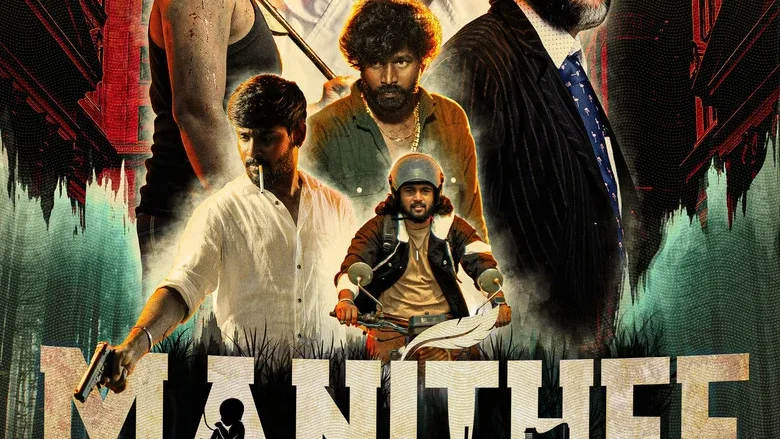
MJ Nitharsan’s Manithee: The Fire Bird opens on a collision of two impossible dreams: a female physicist determined to force a breakthrough technology onto a world that isn’t ready, and a village filmmaker convinced he can conjure a masterpiece from nothing but stubbornness. They are not natural allies. They are barely natural protagonists. And when the film traps them inside a mysterious forest, it stops being a story about aspiration and becomes a story about what aspiration costs when the environment itself refuses to cooperate.
The first act moves with a nervous, almost impatient energy. Nitharsan, who also wrote the screenplay, sketches his two leads through their work rather than their words, the physicist’s hands constantly adjusting instruments, the filmmaker’s eyes scanning every frame of his surroundings as if the world is already a movie he’s failing to direct. It’s a lean setup, and at 98 minutes, the film has no room for the usual Tamil-cinema padding. That restraint is initially bracing.
When the Rules of the Mystery Stay Buried
The central problem arrives with the forest itself. As a confinement space, it’s visually promising, dense, indifferent, shot with a preference for medium-wide frames that keep the characters small against the undergrowth. But Nitharsan never establishes what the forest wants. There are no consistent rules, no escalating logic, no sense that the characters are learning anything about their prison. The mystery doesn’t deepen; it simply persists.
This isn’t a failure of ambition. It’s a failure of dramaturgy. A fantasy-thriller lives or dies on the clarity of its internal physics, and here the film withholds so much that the middle stretch starts to feel like a waiting room rather than a pressure cooker. Compare the spatial discipline on display in Cuddle Café, where even a modest setting is governed by legible emotional rules, and the gap becomes conspicuous. Nitharsan has the atmosphere. He hasn’t yet found the architecture.
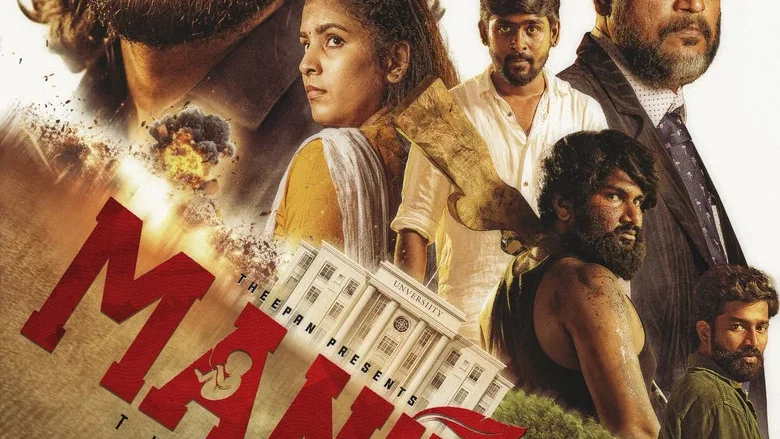
Vithu Vanni’s Ranga Carries What the Script Won’t
What keeps the film watchable, sometimes even compelling, is Vithu Vanni. As Ranga, he plays a man whose ambition has curdled into something closer to compulsion. Watch his jaw in the early scenes: it stays set, almost clenched, even when he’s supposed to be listening. His voice drops into a lower register whenever he talks about his work, as if the dream is too heavy to speak at normal volume.
It’s a performance built on physical withholding rather than emotional release, and it gives the film a center the screenplay doesn’t always provide. The same quality of contained exhaustion anchors Chiram, where a similar stillness does more narrative work than any dialogue could. Vanni isn’t quite at that level yet, his third act breaks feel slightly rushed, as if the film is afraid to let him sit in silence, but he’s the reason the forest scenes don’t collapse into abstraction.
A Supporting Cast Without a Spine
The film’s other performers are given almost nothing to do. Rathitharan Kathiresu’s Balraj and Ravee Murali’s Nitharsan appear and disappear with little narrative consequence, their presence felt mainly as bodies in the frame rather than forces in the story. Maithily Ravivarman’s Thuvaraka has a few moments of quiet observation, but the screenplay never lets her intervene in the central conflict.
More damaging is the absence of any identifiable antagonist. The forest is the only opposing force, and while that can work in the right hands, Baththa managed a similar confinement premise with considerably more bite, here the lack of a human or even semi-human counterforce leaves the second half feeling airless. The characters aren’t fighting anyone. They’re just waiting to be released by a screenplay that doesn’t know when to let them go.
Where the Craft Holds and Where It Slips
Nitharsan’s direction shows real instinct for texture. The forest sequences are lit with a greenish, diffused naturalism that makes the canopy feel genuinely oppressive, and the decision to keep the camera at mid-distance during the characters’ arguments prevents the film from tipping into melodrama. The editing, however, loses its nerve in the final third. Scenes that should build, a confrontation near a stream, a late revelation about the physicist’s technology, are cut so abruptly that they register as plot points rather than dramatic beats.
The score is used sparingly, which is the right call, but it also means the film has no emotional crescendo to fall back on when the visuals run out of ideas. By the time the characters “overcome” their obstacles, the resolution feels less like a victory than an expiration. The dreams are still intact. The film just stops.
A Dream That Never Quite Catches Fire
Manithee: The Fire Bird is a film of genuine conceptual ambition, a Sri Lankan Tamil production that tries to fuse speculative science, artistic obsession, and survival mystery into a single 98-minute shape. That it doesn’t fully succeed is less interesting than how it fails: not through lack of vision, but through a refusal to commit to the rules of its own world. Vithu Vanni’s performance suggests the movie that could have been. The screenplay suggests the movie that wasn’t quite finished.
For audiences hungry for something outside the usual Tamil thriller template, there’s enough here to warrant a look, particularly if you value atmosphere over answers. But the film’s final image, of two dreamers still dreaming in a forest that never explained itself, lands less as ambiguity than as evasion. Some mysteries earn their silence. This one just runs out of things to say.
Rating: 2.5 / 5

Ankit Jaiswal is the Chief Author, covering Indian cinema and OTT releases with honest, no-filler criticism. An SEO strategist by background, he brings a research-driven approach to film writing, cutting through hype to tell you exactly what's worth your time.