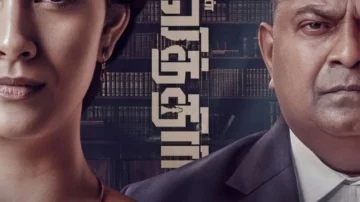
Anandhi steps into the dust and lamplight of North Andhra’s Burra Katha circuit, and for a while the screen belongs to her voice. Then the film starts tidying up its own myth, and the spell thins.
Gowri Naidu Jammu’s biographical drama wants to be two things at once: a tribute to a folk performer who turned storytelling into dissent, and a mystery about what happened when she vanished at her peak. The tension between those ambitions is the whole story of the film’s uneven pull.

A Rushed Childhood Robs The Rise Of Its Foundation
The opening stretch compresses Lakshmi’s formative years into a rapid montage of circumstance rather than lived experience. We are told she was drawn to an art form dominated by men; we are rarely allowed to sit inside the moment that decision calcified into defiance.
This is the first structural misstep, and it echoes the same impatience that flattened the diaspora romance in VISA – Vintara Saradaga, where a promising cultural premise was kept at arm’s length by a screenplay unwilling to linger. Here the cost is steeper, because a biography lives or dies on the texture of its early chapters.
By the time Lakshmi takes a public stage, we understand her ambition intellectually. We have not yet felt it in the gut.
Burra Katha As Weapon, Not Decoration
Where the film genuinely sharpens is in its treatment of performance as argument. Lakshmi’s Burra Katha sequences are staged as public confrontations, her rhythmic narration pressing against village elders and gendered custom with a composure that reads as quiet insurgency.
Anandhi’s physical discipline carries these scenes. Watch how she holds her spine upright through a hostile crowd, how her hands mark the rhythm before her voice rises to meet it, the body leads, the song follows. That is a performer who understands the stage as territory to be claimed.
The screenplay, to its credit, never reduces these sequences to musical interludes. Each performance advances her reach, and each new audience raises the stakes of the opposition gathering around her.
The Second Half Repeats Its Own Argument
Then the repetition sets in. The middle stretch cycles through variations of the same beat, performance, friction, performance, friction, without genuinely escalating the pressure on Lakshmi or deepening the social forces arrayed against her.
There is no named antagonist, and that is a defensible choice: the villain is patriarchy, convention, the slow grinding resistance of a tradition that tolerates a woman’s voice only while it remains useful. But abstraction needs dramatic shape, and the film keeps restating the thesis instead of dramatising its cost.
It is the same trap that made Crazy Kalyanam feel like a sermon delivered to the already converted, sincerity substituting for escalation. Here the stakes are higher, and the missed opportunity cuts deeper.
Anandhi Holds The Frame When The Script Lets Go
The role demands a visible transformation, from gifted village singer to public symbol to absent legend, and Anandhi manages the arc with restraint. Her register shifts subtly across the film, the early performances eager and slightly unsteady, the later ones weighted with the knowledge that visibility is dangerous.
What she cannot do is manufacture emotional peaks the screenplay never builds toward. In the disappearance stretch, her absence becomes the film’s subject, and the actor’s stillness in the flashback fragments is more eloquent than any of the investigation material that follows.
There is a ghost of the same discipline she brought to her work opposite the spectacle of Titanic, where a performer had to hold emotional ground against a production designed to overwhelm her. Here the overwhelm is structural rather than visual, and she holds anyway.
When The Mystery Arrives Too Late To Matter
The disappearance-and-investigation device is the film’s most intriguing formal gamble, shifting the audience from witness to detective. But it arrives after the emotional engine has already stalled, and the retrospective structure cannot retroactively generate the investment the earlier acts failed to earn.
Aditya Javvadi’s camera does its best work in the performance spaces, the low, communal framing that places Lakshmi within her audience rather than above it, the warm lamplight that makes the folk stage feel like a living room and a courtroom at once. The investigation scenes, by contrast, sit flatly on the screen, lit and blocked without the same conviction.
Charan Arjun’s music is narratively central and largely effective, though the score never finds a motif strong enough to carry the mystery thread into the final act.
People Media Factory Bets On Cultural Specificity Over Spectacle
People Media Factory, the banner behind this release, is wagering that regional specificity can travel, that a North Andhra folk artist’s story, told with care, can find an audience beyond the festival circuit. It is a commercially risky bet in a market that rewards scale and star-driven spectacle.
Anandhi’s box-office leverage here rests on goodwill rather than mass draw, and the film’s theatrical window will likely be shaped by word of mouth among viewers hungry for performance-led regional drama. The remake pipeline and franchise economics that dominate the exhibition market offer no safety net for a film like this, making regional discovery hubs like i boom crucial for audiences actively seeking authentic folk-driven storytelling.
What the film does signal is a welcome widening of ambition across contemporary Telugu dramas, where folk traditions and regional histories are being treated as viable cinematic subjects rather than exotic backdrops.
A Biography That Forgets To Earn Its Ending
Garividi Lakshmi is at its most alive when it stops explaining and simply lets Anandhi perform, when the Burra Katha rhythm does the work that dialogue cannot. Those sequences carry the film’s argument about art as resistance more persuasively than any speech in the script.
But a biography must earn its emotional accumulation, and this one spends its early capital too quickly and its later capital on repetition. The disappearance, which should land as a gut-punch, registers instead as a structural convenience.
The film’s final impression is of a subject larger than its container, a remarkable life pressed into a screenplay that never quite trusted its own silences. Anandhi’s performance deserves a film that lingers; this one keeps moving, and the echo fades faster than it should.

Ankit Jaiswal is the Chief Author, covering Indian cinema and OTT releases with honest, no-filler criticism. An SEO strategist by background, he brings a research-driven approach to film writing, cutting through hype to tell you exactly what's worth your time.