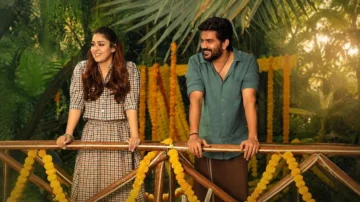
Twenty-three minutes is a cruel canvas for a man’s undoing. Manoj Sivakumar’s short asks Pugazh to carry a lifetime of rejection and a flicker of rescue inside that window, and the strain shows at the seams.
The title promises a journey from shadow into light, and the film’s architecture is built on precisely that arc: Vinith (Pugazh) ground down by cumulative refusal, then hauled back by a bond the synopsis frames as unwavering.
What the compressed form cannot hide is how much of that rescue happens in the gap between scenes rather than inside them.

When A Breaking Point Arrives Without A Visible Breaking
Vinith’s crisis is the film’s engine, and the screenplay treats rejection as an ambient pressure rather than a dramatized event. We are told he is pushed toward a breaking point; we are rarely shown the specific push.
This is the central structural gamble. A character study lives or dies on the granularity of its wounds, and Sivakumar’s script keeps the wounds abstract, trusting the runtime to substitute for the accumulation.
It doesn’t, entirely. The peer landscape of The Paradise demonstrates how a film can weaponize a single sustained pressure into visceral momentum; here the pressure stays theoretical, and Vinith’s despair arrives pre-loaded rather than earned on screen.

Pugazh’s Serious Turn Is A Casting Provocation, Not Yet A Performance
The most interesting thing about this project is the tonal pivot it demands of its lead. Pugazh built an audience on comic timing, and here he is asked to hold stillness, to let silence sit on his face without reaching for the laugh.
That restraint is the right instinct. What the film doesn’t give him is a scene that tests it, a moment where the comedy muscle visibly fights the despair and loses.
The performance foil sits right there in the release calendar. Where the two-phase romantic structure of Haiku asked its leads to sustain emotional register across shifting tonal ground, this film asks Pugazh to do the same in a fraction of the time, and the abbreviated runway flattens what should be a slow collapse into a single posture of sadness.
Kavin And Appa Are Functions Before They Are People
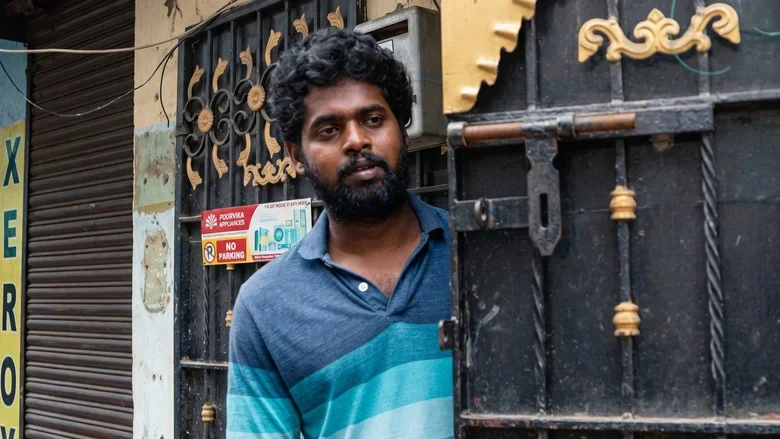
Roshan’s Kavin is positioned as the emotional anchor, the bond that prevents complete collapse. The role’s effectiveness depends on making that support feel active, a hand, a refusal to leave, a specific argument, rather than explanatory.
Senthil’s Appa carries the generational weight, and his established dramatic presence is the film’s most reliable asset. But the father exists as a silhouette of expectation rather than a man with a history.
Then there is Sivakumar himself, casting his writer-director self as Barani, a character the material never clarifies as ally, obstacle, or witness. That ambiguity could be productive; here it reads as a gap the screenplay forgot to fill.
The Darkness-To-Light Motif Needs A Camera Willing To Commit
A film called From Darkness Into Light owes its audience a visual argument, and the title’s metaphor is the one place where the direction could have compensated for the thin plotting. The material gives no verified account of lensing choices, palette shifts, or the blocking of the climactic turn.
What the premise implies, a gradual brightening, a held frame on Vinith’s face as the light changes, is exactly the kind of formal discipline that would make 23 minutes feel complete. Whether Sivakumar delivers it is the film’s open question.
The restrained musical profile, trading elaborate songs for raw emotion, is the correct call for this register. A swelling score would have betrayed the intimacy the film is reaching for.
The Titanic Comparison Is Instructive And Unflattering
There is a reason the recovery-through-connection premise resonates: it is the oldest emotional machinery in cinema. The same architecture that powers the central romance of Titanic, one person’s will to live restored by another’s insistence on their worth, is the spine of this short.
The difference is scale of evidence. The blockbuster earns its rescue across three hours of accumulated specificity; this film asks us to accept it on the strength of a synopsis-level premise.
The Commercial Reality Of A 23-Minute Independent Short
70mmScreenProduction is operating in a market where the short film has become a calling card rather than a commercial proposition. There is no theatrical franchise lifecycle to audit here, no opening-day balance sheet to parse, and no trade verdict to assign before release.
What is at stake is the exhibition pathway itself. The distribution framing is genuinely unresolved, one listing points to a theatrical date, another describes a digital trajectory, and that ambiguity tells you more about the film’s commercial position than any collection figure could.
For Pugazh, the calculation is different. A serious dramatic turn in a festival-oriented short is a portfolio move, a signal of range to casting directors who have only seen him play for laughs. The box-office leverage question is moot; the reputational leverage question is not.
Across contemporary Tamil dramas, this is the emerging pattern: established performers using the short form as a tonal audition, betting that critical notice outweighs commercial return.
The Light At The End Is Real, But We Barely See It Arrive
The film resolves on Vinith pulled back from the edge, and that resolution carries genuine philosophical weight. Connection as a route out of despair is not a small thesis, and a filmmaker willing to stake 23 minutes on it deserves the benefit of the doubt.
But a rescue we are told about is not a rescue we feel. The ending’s meaning depends entirely on whether the preceding 22 minutes built a case specific enough to make the turn land, and on the evidence available, the case is asserted more than argued.
Nizhalilirundhu Velicham is a sincere, compact attempt at the hardest thing in short cinema: making an interior collapse legible without the luxury of time. It may well find its light in the execution. It has not yet shown us the switch.

Ankit Jaiswal is the Chief Author, covering Indian cinema and OTT releases with honest, no-filler criticism. An SEO strategist by background, he brings a research-driven approach to film writing, cutting through hype to tell you exactly what's worth your time.