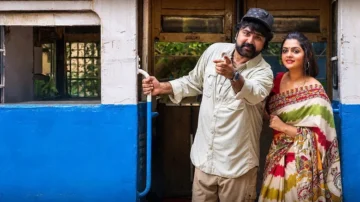
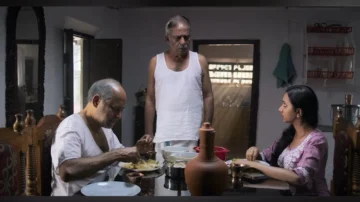
The opening sequence announces its intentions with a radio jockey’s voice drifting over campus footpaths and shared kitchens: an Indian student in America narrating his own small comedies. The stakes are modest by design, a coming-of-age romance set among Telugu students abroad.

When the Narrator Becomes the Safety Net
Udbhav Raghu builds his debut around that radio-jockey framing device, and it is both the film’s most distinctive asset and its structural crutch. The narration hands us a ready-made perspective on homesickness and cultural adjustment without ever forcing the camera to earn that perspective through behavior.
Watch how the protagonist describes a grocery run or a late-night group call rather than living through it. The voiceover arrives as commentary, smoothing over what could have been awkward, revealing silences. That choice keeps the tone breezy, but it also keeps the audience at arm’s length from genuine disorientation.
Ashok Galla’s Easy Charm Meets Its Limits
Galla carries the lead with an unforced likability, his posture loose and his comic timing pitched toward the observational rather than the broad. In the romantic passages he underplays well, letting small glances do the work instead of grand gestures.
Yet the role asks him to be a conduit for a shared student experience rather than a specific, contradictory person. His two previous outings fell short commercially, and the pressure to deliver a crowd-pleaser shows in how carefully the character is kept agreeable. Compare that restraint to the lived-in weight Anupama Parameswaran brings to domestic friction in Crazy Kalyanam, where small domestic gestures carry real emotional cost.
The Chemistry That Carries the Middle Stretch
Sri Gouri Priya’s scenes with Galla form the film’s warmest passages, particularly the “Anaga Anaga America” sequence, where the pair’s ease with each other reads as genuine rather than choreographed. The staging favors their physical proximity and shared laughter over elaborate set pieces.
What the romance lacks is friction. Conflicts resolve with a conversation and a song, and the friends who surround the couple rarely push back in ways that would test the relationship. The ensemble, including Rahul Vijay and Shivathmika Rajashekar, registers as texture rather than dramatic pressure.
A Diaspora Story That Avoids the Hard Questions
The film gestures toward academic pressure, visa anxiety and the emotional cost of leaving home, but treats these as backdrop rather than engine. The “Vintara Saradaga” phrase hints at bureaucratic obstacles and personal longing, yet the screenplay keeps them at a comfortable distance.
Where a colder, more controlled study of displacement might have dug into the loneliness beneath the group chats, this one prefers the warmth of collective belonging. That is a legitimate choice, but it leaves the central tension between personal dreams and emotional roots largely unexplored. The thematic sibling in My Dear Stranger shows how much sharper a study of estrangement can cut when it refuses to soften the edges.
Music, Framing, and the Cost of Comfort
Vijai Bulganin’s songs integrate smoothly into the emotional rhythm, with the romantic track doing much of the heavy lifting in the second hour. The camera stays close to faces during the quieter moments, favoring warm interiors and soft daylight over the spectacle of American locations.
That visual restraint suits the intimate register, though it also flattens the sense of place. The United States becomes a generic backdrop of apartments and campuses rather than a specific environment exerting pressure on these characters. The tension is gentle throughout, and gentle is the operative word.
What Sithara Entertainments Is Betting On
Sithara Entertainments and Fortune Four Cinemas are backing a youth-skewing entertainer in a market where the overseas-student comedy has become a reliable, if crowded, lane. The film’s delayed release, shifted from July to October, suggests the producers are positioning it for a festive window rather than a crowded summer fight.
For Galla, this is a pivotal commercial test after two underperformers, and the film’s modest scale means the bar for success is lower than a tentpole’s. The diaspora-romance formula remains sustainable only if it offers something beyond familiar warmth, and this one leans heavily on its lead pair’s appeal.
The Comfortable Ending and What It Costs
The resolution aims for emotional reconciliation, tying the characters’ personal goals to their relationships in a way that feels earned but unsurprising. It is a film content to leave its audience smiling rather than unsettled, and there is value in that generosity.
Yet the most interesting questions, about what these students sacrifice to stay abroad and what they leave behind, remain politely unanswered. The film’s warmth is real, and so is its reluctance to press harder. In a landscape of contemporary Telugu dramas increasingly willing to sit with discomfort, this one chooses the embrace over the argument, and that choice defines both its charm and its ceiling.

Ankit Jaiswal is the Chief Author, covering Indian cinema and OTT releases with honest, no-filler criticism. An SEO strategist by background, he brings a research-driven approach to film writing, cutting through hype to tell you exactly what's worth your time.