DSP Inbaraj walks back into a case he already failed to close, and the film around him cannot decide whether that is a tragedy or a bit.
Jithu Madhavan’s Tamil debut wants both, and for long stretches it gets neither.
A Rebel Cop Premise That Refuses To Pick A Fight
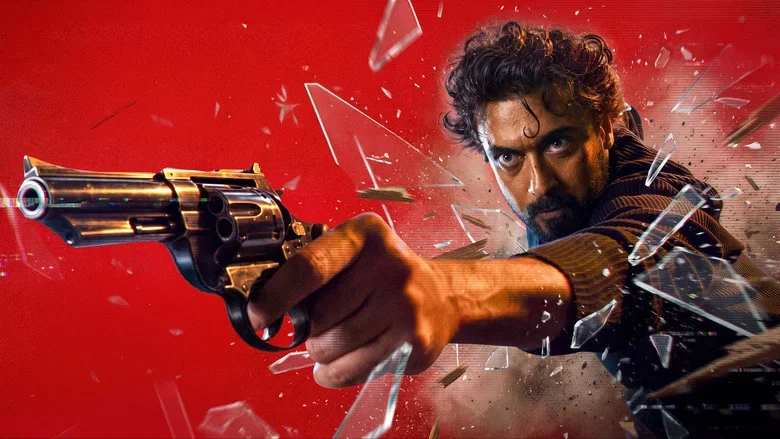
The opening act establishes Suriya’s Inbaraj as the department’s designated irritant, a man whose procedural instincts offend every superior within earshot.
Then the unfinished file resurfaces, and the film hands him a second chance it never quite earns dramatically.
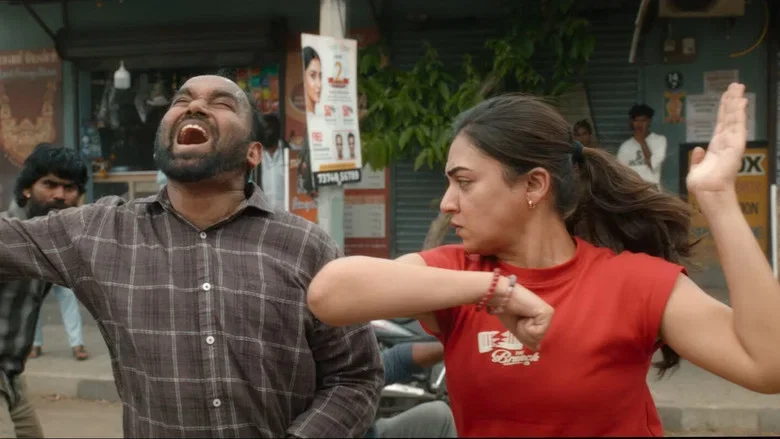
The complication is structural rather than moral: he must now solve the case with a chaotic team instead of alone, which is a comedy premise wearing a thriller’s jacket.
Madhavan builds the entire engine on that mismatch, and the friction between Inbaraj’s autocratic instincts and his useless subordinates is the film’s most reliable generator of scene-level energy.
What the screenplay never supplies is an antagonist worth the runtime. The mystery functions as a filing cabinet the team keeps opening, not as a presence that pushes back.
When The Star Outranks The Script, Tension Goes Missing
Suriya plays Inbaraj with a clipped, low-register impatience, shoulders squared, jaw set, sentences delivered like verdicts he has already stopped arguing for.
The physical comedy lands in the gaps: the way he stops mid-stride when a subordinate offers an opinion, the flat stare he holds a beat past politeness.
It is a controlled turn, and it recalls the disciplined restraint he brought to Vishwanath & Sons, where the same economy of gesture did heavier emotional lifting than the material demanded.
Here, though, the script keeps deferring to him. Every scene resolves into Inbaraj being right, and a protagonist who cannot be wrong cannot generate suspense.
The ensemble around him is texture rather than counterweight. Nazriya Nazim registers in her scenes through a dry, unbothered line delivery that suggests a character with an inner life the screenplay declines to investigate.
Naslen, making his Tamil debut, is deployed as comic ballast, wide-eyed, physically restless, forever a half-step behind the room, and the film never gives him a scene that belongs to him alone.
Malayalam Wordplay, Tamil Cadence, And The Translation Problem
Madhavan’s humour has always been verbal and unhurried, built on the rhythm of people talking past each other rather than on punchlines.
Transplanted into Tamil, that rhythm stumbles. Jokes land on the wrong beat, the wordplay thins out, and several exchanges play as though the comic charge evaporated somewhere between the page and the performance.
The first half still works better than the second, largely because the team-formation scenes have a loose, shaggy comic momentum that the later investigation sequences abandon for plot mechanics.
Once the case tightens, the film’s tonal confidence loosens with it, the comedy thins, the procedural thickens, and neither register fully absorbs the other.
The comparison to the director’s own Jailer 2-style star-vehicle arithmetic is instructive: both films mistake the lead’s gravity for structure.
Vineeth Augustian’s Frames And Sushin Shyam’s First Tamil Score
Vineeth Augustian shoots the investigation in flat, functional medium shots, fluorescent interiors, corridor sightlines, desks arranged so that Inbaraj always sits slightly apart from his team.
That spatial choice is the film’s sharpest visual idea: the composition itself isolates him, and it does more character work than most of the dialogue.
Sushin Shyam’s first Tamil score leans on low percussive undercurrents during the procedural stretches, and the restraint is welcome, the music never shouts a twist the editing has already announced.
The problem is pace. At two and a half hours, the film’s middle section sags under repeated investigative beats that advance the plot without escalating the stakes.
Just as he demonstrated a tighter spatial discipline in Ramayana, Madhavan strips away decorative flourishes here, but this time there is not enough architecture underneath to hold the tension upright.
2D Entertainment’s Bet And The Limits Of Star Gravity
Suriya and Jyotika’s 2D Entertainment, alongside Zhagaram Studios, are banking on a simple proposition: a major Tamil star fronting a Malayalam director’s comic sensibility is a novelty worth paying for.
The commercial logic is sound on paper. The execution leaves the film stranded between the mass-audience expectations of a Suriya vehicle and the ensemble-comedy instincts Madhavan actually directs best.
For a star whose theatrical leverage depends on event-scale openings, a mid-budget police comedy with no clear antagonist is a genuine gamble, one that contemporary Tamil action has rewarded before, but only when the film commits fully to one register.
Scene commits to neither. It is too loose to thrill and too plot-bound to stay funny.
The Case Closes, The Character Doesn’t
What lingers is not the resolution but the suspicion that Inbaraj was more interesting before the film explained him.
A rebel cop who learns to trust his team is a redemption arc; a rebel cop who simply outlasts his colleagues is a character.
Scene offers the first and gestures at the second, and the gap between them is where the film’s real mystery sits, one its own screenplay never solves.

Ankit Jaiswal is the Chief Author, covering Indian cinema and OTT releases with honest, no-filler criticism. An SEO strategist by background, he brings a research-driven approach to film writing, cutting through hype to tell you exactly what's worth your time.