Pavan Sadineni opens on a village girl staring at a passing astrovan, and the film never quite recovers from that image’s quiet power.
What follows is a 2-hour-39-minute climb toward the stars that keeps stopping to apologize for wanting them.
A Wedding Night That Should Detonate, Not Decorate
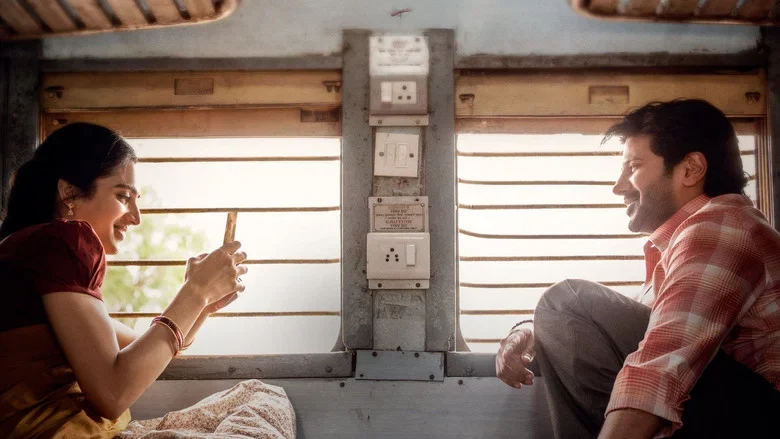
The premise lands with real force: Kalpana is married off at sixteen to a middle-class driver who has no idea what he’s walked into.
When Krishna learns his bride’s age and her astronaut ambition in the same breath, the film has a moral grenade in its hand.
Sadineni fumbles the pin. The discovery registers as a plot hinge rather than a rupture, and the scene’s unease evaporates into the next motivational beat.

Dulquer Salmaan Builds a Husband Out of Small Labor
Krishna’s conversion from confused groom to fierce ally is the film’s most persuasive arc, and it works because Dulquer plays it through logistics.
He takes the extra shift. He counts the money. He sits in a cramped room and listens, jaw tight, while Kalpana explains what she wants from a life that was decided for her.
That restraint recalls the quiet marital ache he carried through ENE Repeat, where the emotional stakes lived in unspoken glances rather than declarations.
Here he’s given a warmer register, and he uses it well, shoulders relaxing, voice dropping into a lower, steadier gear whenever Kalpana needs reassurance.
Satvika Veeravalli Carries the Film on a Teenager’s Certainty
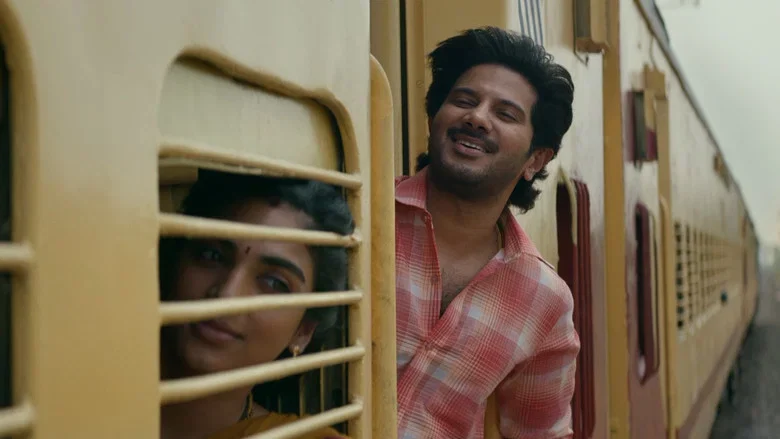
The debut performance is the reason to buy a ticket. Satvika Veeravalli plays Kalpana with wide-eyed curiosity and a stubborn, almost unnerving focus on the sky.
Watch her in the district-topper sequence: she doesn’t celebrate. She reads the result, exhales, and looks at Krishna like she’s already calculating the next hurdle.
That single gesture does more narrative work than any motivational speech the screenplay hands her.
The supporting ensemble, Shruti Haasan, Ruhani Sharma, Murali Sharma, Nassar, mostly functions as texture, drifting through scenes without the screen time to register as characters.
Gautham Vasudev Menon gets a handful of moments but never a confrontation worth remembering, and the film’s refusal to give its established performers real dramatic weight is a genuine waste.
The Antagonist Is a House, Not a Man
Kalpana’s father is the villain by default, an abusive patriarch who controls education, marriage and money with the same clenched fist.
But the film’s real antagonist is the entire social architecture: the in-laws who treat her ambition as an insult, the village that measures a girl’s worth in domestic compliance.
That’s a smarter target than a mustache-twirling villain, and for two acts it works. The pressure feels ambient, inescapable, structural.
Then the third act arrives and the whole apparatus folds like a cheap chair.
When Reconciliation Becomes a Convenience, the Drama Deflates
The abusive father apologizes. The hostile sister-in-law softens. The village that once sneered now claims her as its own.
None of it is earned. These reversals arrive in a rush, as if the screenplay ran out of pages and decided social change could be scheduled like a train.
The same instinct to smooth over friction weakens the film’s relationship to its own genre, a problem that also hobbled the emotional logic of #Cult, where village drama and urban longing refused to actually collide.
Here, the collision is avoided entirely. The film wants to be inspirational, but inspiration without resistance is just a poster.
A Camera That Loves the Sky and Forgets the Ground
The visual grammar is simple and effective in the early stretches: low angles on Kalpana looking up, wide frames of dusty streets pressing in on her.
The astrovan becomes a recurring motif, a metal promise that keeps passing through her village and out of reach.
But once the story moves into the education-and-sacrifice phase, the imagery flattens into functional coverage, shot-reverse-shot conversations, medium close-ups, nothing that matches the ambition of the premise.
The runtime doesn’t help. At 2 hours and 39 minutes, the middle section repeats its motivational beats with the patience of a teacher who has forgotten the bell rang.
A Supporting Cast That Never Gets to Support
This is a two-hander wearing an ensemble’s clothes. Dulquer and Satvika hold the frame, and everyone else orbits without gravitational pull.
Shruti Haasan’s presence is registered but not utilized; the screenplay never gives her a scene that justifies her billing.
The same is true of the broader household, the royal relatives, the temple elders, the village chorus, who exist to react rather than to complicate.
Compare that to the ensemble energy of Bachelor Party D'eux, where every performer got a beat worth playing, and the gap in generosity becomes obvious.
Geetha Arts Bets on Sincerity Over Spectacle
The producing combine of Geetha Arts, Swapna Cinema and Lightbox Media is clearly chasing the family-drama sweet spot, a mid-budget aspiration story with a bankable Malayalam star and a debutante at its center.
It’s a sensible bet. Dulquer’s Telugu-market leverage has grown steadily, and the dubbed Malayalam and Tamil releases widen the net.
But the film’s commercial ceiling is tied to its refusal to escalate. Audiences will show up for the message; they may not return for a second viewing of a story that resolves its conflicts with apologies instead of consequences.
Across contemporary Telugu dramas, the ones that endure are those that let their social friction stay unresolved long enough to sting.
The Verdict: A Sincere Flight That Never Leaves the Runway
Aakasamlo Oka Tara means well, and for long stretches it means well beautifully, Dulquer’s quiet husband, Satvika’s unblinking ambition, a camera that believes in the sky.
But a film about a girl who refuses to accept the life she was handed shouldn’t end with everyone who handed it to her getting a clean conscience.
The final image is meant to lift. It settles instead, like a rocket that fired its engines and forgot to release the clamps.

Ankit Jaiswal is the Chief Author, covering Indian cinema and OTT releases with honest, no-filler criticism. An SEO strategist by background, he brings a research-driven approach to film writing, cutting through hype to tell you exactly what's worth your time.