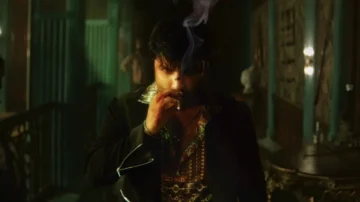
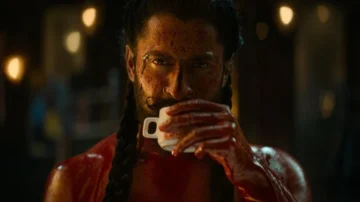
The red sandalwood is stacked in bundles the size of coffins, and the men who guard it pray before they kill. Rajkumar Periasamy opens his two-part crime saga in the temple corridors of Tirupati, where incense and contraband share the same air.
It is a striking image. It is also, across nearly three hours, an image the film never quite earns.

A Woodcutter Walks Into a Syndicate, and the Film Breathes
Dhanush plays Palanivel, a labourer with an axe and a wife and not much else. The screenplay’s smartest instinct is to make his criminal entry a matter of economics rather than ambition.
He does not want the syndicate. The syndicate wants his hands. That distinction gives the first hour a quiet, grinding pressure that a flashier film would have squandered on montage.
Periasamy stages the recruitment with patience. We watch Palanivel learn the geography of the trade, which forest, which officer, which lie, and the film’s procedural texture is genuinely absorbing.
The covert operation that gives the film its title arrives as a second track, and this is where the architecture starts to strain.
Two Movies Wrestling for the Same Runtime
There is a woodcutter’s survival drama here, and there is an undercover procedural, and they do not always want the same things.
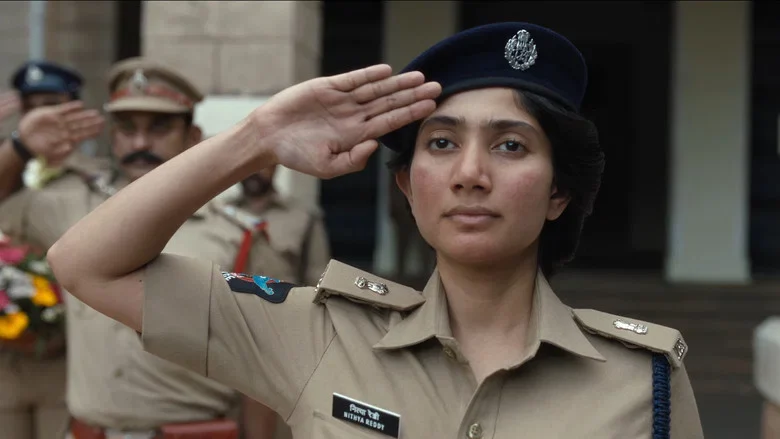
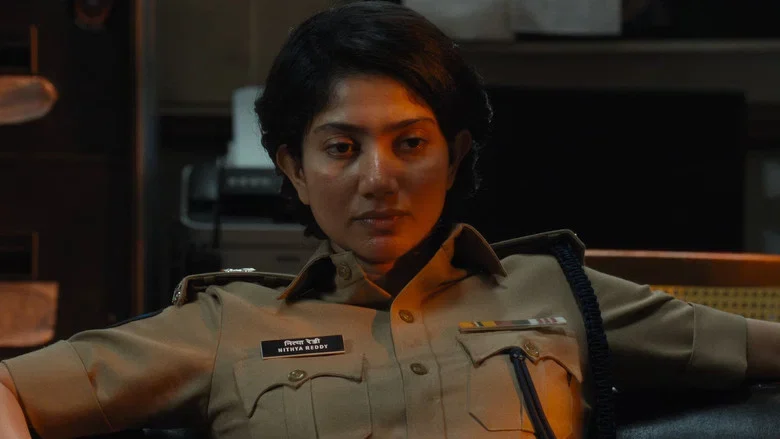
Sai Pallavi’s Nithya Reddy IPS carries the institutional counterforce, and she is given the harder job: to make bureaucracy feel dangerous. She does it with a clipped, unsentimental efficiency that keeps the task-force scenes from becoming paperwork.
Mammootty, as Burma “Siya” Karthikeyan, is the film’s gravitational centre whenever he is on screen. He does not raise his voice. He does not need to. A single pause before a sentence does more work than a page of dialogue.
The problem is structural. A franchise opener must leave its largest stakes unresolved, and this one leaves so much unresolved that the second hour starts to feel like a very expensive trailer for Chapter 2.
The red-sanders economy is a genuinely specific backdrop, ecological, regional, economically precise, and it deserves better than to function as set dressing for a sequel. The film’s interest in poverty as a recruitment tool is real, but it keeps getting interrupted by plot.
Stillness, Silence, and the Weight of a Held Frame
The best passages are the quietest. Periasamy understands that threat lives in proximity, and he stages confrontations at distances that feel uncomfortably intimate.
Watch Dhanush in the syndicate’s inner rooms. His shoulders stay low. His eyes do the negotiating. When he is asked to prove himself, the film lets the silence stretch a beat past comfort, and the tension is entirely physical.
Mammootty’s power is conveyed through seating. He is almost always lower than the men who fear him, and the inversion does more than any dialogue could.
Where the direction falters is in escalation. The action beats arrive on schedule rather than on instinct, and a film this long cannot afford to feel predictable.
The pacing in the second half carries an audible drag, not because nothing happens, but because too much happens without consequence. The film mistakes accumulation for momentum.
The Supporting Architecture and the Missing Antagonist
Sreeleela’s Roja anchors Palanivel’s domestic life, and her scenes carry a warmth the criminal passages lack. But the role is underwritten, and the film keeps returning to her as a reminder of what he stands to lose rather than as a person with her own stakes.
The syndicate itself is the antagonist, which is a bold choice and a costly one. A system cannot stare back at you across a table. The film’s criminal politics are intricate, but intricacy is not the same as menace.
Indrans and Naseeruddin Shah appear in the margins, and their presence lends the texture of a lived-in world. But the screenplay gives them little to do beyond establishing that the world is large.
The ensemble is deep. The character work is not. That imbalance is the film’s central frustration.
What the Camera Believes That the Script Does Not
The visual scheme is built on contrast: sacred stone against forest mud, daylight ritual against nocturnal transaction. It is a coherent idea, and it is executed with discipline.
The temple sequences are shot with a documentarian’s patience, and the effect is unsettling in exactly the right way. The film is at its most confident when it simply observes.
The score, credited to Sai Abhyankar, leans heavily on percussion during the action passages, and the result is more exhausting than exciting. The film does not trust its own silences, and that is a directorial misstep.
Editing is the larger issue. A film of this length needs a ruthless hand in the middle section, and the middle section is where the film loses its grip.
Compared to the tighter spatial discipline of Khushi – The Princess, this is a more ambitious but less controlled piece of filmmaking. Ambition, here, is not always a virtue.
Dhanush Carries the Weight, and the Film Knows It
Dhanush is the reason the first hour works. He plays Palanivel as a man who is always calculating the distance to the door, and that vigilance is the film’s most reliable source of tension.
His physical register here is different from the coiled, wounded energy he brought to Kara. There, the exhaustion was internal. Here, it is in the spine, a labourer’s posture that never quite straightens, even when he is standing in a room full of men who could kill him.
It is a performance of small adjustments, and it is the film’s most valuable asset. When the screenplay loses its way, he keeps it anchored.
The same cannot be said for the film’s engagement with its own politics. The screenplay gestures at the economics of smuggling without ever committing to a real argument about them.
That hesitation is visible in the way the film handles the law-enforcement side. The task force is presented as a mechanism rather than a moral position, and the result is a film that has stakes without a thesis.
The thematic territory here is adjacent to what Black Gold attempted with the hair-trade crime economy, but this film is less willing to sit with the ugliness of its own premise.
Wunderbar’s Bet, and the Franchise Arithmetic
Wunderbar Films and RTake Studios are not making a modest film. The reported budget sits in the twenty-million-dollar range, and the two-part structure is a commercial wager as much as an artistic one.
For Dhanush, this is a test of whether his theatrical draw can sustain a franchise built around him rather than around a star vehicle. The advance sales suggest curiosity. Curiosity is not the same as commitment.
The release was pushed to avoid a collision with larger titles, which tells you something about how the producers read the market. This is a film that needs room to breathe at the box office, and it is arriving in a crowded corridor.
The broader question is whether the regional crime epic can sustain itself across two parts without the second instalment feeling like an obligation. The current landscape of contemporary Tamil thrillers is crowded with ambitious multi-part constructions, and not all of them have earned their length.
This one has the cast and the texture. What it does not yet have is a reason to believe that Chapter 2 will be more than a continuation.
The Ending That Refuses to End
The film closes on a held breath rather than a resolution, and that is a choice the audience will either respect or resent.
The final image is of a system still intact, a man still inside it, and a task force still watching. It is a deliberate refusal of closure, and it is also a refusal to take a position.
That is the film’s deepest problem. It is a crime epic that is fascinated by its own machinery, and it never quite decides what it thinks about the men who run it.
Dhanush holds the centre. Mammootty gives it gravity. The red sandalwood gives it a world. What is missing is the conviction that any of it matters beyond the next chapter.
See it for the performances and the texture. Leave questioning whether a film this long should have ended with a question mark instead of a full stop.

Ankit Jaiswal is the Chief Author, covering Indian cinema and OTT releases with honest, no-filler criticism. An SEO strategist by background, he brings a research-driven approach to film writing, cutting through hype to tell you exactly what's worth your time.