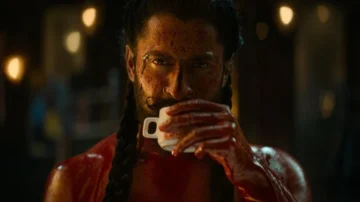
Nitesh Tiwari opens his Ramayana with a prayer for power, not a coronation. The man on his knees is an Asura, and the film’s first instinct is to make you understand him before you fear him.
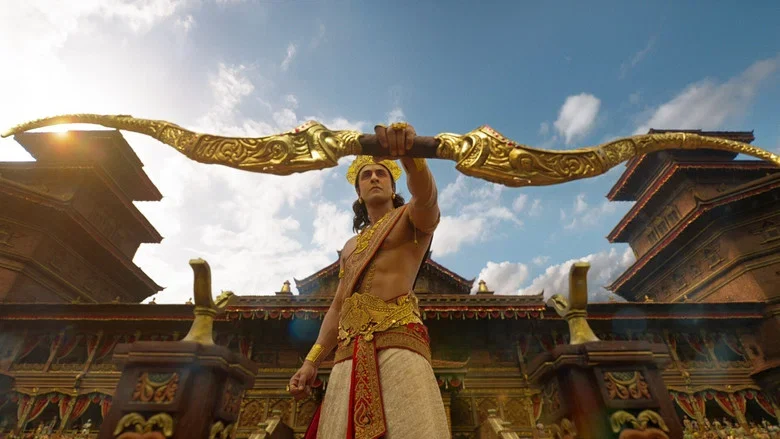
When The Villain Gets The First Prayer, Devotion Becomes Political
Ravana’s introduction is the film’s most radical gesture: he seeks liberation for an enslaved clan, not conquest for its own sake. That grievance gives Yash’s character an ideological floor to stand on before the screenplay lets him slide.
The Devas respond to his rise by turning to Vishnu, and the incarnation of Rama becomes a counter-move in a war of political theology. Tiwari stages the cosmic imbalance as a question of governance, not just divine order.
The prologue carries real weight, but it also front-loads the film with exposition it never fully shakes. By the time Ayodhya appears, the audience has absorbed three realms and two political systems before meeting a single prince.
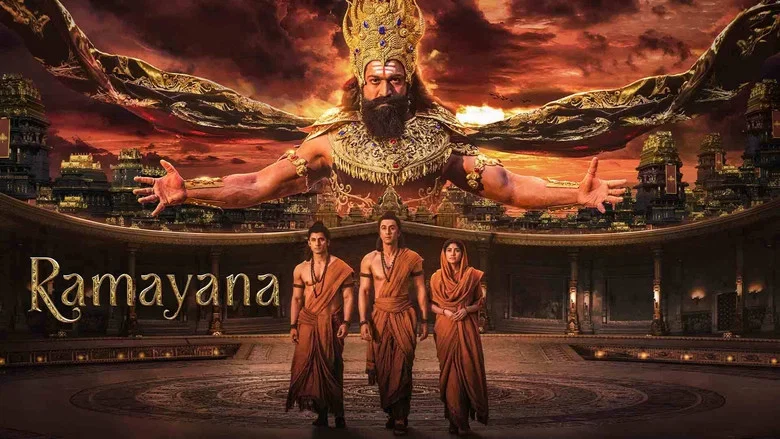
Ranbir Kapoor Plays Duty As A Cage, Not A Virtue
Kapoor’s Rama is built on restraint: lowered eyes in the royal court, a stillness in his shoulders when his father’s word becomes law. He plays obedience as a physical discipline, not a personality trait.
Where Brahmāstra: Part One – Shiva let him chase spectacle, this role asks him to underplay against green screens and vast armies. The choice is intelligent, though the film rarely gives him a quiet scene long enough to deepen it.
Sai Pallavi’s Sita meets that stillness with a warmer, more watchful presence, and the marriage sequence carries genuine emotional texture. The exile that follows turns her from a partner into a passenger, and the script does not yet seem to know what to do with that.
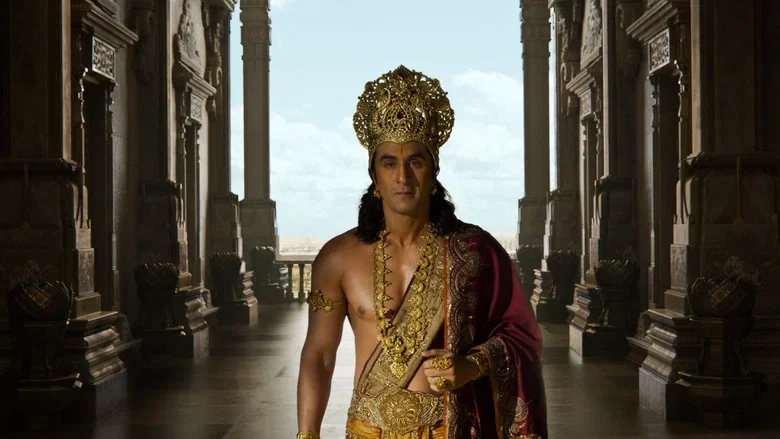
Yash Builds A King Out Of Grievance And Then Lets It Rot
Yash’s Ravana is the film’s structural engine, and his authority is physical first: a wide stance in council, a low voice that never rises to prove itself. When his purpose hardens into the destruction of Vishnu, the performance shifts register without announcing the change.
It is a more controlled piece of screen presence than the lean genre gamble of Mr. Lucky, and it confirms his instinct for playing men whose conviction outpaces their morality.
The supporting ensemble is thinner than the cast list suggests. Arun Govil’s Dashrath carries the weight of Ayodhya’s authority in his posture alone, while Lara Dutta’s Kaikeyi is given palace intrigue but almost no interiority to play.
Sunny Deol’s Hanuman registers as presence rather than character, and the film’s biggest missed opportunity is that it never lets that devotion become a scene of its own.
The Two-Part Structure Is A Business Decision Wearing A Story’s Clothes
Tiwari’s direction shows real ambition in how he frames Ravana as a liberator before a tyrant, echoing the political reimagining that powered Geriga without its structural collapse. Here the problem is different: the film is designed to end before it resolves.
Retitling the international release “Rise of a Legend” rather than “Part 1” is a marketing choice with narrative consequences. Audiences walk in expecting a complete arc and leave with a prologue to a war that never arrives.
The CGI strategy is expansive and occasionally beautiful in its cosmology, but it also flattens the tactile intimacy that made Tiwari’s Dangal so devastating. Grandeur replaces closeness, and the film feels the loss even if it never admits it.
Hans Zimmer and A.R. Rahman’s collaboration gives the mythology a choral grandeur, though the score leans on scale where a single sustained note might have done more.
The Fantasy Epic That Forgot To Give Its Audience An Ending
The film’s genre ambition is genuine: it externalises the Deva–Asura conflict, converts villainy into ideology, and connects divine incarnation to human royal duty. That is more sophisticated world-building than most mythological releases attempt.
But the screenplay’s incompleteness is not a cliffhanger, it is a withholding. The marriage and exile should be the emotional climax of a first chapter, and instead they function as setup for a film the audience has not yet been promised.
The comparison to Nagabandham – The Secret Treasure is instructive: that film worshipped its visuals at the expense of narrative grip, while this one grips hard and then refuses to let go of its own setup.
Prime Focus, DNEG, And Monster Mind Are Betting On A Two-Film Wager
The production alliance of Prime Focus Studios, DNEG, and Yash’s Monster Mind Creations is not a typical Indian mythological investment. The reported combined budget of roughly ₹4, 000 crore across both parts makes this a franchise wager, not a single release.
That structure means the first film’s box office must justify the second’s completion, and the decision to market it as a standalone epic rather than an explicit Part 1 is a commercial hedge that could backfire with general audiences.
Kapoor’s theatrical leverage is being tested here in a way it hasn’t been since his fantasy-franchise debut, and the film’s opening weekend will tell the industry whether mythological spectacle can sustain a two-part theatrical model.
Across contemporary hindi fantasys, the pattern is clear: scale sells tickets, but only resolved stories build the word-of-mouth that carries a franchise into its second chapter.
The Verdict: A Beautifully Built First Act That Mistook Itself For A Whole Film
Ramayana: Rise of a Legend is the rare mythological epic that improves its villain and shortchanges its hero, giving Yash the film’s richest psychological terrain while Ranbir Kapoor holds a stillness the screenplay never lets him break.
What lingers is not the spectacle but the frustration: a film that understands power, duty, and liberation as moral questions, and then declines to answer any of them before the credits roll.
Tiwari has built a foundation worthy of the epic it adapts. Whether that foundation becomes a temple or a ruin depends entirely on whether the second part remembers that audiences came for a story, not a down payment.

Ankit Jaiswal is the Chief Author, covering Indian cinema and OTT releases with honest, no-filler criticism. An SEO strategist by background, he brings a research-driven approach to film writing, cutting through hype to tell you exactly what's worth your time.