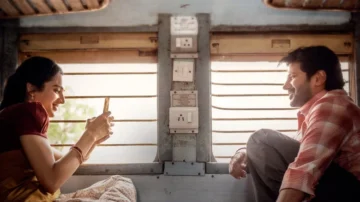
Nawin Ghanesh opens his survival thriller with a man who has lost the two things cinema depends upon: a face the world will register and a voice it will obey. Pulse asks whether a hero can save anyone when the crowd simply refuses to see him.
It is a premise with genuine intellectual charge. The question is whether the film has the patience to build an engine around it, or whether it mistakes the idea itself for a screenplay.

The Invisible Man Meets A Government Hospital, And The Movie Nearly Drowns In Its Own Elevator Pitch
The film’s central contradiction is its most interesting asset. Master Mahendran’s protagonist is searching for a woman while trapped inside a government-hospital corridor of institutional neglect and a swelling street protest.
That collision of private longing and public dysfunction gives Pulse a scale most Tamil thrillers of this budget bracket never attempt. The hospital is not a set; it is a thesis about who gets heard in a system designed to lose people.
But the film leans on that thesis like a crutch. The unseen-and-unheard condition, established early and hammered relentlessly, becomes a one-note obstacle rather than a shifting dramatic pressure.
Where a sharper film would let the condition evolve, sometimes a curse, sometimes a strange advantage, Ghanesh keeps it static. The hero cannot be perceived, so the script keeps staging scenes where he cannot be perceived, and the pattern calcifies.
The protest backdrop, which should be the film’s secret weapon, arrives as noise rather than architecture. Crowd chaos is filmed for volume, not for the claustrophobia that a survival thriller needs to press against the audience’s ribs.
A One-Beat Communication Handicap Needs A Second Act That Actually Escalates
The middle stretch is where Pulse reveals its structural nerve damage. The search for the love interest keeps the plot personal, which is smart, but the film never finds a mid-movie reversal that changes the rules of the game.
Compare the way Shankarabharana at least lets its folklore mythology mutate across acts, giving the audience new information to chew. Pulse offers escalation in volume without escalation in understanding.
The screenplay’s cause-and-effect chain is legible: search, entrapment, protest, survival. What it lacks is a turn, a moment where the hero’s inability to be seen or heard stops being a prison and becomes a strategy.
That absence is fatal for a survival thriller. Without a pivot, the second hour becomes a treadmill of near-misses, and the audience starts counting the minutes instead of the threats.
The film also never quite decides what to do with its social-issue framing. Government hospitals as a subject demands specificity, and specificity demands scenes that implicate institutions rather than merely decorate a backdrop.
Master Mahendran Carries The Isolation, But The Script Gives Him Little To Push Against
Mahendran is the film’s most reliable asset. His physical performance of a man talking into a void, jaw tight, eyes darting to faces that slide past him, has a real, unglamorous desperation.
There is a stretch in the hospital sequence where he simply stands still amid moving bodies, and the film briefly becomes the movie it promised. His stillness sells the horror of invisibility better than any chase.
What he is not given, however, is a scene partner who can meet that register. Rishika Rajveer’s presence in the film is felt mostly as absence, a motivating ghost rather than a character with her own texture.
Livingston and R. V. Udayakumar appear in roles the screenplay treats as furniture. The supporting ensemble exists to populate corridors and crowds, not to complicate the hero’s predicament with competing agendas.
That is a casting failure as much as a writing one. A survival thriller needs friction from other people, and Pulse keeps its supporting players safely at the edge of the frame.
Abhishek AR’s Score Pushes Where The Camera Should Hold
The film’s craft instincts lean toward overstatement. Abhishek AR’s background score is constantly telling us the scene is tense, which is the surest sign the images are not doing the job alone.
The visual scheme splits between the fluorescent institutional pallor of the hospital and the brown, dust-choked energy of the protest. Both are promising arenas, but the camera rarely finds a composition that makes either feel like a trap.
Ghanesh’s direction has ambition but not yet discipline. He stages chaos broadly, and the editing follows suit, cutting on movement rather than on dread, so the film’s threat never settles into the body.
The clearest point of comparison is the way Appa Kutty uses procedural confinement, a single room, a fixed set of rules, to generate pressure. Pulse has more space and less tension.
Where the film does work is in its quieter passages, when the score drops out and Mahendran’s isolation is allowed to breathe. Those moments suggest a better, more patient version of this movie exists inside the one we got.
The Protest Is A Spectacle, Not A Threat, And That Is The Film’s Central Miscalculation
A crowd should be the most terrifying thing in a survival thriller. It is unpredictable, it has its own physics, and it does not care about your protagonist’s emotional arc.
Pulse treats its protest as a backdrop for set pieces rather than an organism with its own logic. The result is scale without menace, a lot of people moving, and very little sense that any of them could kill the hero by accident.
The film’s closest genre sibling in the current Tamil landscape is O.M, which understands that a sprawling canvas only matters if the protagonist is squeezed by it. Pulse gives its hero room to run, and running is rarely as tense as being pinned.
What the film needed was a tighter geography: a corridor, a stairwell, a single ward. Instead it keeps opening up, and every time it opens up, the pressure leaks out.
The climax, staged as a desperate scramble through the protest, is busy but not frightening. It is the kind of sequence that looks expensive and feels weightless.
T-Series South Bets On A High Concept Without A Proven Star Vehicle
The commercial math here is genuinely uncertain. T-Series South is backing a survival thriller fronted by Master Mahendran, a performer with real screen presence but not the kind of opening-weekend pull that guarantees a strong first Monday.
That is a bet on concept over star, and in the current Tamil market that bet only pays when the concept delivers a genuinely novel theatrical experience. Pulse has a novel hook and a conventional execution.
The film’s release window also matters. A survival thriller needs word-of-mouth to build across the week, and word-of-mouth requires audiences to leave arguing about the movie rather than shrugging at it.
The broader landscape of contemporary Tamil thrillers rewards films that either deliver a star’s signature intensity or a genuinely fresh structural idea. Pulse sits awkwardly between those poles.
For T-Series South, this reads as a portfolio play, a modestly budgeted genre entry designed to test the market rather than dominate it. Whether that strategy holds depends on how the film performs outside the opening weekend.
A Survival Thriller That Forgets Survival Is A Clock, Not A Mood
The film’s final stretch tries for catharsis, but the emotional math does not quite close. The hero’s search for his love has been the engine, and the film’s resolution treats that search as a destination rather than a cost.
What lingers is not the climax but the small, stranded moments: Mahendran’s face in a hospital corridor, the sound of a voice that no one turns toward. Those are the film’s real pulse.
Nawin Ghanesh has a filmmaker’s instinct for high-concept pressure and a first-timer’s uncertainty about how to sustain it. The premise deserves a sharper, meaner, more claustrophobic movie than the one that surrounds it.
Pulse is worth seeing for what it attempts and worth arguing about for what it avoids. It is a film about a man no one can hear, made by a filmmaker still learning how to make himself heard.

Ankit Jaiswal is the Chief Author, covering Indian cinema and OTT releases with honest, no-filler criticism. An SEO strategist by background, he brings a research-driven approach to film writing, cutting through hype to tell you exactly what's worth your time.