Sumanth Bhat opens on a schoolboy gripping an imaginary steering wheel, and for twenty minutes the film runs on that clean, combustible idea: driving as calling, not employment.
Then the bus gets a route, the route gets a ghost, and the machine starts pulling in two directions at once.
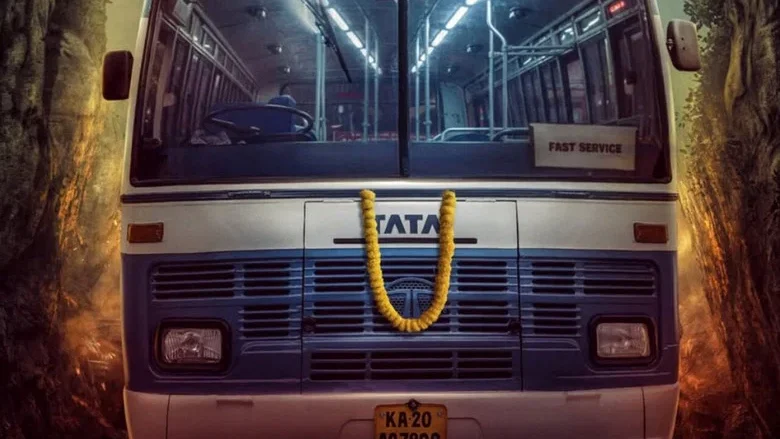
A Working-Class Dream Pledged Against Family Gold
Shankara’s humiliation under Madhu Anna is staged with unglamorous precision, a man dismissed in front of his own passengers, absorbing it because the loan depends on silence.
When the family pledges its jewellery, Bhat gives us the ledger, not the tears. The bus is named Shankarabharanna the way a child is named: publicly, permanently, and at ruinous cost.
This is the film’s firmest ground. Ownership as dignity, route permits as caste-adjacent gatekeeping, the vehicle as proof of personhood.
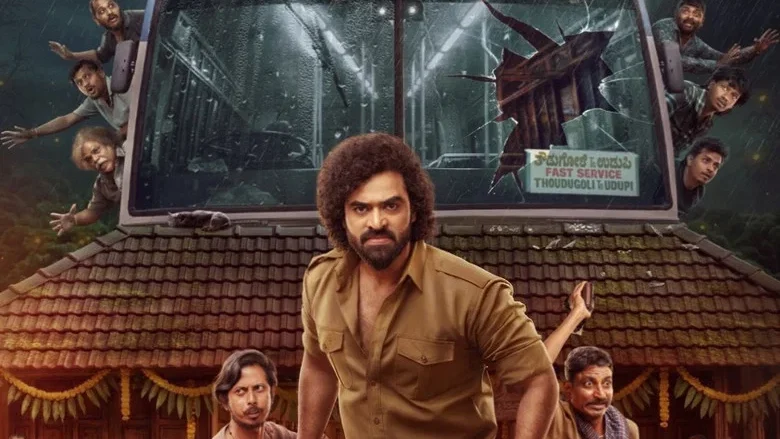
Thoudgudi Arrives and the Film Changes Its Spine
The abandoned stretch is introduced as an assignment, not an omen, which is the smartest structural move Bhat makes, horror entering through paperwork rather than prophecy.
But the screenplay never reconciles its two engines. The social-realist register wants patience and observation; the supernatural register wants escalation and dread.
Where a peer release like Appa Kutty committed fully to a single tonal chamber, this one keeps switching rooms mid-conversation.
Sampath Raj Brings Weight Without Enough Screen Time
As Sudhakara, the figure the village calls PT Sudha, Sampath Raj works in a low, unhurried register, he lets silences land before speaking, and his stillness in a doorway does more than any jump cut.
The problem is arithmetic. He is the film’s gravitational centre and it keeps him off-screen for long stretches, so the dread has to be maintained by landscape alone.
Shine S Shetty carries the first half with a driver’s physical vocabulary, hands at ten and two, a jaw that tightens before he answers, but the script asks him to become a different protagonist after the interval.
That shift recalls the soft-edged sincerity Dulquer Salmaan anchored in Aakasamlo Oka Tara; here the same warmth is asked to harden into resolve without the intervening scenes to justify it.
A Support System That Never Becomes Characters
Tanvi Ram’s Jenny exists almost entirely as encouragement, and Deepak Rai Panaje’s Vittala registers mainly as the man who signs away the gold.
Krithi B Shetty’s Shanti gets one sharp look of dissent at the pledge and then nothing. The family is the film’s emotional collateral, and Bhat treats them as collateral.
Route Geography Does the Heavy Lifting
Bhat’s camera understands roads. Long lenses compress the bus against laterite and rain, and the recurring framing of the empty rear-view mirror does quiet work the score doesn’t need to underline.
The comedy, though, sits awkwardly against the haunting, passengers cracking jokes on a road the film has just told us is cursed deflates tension the editing had carefully built.
Where a genre sibling like Lambodhara 2.0 let its concept curdle into unease, this one keeps apologising for its own darkness with a laugh track.
What the Ending Refuses to Resolve
The climax links the bus, the family’s sacrifice, and Thoudgudi’s buried history into one confrontation, and then declines to say what Shankara has actually won.
Owning the bus was supposed to mean escaping another man’s authority. The final image suggests he has simply traded one inherited debt for another, which is either the most honest beat in the film or the least thought-through.
Bhat’s instinct to leave the ledger open is defensible. His failure to dramatise the choice that opens it is not.
The Box-Office Question Nobody Wants to Ask
This is a Kannada-language genre hybrid arriving without a franchise spine, a star-vehicle hook, or the marketing architecture that usually converts folklore horror into a first-weekend event.
Trade listings showed no usable opening-day figures at the time of reporting, which for a mid-budget regional release is less a data gap than a verdict forming in real time.
The wider pattern across contemporary Kannada thrillers is instructive: films built on regional texture and a single strong idea can find an audience, but they need word of mouth to do the work a star normally does.
Shetty is a genuine screen presence and this performance will travel further than the film’s theatrical run. Whether the producers see a return on that is a different ledger entirely.
The Verdict: A Bus With Two Drivers
Shankarabharanna is at its best when it trusts the mundane, a man, a machine, a loan, a name painted on a flank in fresh white.
Everything supernatural it adds is competent and almost none of it is necessary, because the haunting was already there in the humiliation.
Bhat has made a film about dignity that keeps interrupting itself to be a ghost story, and the ghost is the least interesting thing in the frame.

Ankit Jaiswal is the Chief Author, covering Indian cinema and OTT releases with honest, no-filler criticism. An SEO strategist by background, he brings a research-driven approach to film writing, cutting through hype to tell you exactly what's worth your time.