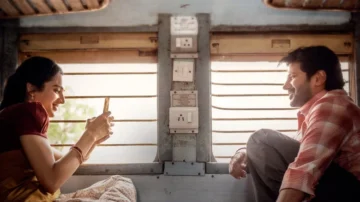
The opening image is a city that breathes in data: streetlights dimming on cue, commuters glancing at wristbands that calibrate their moods, a skyline that seems to hum with the quiet arithmetic of contentment.
Simple Suni wants us to feel the seduction of a happiness that can be measured, and for a few minutes, the film nearly pulls it off.
What follows is a science-fiction thriller that arrives with its premise fully formed and its dramatic architecture still under construction, a film that knows exactly what it wants to say about algorithmic control but hasn’t quite figured out how to make us feel it.
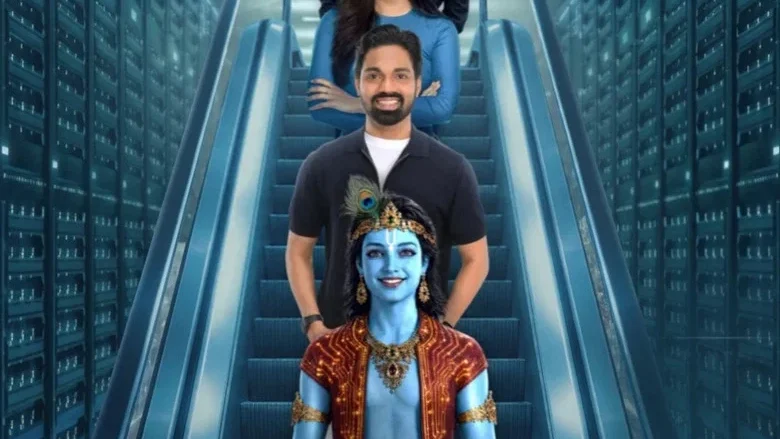
A Hacker Without A Face, A System Without A Villain
The central conceit is genuinely promising: a rogue hacker stumbles into a war over the digital infrastructure that quantifies human joy. Kunal Kapoor, making his Kannada-cinema debut, is tasked with carrying this ideological burden.
Yet the screenplay keeps him at arm’s length, offering a protagonist whose opposition to the system is stated rather than dramatized. We hear about his skills; we rarely see the sweat of his resistance.
The antagonist is even more abstract, a system of algorithms and predictive metrics that has no face, no voice, no physical presence. In theory, this is a bold choice, forcing the audience to confront the banality of technological control. In practice, it leaves the second act without a dramatic engine.
The film’s structural gamble is to treat the system itself as the villain, a decision that recalls the procedural detachment of The Third Murder, where Suni similarly prioritized intellectual inquiry over visceral confrontation. Here, that approach yields a thriller that thinks hard but feels little.
Kunal Kapoor’s Restraint Meets A Screenplay That Won’t Let Him Loose
Kapoor brings a welcome stillness to the role, a guarded physicality, shoulders slightly hunched, eyes scanning rooms as if calculating exit routes. It’s a performance of micro-adjustments rather than grand gestures.
But the script denies him the scenes that would let that stillness crack into something explosive. His hacker is never allowed a moment of genuine panic, a flash of rage, or even a sustained connection with another human being.
The supporting cast fares no better. Anil Shetty, credited by some listings as director and by others as a performer, appears in a handful of scenes that suggest a figure of institutional authority, but the film never clarifies his function or his relationship to the protagonist.
Meghana Gaonkar, a performer capable of real warmth, is reduced to a series of reaction shots, a face in a crowd, a voice on a phone, a presence that never coalesces into a character. The film’s emotional register stays locked in a narrow band of muted anxiety.
This is a stark contrast to the lived-in desperation of Black Gold, where the actors’ physical exhaustion became the film’s primary text. Kapoor’s restraint here reads less like a choice and more like a consequence of a screenplay that refuses to give him anything to push against.
The Algorithmic Dread That Never Quite Crystallizes
Where the film succeeds is in its ambient unease, the sense that every smile is being logged, every heartbeat catalogued. The production design leans into this, with sleek interfaces and sterile lighting that suggest a world scrubbed clean of spontaneity.
But the thriller mechanics are undernourished. The hacker’s investigation unfolds in a series of dimly lit rooms and hushed conversations, but the stakes remain theoretical. We are told that free will is at risk; we are rarely shown what that loss looks like on a human face.
The film’s closest analogue in the current Kannada landscape is Mr. Lucky, another high-concept thriller that struggled to translate its intellectual ambitions into sustained dramatic tension. Both films share a fascination with systems, financial, technological, psychological, and both falter when asked to make those systems bleed.
The climax arrives with a flurry of cross-cutting and raised voices, but the resolution feels less like a catharsis and more like a concession.
The film’s final image is meant to be ambiguous, a question mark hanging over the future of human autonomy. Instead, it reads as uncertainty, a filmmaker who hasn’t decided what he believes.
A Bilingual Gamble With An Unresolved Credit Sheet
Behind the camera, the film carries the weight of a production that seems to have struggled to define itself. Trade reporting names Simple Suni as director, while booking platforms credit Anil Shetty, a discrepancy that speaks to a project still negotiating its own identity.
Presented by Mahaveer Jain Films, the film is positioned as a Kannada-Hindi bilingual, a commercial strategy that makes sense on paper but requires a clarity of vision that the finished product only intermittently delivers.
The runtime, just over two hours, suggests a disciplined edit, but the pacing tells a different story: long stretches of exposition punctuated by brief, under-choreographed bursts of action. The film’s visual grammar is competent but anonymous, a series of medium shots and close-ups that never develop a distinctive rhythm.
This is a project that seems to have been assembled rather than directed, its pieces slotted into place without the friction that generates real cinematic heat. The result is a film that gestures toward the anxieties of contemporary Kannada thrillers without fully inhabiting them.
The Box-Office Arithmetic Of A Concept Without A Hook
For Mahaveer Jain Films, the commercial calculus is precarious. A science-fiction thriller with no established franchise, no clear antagonist, and a lead actor making his debut in the Kannada market is a hard sell in a theatrical landscape that rewards familiarity.
Kunal Kapoor’s box-office leverage in Karnataka is untested, and the bilingual release strategy splits the audience rather than consolidating it. The film’s best hope is word-of-mouth from viewers hungry for something other than formula, but the muted emotional payoff makes that unlikely.
The Kannada remake and sequel pipeline has been lucrative for the industry, but original IP remains a riskier proposition. Lambodhara 2.0 is caught between the ambition of its premise and the commercial safety net it seems to crave.
The Uncomfortable Question Of A Film That Thinks But Doesn’t Feel
What lingers after the credits roll is not a scene or a performance but a nagging sense of a missed opportunity. The film’s central question, can happiness be quantified without being corrupted?, is genuinely urgent in an age of algorithmic curation and emotional surveillance.
But urgency requires dramatization, and Lambodhara 2.0 keeps its ideas at a safe distance. It is a film that asks us to consider the cost of a world without friction, while itself remaining strangely frictionless.
The final shot, a face half-lit by a screen, caught between resistance and surrender, is the closest the film comes to genuine ambiguity. It’s a fleeting moment of possibility, a glimpse of the movie that might have been.
What we are left with is a thoughtful, uneven, occasionally arresting experiment that never quite justifies its own existence. It is not a failure of ambition, but a failure of nerve, a film that knows the right questions and lacks the courage to sit with their answers.

Ankit Jaiswal is the Chief Author, covering Indian cinema and OTT releases with honest, no-filler criticism. An SEO strategist by background, he brings a research-driven approach to film writing, cutting through hype to tell you exactly what's worth your time.