The forest glows. The animals speak. And somewhere beneath all that synthetic shimmer, a movie is supposed to be happening.
ManoramaMAX’s Children’s Day offering arrives with an unusual distinction: it is being positioned as Malayalam’s first AI-produced children’s original. That is a production note, not a storytelling achievement.
A Portal Fantasy With No One Guarding The Door
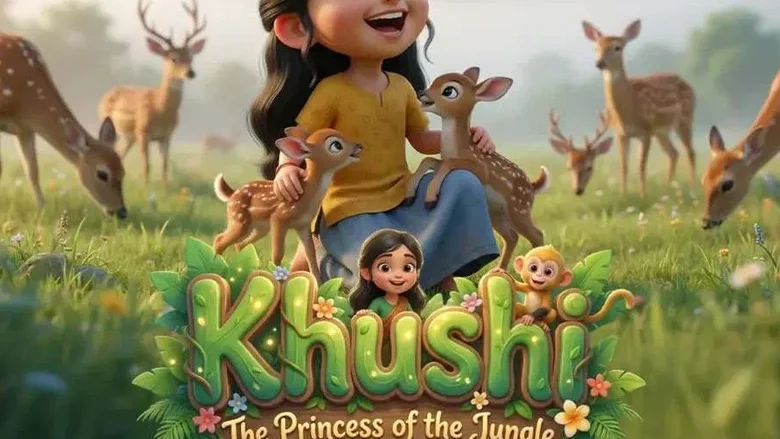
Khushi and her younger brother Chottu step from an ordinary human world into a hidden forest of talking creatures and luminous beings. The mechanism is pure portal fantasy, the oldest trick in children’s literature.
What the film never establishes is who or what controls that door. No antagonist is named. No threat is sustained. Discovery alone is asked to carry the dramatic engine, and discovery, by itself, is a premise rather than a plot.
The companion ensemble is assembled with care: Bundu the monkey, Tara the elephant calf, Golu the porcupine. Species variety substitutes for personality differentiation, and the group moves through the forest without ever being tested by a force that wants something from them.
When The Forest Has No Teeth, The Journey Has No Stakes
Children’s animation does not require a snarling villain to work. It requires consequence. A rule that can be broken, a friend who can be lost, a choice that costs something.
Here the ecological and educational intent is folded gently into the adventure, which is admirable in theory. In practice, the film treats nature as a lesson to be absorbed rather than a world with its own dangers.
The tonal patience on display recalls the quiet spatial discipline of Sooriyan Maraindha Maalai, but that film had adult grief pressing against its stillness. This one has a porcupine.
Suraj Venjaramoodu’s Voice Is The Only Human Pulse In The Room
The narration is the film’s most reliable asset, and it is a modest one. Venjaramoodu’s warm, unhurried register gives the forest a recognizable Malayalam cadence that the animation itself cannot supply.
He is narrating, not performing a character, which means the emotional labor of the film rests on an unseen voice rather than on any figure the audience can attach to. The contrast with the fractured identity work in Maya lady is instructive: there, performance shouldered the narrative weight. Here, performance is a life raft.
Khushi, as a protagonist, is defined almost entirely by her ability to communicate with animals. It is a clean imaginative hook and a thin characterization, and the film never asks her to be anything other than a translator.
The AI Production Pipeline Is A Curiosity, Not A Craft Argument
Glowing creatures drift through the frame. The forest pulses with color. The visual design aims squarely at the four-to-twelve demographic and hits it without ambition beyond that target.
What the film cannot hide is the absence of authored directorial presence. No credited director or writer is attached to the project in any public-facing material, and the screen reflects that void: sequences unfold with functional clarity but no staging intelligence, no shot that lingers because someone chose to linger.
The genre’s recent Malayalam experiments have at least failed ambitiously. The craft collapse under its own reach in Aadu 3 is a more interesting failure than this film’s smooth, frictionless competence.
ManoramaMAX Bets On Volume While Theatrical Malayalam Fantasy Grows Up
The commercial math here is straightforward and small. ManoramaMAX is a streaming platform, not a theatrical distributor, and this is a holiday-timed original designed to drive subscriptions and family viewing hours rather than ticket sales.
There is no box-office leverage to calculate, no opening-day figure to parse, no star-vehicle economics at play. The platform’s real wager is on the AI-production label as a differentiator in a crowded children’s content market.
That bet looks shaky. Theatrical Malayalam fantasy is currently maturing into something genuinely ambitious, and a growing appetite across contemporary Malayalam fantasy for authored world-building makes this film’s anonymous, assembly-line construction feel like a step backward dressed as innovation.
The Ending Teaches Children That The Forest Is Safe, Which Is The Wrong Lesson
The film resolves into a warm, educational affirmation: nature is wonderful, animals are friends, curiosity is rewarded. It is a defensible message delivered without a single moment of genuine unease.
Children’s fantasy earns its wonder through risk. The best of the form lets young viewers feel the dark edge of the woods before the light returns. This film skips the dark entirely and hands out the light for free.
What lingers is not the magic but the machinery. A recognizable voice, a glowing forest, and a production pipeline doing the work that a director should have done. Khushi may be the princess of the jungle, but nobody bothered to rule it.

Ankit Jaiswal is the Chief Author, covering Indian cinema and OTT releases with honest, no-filler criticism. An SEO strategist by background, he brings a research-driven approach to film writing, cutting through hype to tell you exactly what's worth your time.