The opening ritual is pure spectacle: two primordial forces circling a sacrifice, torchlight carving the dark, a queen trading her life for her son. Sundar C stages it with genuine grave authority, then the film cuts to a trembling police constable, and the seams begin to show.
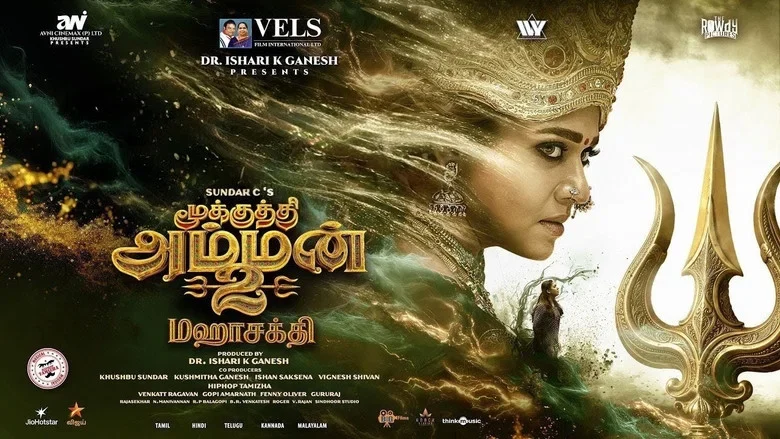
A Mythology That Announces Itself Before It Earns Belief
The structural gamble here is the ancient-to-modern handoff, and it’s the film’s most exposed nerve. The period prologue establishes a cosmic war with real gravity, the queen’s sacrifice has weight, the invading darkness has texture, but the screenplay treats that mythology as a launchpad rather than a living organism.
When the narrative lands in the present day, the constable’s fear is introduced as a punchline before it’s allowed to be a wound. The transition doesn’t braid the timelines; it simply parks one and starts another, trusting exposition to do the connective labor that imagery should carry.
When A Goddess Becomes Two Performances, One Wins
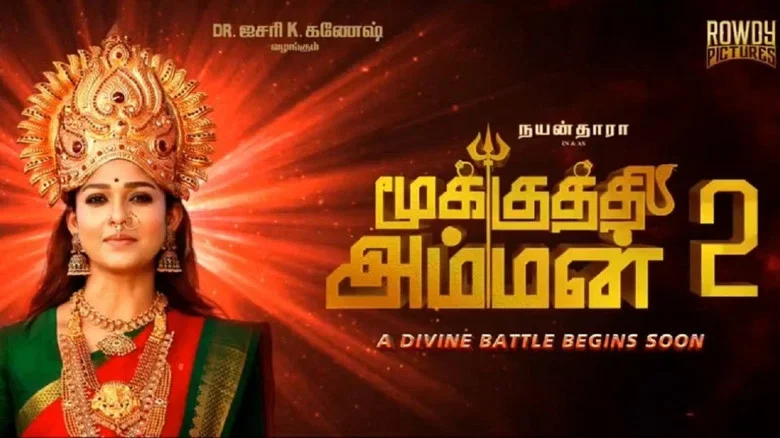
Nayanthara’s dual assignment is the film’s commercial engine and its most uneven dramatic instrument. As the divine avatar, she commands the frame with a stillness that reads as absolute jurisdiction, chin level, spine immaculate, voice dropped into a register that expects obedience rather than requests it.
The modern constable is a different animal entirely, all flinching shoulders and swallowed sentences, and the contrast is deliberate. Yet the timid officer’s arc leans on reaction shots where the divine half earns full-body staging; one performance is architecture, the other is a series of nervous gestures waiting for a revelation to land on them.
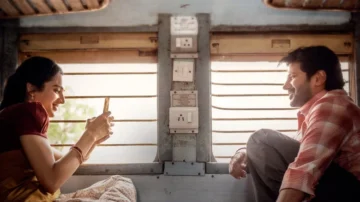
There’s a discipline to her divine work that recalls the controlled romantic register she brought to Hi, where charm did the heavy lifting without spectacle. Here the spectacle is the point, and the actress meets it, but the human half of the equation never quite earns equal billing.

A Dark Sorceress Who Threatens Without a Clear Appetite
Regina Cassandra is positioned as the embodiment of a new evil, and her physical presence is genuinely unsettling, a coiled economy of movement, eyes that hold rather than dart, a smile deployed like a closing door. She gives the film its only true antagonist energy.
What she isn’t given is an objective. The screenplay frames her as a supernatural counterweight to the goddess without ever clarifying what she wants, what she’d lose by failing, or why the ancient conflict requires her specifically. Villainy without appetite is just atmosphere in a black costume.
The supporting ensemble fares no better structurally. Urvashi and Yogi Babu occupy the comic margins with practiced timing, but their set-pieces sit adjacent to the plot rather than inside it, comic relief bolted on, not woven through.
Sundar C’s Escalation Problem: More Deities, Less Pressure
The director knows how to build a trailer, the escalation from mythic preparation to contemporary vulnerability to a cliffhanger teasing three additional divine entities is textbook sequencing. In the finished film, that instinct curdles into congestion.
Gopi Amarnath’s camera does draw a clean visual distinction between the timelines, favoring wide, torchlit compositions in the period material and tighter, more anxious framing in the present.
But the film’s tonal transitions between devotional drama, police comedy, and fantasy action are managed by cutting, not by modulation, the register shifts land like gear changes you can hear.
Hiphop Tamizha’s score leans hard on devotional scale, and it’s doing more narrative work than the screenplay should require. The runtime compounds the problem: two and a half hours is a long time to sustain a mythology that keeps introducing new players before resolving the ones already on the board.
The genre itself is in a fascinating moment, and this film’s ambition to build a larger divine universe sits alongside the mythic world-building attempted in Ramayana, but where that project withholds to create hunger, this one over-serves and creates fatigue. It’s a cautionary contrast for contemporary Tamil fantasy at large.
The Box-Office Arithmetic of a Diwali Devotional Gamble
Avni Cinemax, Rowdy Pictures, and Vels Film International have staked a Diwali corridor release on a sequel that inherits a beloved 2020 original but not its director or its writing voice, a calculated bet that the goddess IP outweighs the creative discontinuity.
The advance-booking pulse was real, with reported figures around ₹4.27 crore gross across six show dates before release, and the festive window is the most forgiving slot in the Tamil calendar.
But the sequel pipeline that leans on star-plus-deity spectacle rather than original storytelling carries diminishing returns, and Nayanthara’s theatrical leverage now depends on whether audiences reward scale or punish bloat.
The comparison with a leaner, more aggressive contemporary theatrical swing like Disco is instructive: that film bets on momentum, this one bets on mythology, and only one of those bets requires the audience to hold still for two and a half hours.
The Cliffhanger That Forgets to Close Its Own Story
Ending on the tease of three more divine entities is a franchise move, not a narrative one, and it exposes the film’s deepest anxiety, that the goddess-versus-sorceress confrontation it spent the whole runtime building isn’t considered sufficient payoff on its own.
A devotional fantasy earns its transcendence through resolution, through the moment the divine presence settles the human crisis it entered. This one keeps the door open so wide that the room never feels occupied. The sacrifice in the prologue promised consequence; the finale offers only continuation.
Sundar C has built a temple with impressive pillars and no roof. Nayanthara’s goddess remains the most convincing thing in it, and the most under-served, standing in a doorway that the screenplay keeps widening instead of walking through.

Ankit Jaiswal is the Chief Author, covering Indian cinema and OTT releases with honest, no-filler criticism. An SEO strategist by background, he brings a research-driven approach to film writing, cutting through hype to tell you exactly what's worth your time.