Prasankar opens on a self-defence hall where women learn to break a grip before they learn to trust a man. It is the most interesting sentence the screenplay ever writes about Krish, and it spends the next two hours forgetting it.
A Karate Coach, A Court Case, And The First Crack In The Ideal
The meet-cute arrives through litigation rather than a rain song. Krish, played by Rakesh Varre, is drawn to Asha because she is socially engaged and quiet in a way that reads to him as safe.
That word, safe, is the film’s real subject, and Prasankar knows it. A man who teaches women to fight predators has built his entire romantic imagination around a woman who will never need the training.
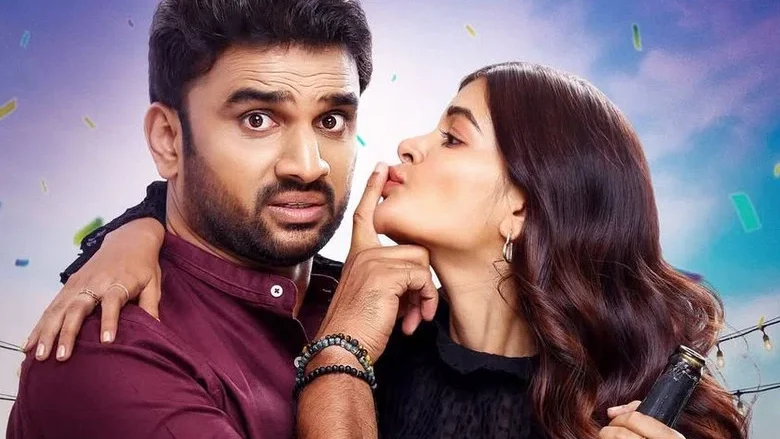
The early passages lean on family banter and Vinay’s comic interjections to warm the room. Sathya pitches Vinay as a decent-natured pest, leaning into Krish’s shoulder during the courtship scenes with the practised timing of a man who has never once been the one in danger.
What the first act does well is refuse to make Krish a passive romantic. His professional identity is physical, and the staging lets him move through space with a coach’s economy, hands loose, weight forward, always assessing.
The Twin Reveal Lands, Then The Film Stands Still Holding It
When Krish learns the woman in his life may be Roopa rather than Asha, the floor tilts. It is a genuinely good hinge, and for twenty minutes the film becomes the psychological thriller its marketing half-promised.
Madhumita Sarcar does the heavy lifting here. Asha holds her hands close to her body and speaks at a lower volume, while Roopa occupies doorways before she occupies conversations, chin level, shoulders open, eyes that never break first.
The differentiation is behavioural, not cosmetic, and that discipline is worth noting. Just as the filmmaker behind Dark Chocolate understood that a slippery descent needs a stable frame to fall from, Prasankar understands that a double role collapses if the audience cannot read the switch before the dialogue confirms it.
Then the explanatory machinery arrives, and the temperature drops. The concealed history turns out to be trauma of a very familiar kind, and the screenplay treats it as a plot key rather than a wound.
When The Explanation Arrives Before The Feeling Does
A PTSD-shaped backstory is not a flaw in itself. The problem is structural: the film withholds Roopa’s motive so long that the reveal has to do the emotional work of three scenes at once.
By the time Indraja’s psychiatrist is asked to translate behaviour into diagnosis, the drama has shifted from rooms and bodies into a verbal debrief. Indraja is quietly effective in the part, listening with a stillness that makes Krish’s evasions look childish.
But a clinician explaining a character is not the same as a character explaining herself. The screenplay chooses the former, and the climax pays for it.
The tonal wobble is real, too. A light family comedy that suddenly asks to be taken seriously about dissociative distress needs either sharper comedy up front or a colder thriller register later; this one splits the difference and loses tension at both ends.
Compare the tonal nerve of a film like Abadameva Jayathe, which lets its high-concept comedy carry a social argument without apologising for either half. Maya Lady keeps apologising for its dark half by cutting to Vinay.
Rakesh Varre’s Physical Composure Is The Film’s Most Reliable Asset
Varre is at his best when Krish is being asked to do something with his body rather than his vocabulary. Watch him in the self-defence sequences: he corrects a student’s stance with two fingers and no commentary, and the authority lands.
His romantic register is thinner. Krish’s confusion is played mostly in the eyes and a half-step backward, which works once and then repeats.
The physical exhaustion Varre brought to earlier, more interior roles, the kind of quiet, watchful presence that carried VISA – Vintara Saradaga, is only intermittently visible here. When it surfaces, in the final confrontation with Roopa, the film briefly finds a pulse.
Sarcar, meanwhile, is doing the harder job. Roopa’s aggression is not performed as villainy; it is performed as appetite, and that makes her far more unsettling than a conventional antagonist would be.
The Camera Trusts Faces, The Score Does Not Trust Silence
Prasankar’s visual grammar is unfussy and mostly correct. The twin confusion is staged in two-shots where one sister is half-lit, the other in shadow, and the frame keeps Krish between them, a body caught in a decision.
What undercuts the tension is the sound design’s reluctance to sit still. Vishal Chandrasekhar’s score arrives early in scenes that would play better dry, cueing the audience to feel suspicion before the performances have earned it.
The editing is the more serious issue. The first half breathes; the second half compresses the psychological material into a rush of explanation, so the climax feels like a summary of a film we did not quite get to watch.
Crazy Ants Productions Is Betting On A Small Film With A Big Hook
Mogulla Chandrasekhar’s Crazy Ants Productions has mounted this on a scale that suits its ambitions: a two-hour romantic comedy with one strong structural idea and no spectacle to fall back on.
The commercial logic is legible. Twin-identity romances travel well in the Telugu market, and a dual-role showcase gives the film a trailer-friendly selling point that costs nothing in VFX.
But the early returns are sobering, a reported ₹9 lakh India net on day one, with the film’s own tracking pages still showing incomplete totals. That is not a number that sustains a theatrical run; it is a number that hands the film to streaming.
For Varre, this is a test of whether a physically grounded leading man can open a film without a mass-comedy safety net. The honest answer so far is that the audience has not been given enough reason to find out.
The broader turn toward character-driven, mid-budget Telugu storytelling across contemporary Telugu comedys is real, but it rewards films that commit fully to one register.
The Ending Chooses Romance When The Material Demanded Reckoning
The resolution tidies the sisters’ history and hands Krish a decision, but the decision is framed as a romantic selection rather than a moral one. He chooses the woman who fits the life he imagined, and the film treats that as growth.
It isn’t. It is the same idealisation that got him into the mess, now wearing a happier ending.
That is the film’s unexamined residue: a story about a man who cannot tell two women apart, which never quite asks why he needed them to be interchangeable in the first place.
Maya Lady has a sharp premise, a genuinely skilled dual performance, and a director who knows where to put the camera, and it still walks out of the theatre having said less than its first five minutes promised.

Ankit Jaiswal is the Chief Author, covering Indian cinema and OTT releases with honest, no-filler criticism. An SEO strategist by background, he brings a research-driven approach to film writing, cutting through hype to tell you exactly what's worth your time.