Donga Naa Koduku opens on a phone screen glowing with a betting app, and the debt counter climbing beneath it.
That single image is the most honest thing in Sreenu Kambala’s debut: a young man treating easy money as a birthright until the arithmetic catches up.
When The Debt Collector Is Your Girlfriend’s Father, Comedy Writes Itself
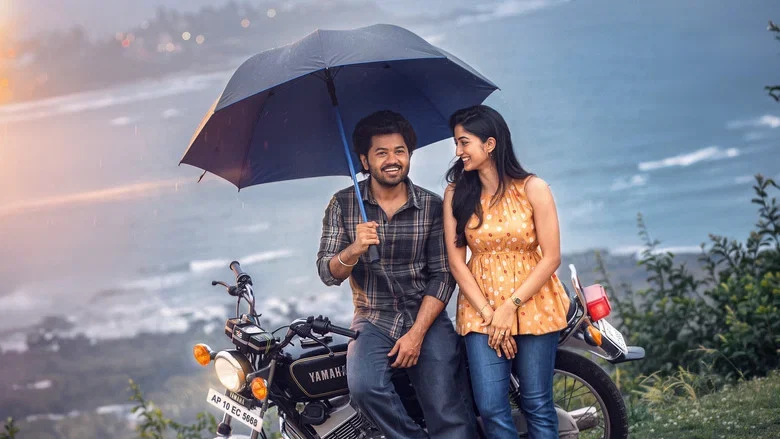
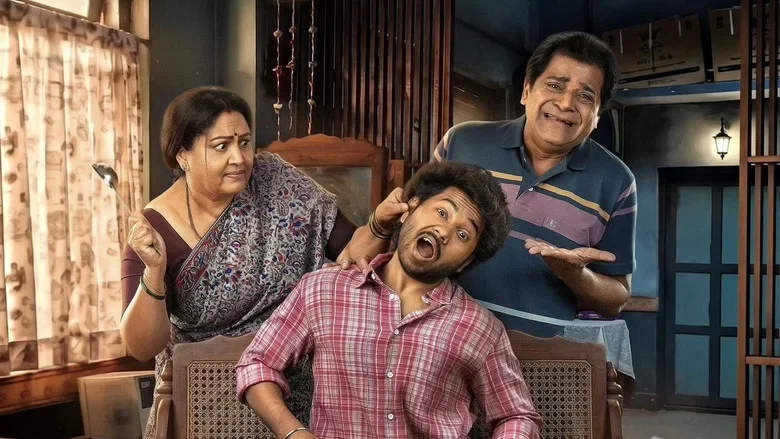
The premise is genuinely contemporary: online betting, loan-app debt, a protagonist who borrows from his girlfriend and then gets publicly cornered when her father arrives at the family home demanding repayment.
That confrontation is the film’s sharpest comic engine because the humiliation is domestic rather than criminal. The shame lands in a living room, in front of relatives, and the screenplay knows the difference.
From there the story moves linearly: debt to borrowing, borrowing to deception, deception to robbery.
Mouli Tanuj Prasanth plays the lead as a man allergic to consequence, and the performance finds its register in the small panic of a person doing math he can’t win.
The Robbery Plot Is Where The Film’s Nerve Goes Missing
Once the protagonist and his friend decide to rob their way out of the hole, the film trades its specific financial anxiety for generic caper mechanics.
The escalation is advertised as a chain of unexpected complications, but the promotional beats suggest a familiar loop of mishaps rather than a genuinely escalating structure.
What the screenplay never quite commits to is whether the online-betting thread is a real subject or just a convenient ignition switch.
The cautionary message about financial irresponsibility is stated, but stating a theme is not the same as dramatizing it, and the film too often settles for the former.
The tonal balancing act is the real test. Kambala is working with crime, comedy, romance, and family drama in a single frame, and the risk is that none of them gets the room to breathe.
Where a tighter film would let the silence after a bad decision do the work, this one reaches for the next gag.
Mouli’s Energetic Lead Performance Carries What The Script Won’t
Mouli’s screen presence is the film’s most reliable asset. He plays embarrassment without begging for sympathy, and his physical restlessness suits a character who can’t sit still long enough to face his own ledger.
There’s a moment in the repayment confrontation where he does nothing but look at the floor, and it’s more eloquent than any of the film’s louder comic beats.
Sushmitha Shetty’s girlfriend is structurally load-bearing: her money is the plot’s fuse, and her relationship with the protagonist absorbs the collateral damage.
The screenplay doesn’t give her much to do beyond reacting, and that’s a real waste of the film’s most interesting emotional pressure point.
Ali and Rajitha are deployed for comic relief, and they deliver the broad beats the material asks for.
Their scenes function as release valves, though the film leans on them often enough that the comedy starts to feel like a structural crutch rather than an organic outgrowth of the story.
Suriya Balaji’s Camera And Sinjith Yerramilli’s Score Keep The Engine Humming
The craft is competent without being distinctive. Suriya Balaji’s framing favors the protagonist’s face in close quarters, which suits a story about a man trapped by his own choices.
But the visual language rarely pushes beyond functional coverage, and the film’s domestic spaces never acquire the texture that would make the debt feel physically oppressive.
Sinjith Yerramilli’s score does the tonal heavy lifting, nudging the audience toward comedy whenever the material threatens to get too dark.
That’s a reasonable strategy, but it also flattens the film’s more uncomfortable moments, signaling to the audience that they shouldn’t take any of this too seriously.
The editing keeps the first half brisk, moving from betting to borrowing to confrontation with reasonable efficiency.
The second half, once the robberies begin, starts to feel like it’s marking time rather than building toward anything genuinely surprising.
Mythri Movie Makers Bets On A Familiar Formula In A Crowded Market
Mythri Movie Makers is a banner with real theatrical muscle, and backing a debut director’s crime comedy is a calculated play for the mid-budget entertainer market.
The film’s commercial logic is clear: a recognizable star, a contemporary hook, and a festival-adjacent release slot aimed at friends and family groups.
But the Telugu crime-comedy space is crowded, and the theatrical window is unforgiving for films that don’t generate strong word-of-mouth on day one.
Mouli’s box-office leverage is still being established, and this film’s success will depend less on its premise than on whether audiences leave talking about the comedy or the missed opportunity.
The comparison to other contemporary Telugu crime films is instructive. The genre has recently produced work that treats its criminal mechanics with more conviction, and DNK’s refusal to fully commit to its own stakes puts it at a disadvantage.
Where a film like Dongamohan at least swung for a distinctive tone, this one settles for a safer middle ground.
The director’s lineage is harder to chart, given that Kambala is making his debut, but the film’s visual restraint echoes the kind of grounded storytelling seen in recent mythological adaptations like Ramayana, where scale is achieved through intimacy rather than spectacle.
That’s a generous comparison, though, and DNK doesn’t earn it.
The film’s real problem is that it wants to be a cautionary tale and a crowd-pleaser at the same time, and it never resolves that tension.
The result is a movie that’s easier to admire in pieces than to love as a whole, a collection of decent scenes in search of a stronger spine.
Mouli’s performance deserves a better vehicle, and the film’s most interesting idea, that financial shame is a kind of violence, gets buried under the mechanics of its own plot.
There’s a version of this story that’s genuinely uncomfortable and genuinely funny, and DNK keeps circling it without landing.
What lingers is the image of that phone screen, the debt counter climbing, and a young man who can’t look away.
The film understands that image better than it understands the story built around it, and that’s the gap it never closes.

Ankit Jaiswal is the Chief Author, covering Indian cinema and OTT releases with honest, no-filler criticism. An SEO strategist by background, he brings a research-driven approach to film writing, cutting through hype to tell you exactly what's worth your time.