The estate appears before the singer does, a mass of shadow and wet stone that the camera regards with the patience of something waiting to be recognised.
Rejin S. Babu’s Bouma arrives with the confidence of a film that trusts its own silence, and for long stretches that trust is earned.
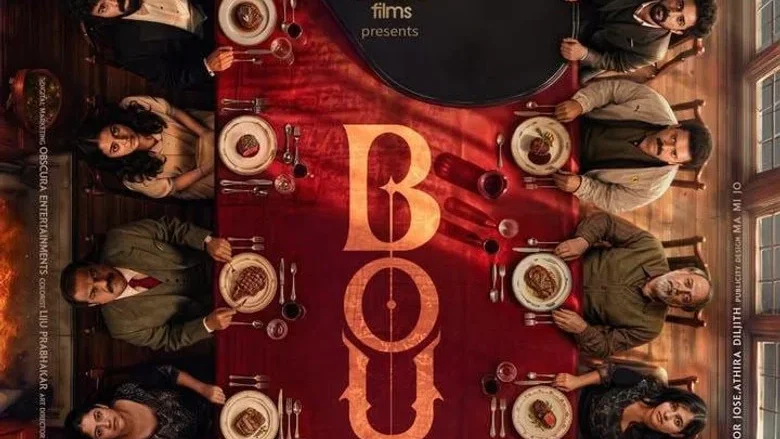
A Singer Returns to a House That Knows Her Better Than She Does
The premise is deceptively clean: a struggling vocalist travels to an isolated property tied to a past she can barely reconstruct, and the film refuses to clarify whether she is remembering or inventing.
What elevates the opening act is Babu’s refusal to explain the geography of the place. Rooms are entered without introduction, corridors recur with slightly altered light, and the film withholds the comfort of a floor plan.
That formal choice matters because the mystery is not really about who did what. It is about whether the woman at the centre of it can trust the version of herself she is being handed.
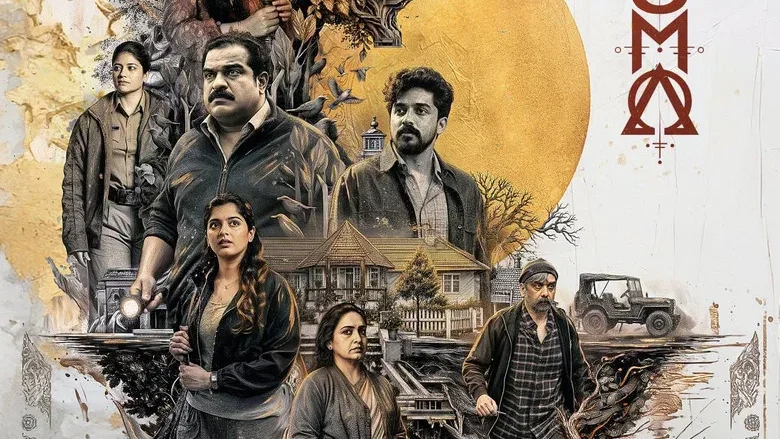
The Police Procedural Is the Film’s Weakest Immune System
Running alongside the singer’s dislocation is an investigation into missing local women that gradually curves toward the same grounds, and this is where the screenplay’s discipline begins to fray.
The procedural track supplies external verification, which is structurally necessary, someone has to confirm that the estate is not merely a private hallucination. But the investigators are written as conduits rather than people.
They arrive, they consult, they look at photographs, and they never develop a single habit or contradiction that would make their presence feel like more than narrative plumbing.
Compare the tighter spatial economy Babu brings to the memory sequences with the comparative looseness of DNK, where a similarly overpopulated plot at least kept its competing strands in visible friction.
Dileesh Pothan Anchors the Film Without Ever Raising His Voice
The film’s centre of gravity is a performance built almost entirely out of withheld reaction, a jaw that tightens a half-second before the line lands, eyes that track a doorway rather than the person speaking to them.
There is a moment early on where the character is offered a recollection and simply does not respond, letting the silence sit long enough to become an accusation. It is the most articulate thing in the film.
That register of exhausted watchfulness echoes the work he did in Oru Durooha Saahacharyathil, though here the exhaustion is given a darker provenance.
Aditi Balan registers with real texture in a handful of scenes, mostly through stillness and a refusal to blink at the wrong moments, but the script gives her character too little to do beyond absorb information.
When Atmosphere Becomes a Substitute for Escalation
Babu’s command of texture is genuine. The estate is lit in a way that keeps faces half-resolved, and the sound design favours room tone over score, so that a door closing two rooms away carries more threat than any musical cue could.
But atmosphere is not structure, and somewhere past the midpoint the film begins mistaking sustained dread for forward motion.
Scenes repeat their emotional function rather than advancing it, another memory that destabilises, another corridor walked in the same rhythm, another conversation that circles the same withheld information.
The screenplay resists the kinetic sensationalism that overtook Disco, which is admirable in principle, but it also declines to replace that energy with anything that tightens the screw.
By the time the two strands converge, the revelation lands with the softness of something long anticipated rather than the shock of something earned.
The Confined-Estate Thriller Is Becoming a Crowded Room
What Bouma demonstrates is how thoroughly the memory-displacement thriller has become a house style across contemporary Malayalam thrillers, the isolated property, the unreliable recollection, the investigation that arrives too late to prevent anything.
The template still works when a filmmaker brings a specific obsession to it. Here the obsession appears to be mood rather than meaning, and mood alone cannot carry a hundred and fifteen minutes.
The film’s adult certification is not the issue. What limits its reach is a temperament that asks an audience to lean in without ever rewarding that lean with a decisive turn.
The Commercial Arithmetic of a Prestige-Adjacent Mystery
Bouma enters a theatrical market where the Malayalam mid-budget thriller has become a reliable exhibition staple, and its fortunes will hinge less on opening weekend than on whether word of mouth frames it as a puzzle worth solving.
That is a fragile proposition for a film with no franchise scaffolding and no star-vehicle machinery behind it. The cast is deep in recognisable faces but thin in marquee draw, which places the entire commercial burden on the title’s ability to generate curiosity rather than loyalty.
The producer-side calculation is familiar: modest negative cost, a contained location shoot, and a bet that the genre’s current heat can carry an original property past its first week. Whether that bet clears depends on a recommendation economy this film is not built to dominate.
The Verdict: A Haunting That Never Quite Finds Its Ghost
Bouma is the work of a director who understands that dread lives in the unlit corner of a frame, and a performer who understands that the most frightening thing a person can do is fail to react.
What the film lacks is the willingness to choose, to decide whether its central woman is a victim, a witness, or something the audience has not been permitted to consider.
That ambiguity is clearly deliberate, and there is integrity in it. But ambiguity without consequence becomes a mood board, and by the final image the film has left its most interesting question unanswered not out of daring, but out of reluctance.
It will find its audience among those who prize atmosphere over resolution. It will lose the rest at the door it never opens.

Ankit Jaiswal is the Chief Author, covering Indian cinema and OTT releases with honest, no-filler criticism. An SEO strategist by background, he brings a research-driven approach to film writing, cutting through hype to tell you exactly what's worth your time.