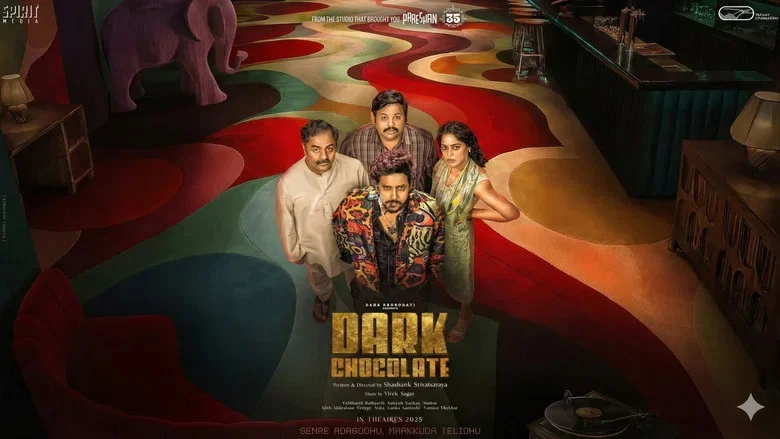
Shashank Srivatsavaya opens on a mansion hall where a fading matinee idol has assembled three old associates and calmly informs them they are hallucinations. It is a magnificent curtain line. The trouble is that the film spends its remaining hour trying to decide whether it believes it.
The Premise Is A Trapdoor, And The Script Knows It
The setup is genuinely audacious for mainstream Telugu cinema. Fire Star Yagna, a has-been whose career collapsed under public backlash, lures three influential figures from his past to an isolated property under the pretext of a comeback.
Then he tells them they do not exist. From that instant, every handshake, every accusation, every threat of violence becomes double-signed: real or imagined.
What elevates the conceit is its professional stake. This is not generic madness; it is the specific pathology of an ego that cannot metabolise irrelevance, and the screenplay keeps the box-office failure of Yagna’s life as the engine of his paranoia.
Vishwadev Rachakonda Plays Two Men In One Skin, And Only Sometimes Wins The Bet
The role demands a single body simultaneously projecting theatrical authority and hairline fracture. Watch him in the summoning scene: shoulders squared, voice pitched in the low, unhurried register of a man accustomed to being obeyed.
Minutes later, the same posture reads as brittle, the chin lifted a degree too high, the eyes sliding off his guests before they can hold his gaze. It is a disciplined piece of physical calibration.
The risk is monotony. When every line must function as both manipulation and symptom, the performance begins to flatten into a single sustained note of grandiosity, and the middle stretch offers few registers between imperious and unravelling.
The supporting ensemble exists largely as a sounding board rather than a counterforce. Bindu Madhavi’s Hamsa carries a watchful stillness in the early confrontations, holding her silence a beat longer than the room expects, a useful anchor of scepticism.
But the visitors rarely get the interiority to challenge Yagna’s version of events, which dulls the film’s central ambiguity.
A Confined Space Is Only As Tense As Its Camera Allows
Cinematographer Sathish Saakar has the right instinct for the material: shallow focus that keeps background figures slightly soft, as if they might dissolve if the lens held them too long. Corridors are framed with dead space at the edges, inviting the eye to search for someone not there.
Yet the visual grammar rarely escalates. Once the mansion’s geography is established, the film settles into a repetitive pattern of confrontations staged at similar distances, and the paranoia stops compounding.
The bigger structural gamble is Srivatsavaya editing his own work. Concentrated authorship can produce a relentless rhythm; it can also remove the outside eye that catches a scene overstaying its welcome. Here, the nocturnal middle section drifts, circling the same argument about who is real without tightening the screw.
Vivek Sagar’s score does much of the persuasion the staging should be doing, nudging dread where the framing alone would not. The comedic layer is the film’s strangest asset, dry, uncomfortable, aimed at the absurdity of a man negotiating with his own furniture.
That tonal friction is where the film is most alive, and it places the project in conversation with the more disciplined chamber-piece instincts of Ah, which trusted atmosphere over explanation to a fault.
The Ending Refuses To Cash The Cheque The Opening Wrote
A film built on an unreliable narrator owes its audience a reckoning, not necessarily a tidy one, but a formally earned one. Dark Chocolate gestures toward that confrontation with sanity while withholding the kind of decisive reveal that retroactively reorders everything you have watched.
Ambiguity is a legitimate destination. Vagueness is not. The distinction lies in whether the film has planted the evidence that makes either reading defensible, and too much of the final act relies on mood rather than construction.
Where a peer release like Lambodhara 2.0 arrived half-built from a similar ambition, this film at least commits to its central question. It simply declines to answer it with the rigour the premise deserves.
Rachakonda’s closing stretch is the strongest argument the film makes for itself, the arrogance draining out of his face into something smaller and more frightened, a star realising the audience he has been performing for may be entirely his own invention.
Spirit Media And Waltair Productions Are Betting On A Difficult Sell
Produced by Siddharth Rallapalli and Rana Daggubati under Spirit Media and Waltair Productions, the film occupies a commercially awkward slot: an A-certified psychological comedy with no conventional villain, no star-vehicle set pieces, and a leading man whose fame is itself a niche proposition.
The advance booking numbers reported in the final week before release were modest, and with a budget kept undisclosed, the theatrical ceiling looks low. This is the kind of title that finds its real audience on streaming, where the hallucination puzzle can be paused, rewound, and argued over.
For the producers, the value is reputational, a marker of adventurous taste in a market increasingly dominated by franchise spectacle. Within contemporary Telugu thrillers, that instinct deserves encouragement even when the execution wobbles.
An Ambitious Misfire That Still Merits A Look
What lingers is not the twist but the image of a man rehearsing his own relevance in an empty room, insisting on an audience that may be a mirror. That is a sharper idea than most films of this scale attempt.
The comparison to Black Gold is instructive: both films trust a single performer to carry an unstable reality, and both discover that conviction alone cannot substitute for a screenplay willing to land its punch. Dark Chocolate is a genuine swing. It just never quite connects.

Ankit Jaiswal is the Chief Author, covering Indian cinema and OTT releases with honest, no-filler criticism. An SEO strategist by background, he brings a research-driven approach to film writing, cutting through hype to tell you exactly what's worth your time.