The reunion begins with laughter and ends with the specific silence of men who have run out of jokes. Nikhil Mohan’s debut wants to be two films at once, and the seam shows.
When a Bachelor Party Becomes a Survival Exercise
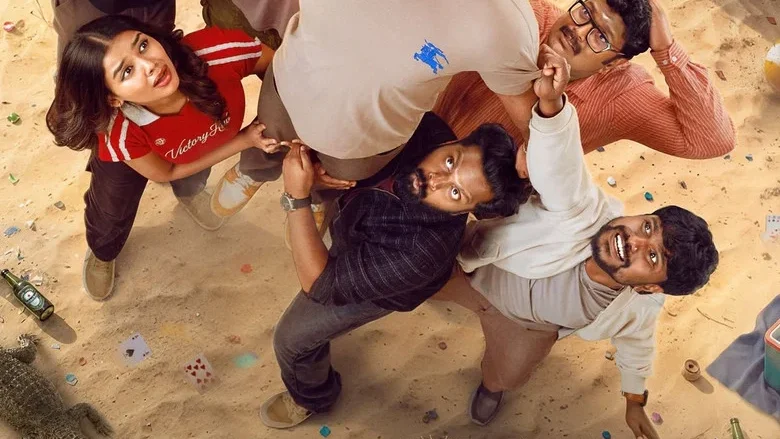
The premise is a clean, marketable machine: expelled college friends reconvene in Pondicherry for a bachelor party, then discover that buried history has been waiting for them. It is a setup engineered for tonal whiplash, and the film leans into it early.
The trouble is that the comedy and the dread are staged as separate buildings rather than one house. The first stretch trades on group nostalgia, old nicknames, old grudges, the easy cruelty of men who peaked in a hostel corridor.
Then the secrets surface, and the film changes costume. What it never quite changes is its nervous system; the escalation arrives as a plot instruction rather than a physical inevitability.
The Ensemble Is a Crowd Before It Is a Set of People
Arjun Ashokan carries the film’s centre of gravity with a performance built on watchfulness rather than volume. He spends the early scenes reading the room, and that reading is the most persuasive suspense device the film has.
His work here sits in the same register of frayed masculine composure he brought to Disco, though this time the exhaustion is collective rather than solitary.
Around him, the friend group is differentiated by volume and facial hair rather than motive. Balu Varghese gets the loudest comic licence and uses it; Sreelakshmi Vijayan, positioned as the female lead, is given almost nothing to push against.
Mottai Rajendran arrives with the film’s most distinctive screen energy, and the picture visibly relaxes whenever he is in frame. That is not a compliment to the screenplay.
The Location Does the Work the Script Won’t
Pondicherry is the film’s most articulate character. The camera holds the town in wide, sun-bleached frames before the danger arrives, then begins closing the frame down, doorways, corridors, the backs of heads.
It is a legible grammar of entrapment, and it recalls the spatial patience of Ah, which trusted atmosphere over explanation. Mohan has the instinct; he does not yet have the control.
Electronic Kili’s score is the film’s most aggressive collaborator, pushing tension into scenes that have not earned it. When every corridor gets a low drone, no corridor gets one.
The Pivot That Never Quite Lands
The moment the celebration turns is the film’s whole thesis, and it is handled with a bluntness that flattens the stakes. One scene of revelation does the work of three, and the friends’ shift from camaraderie to suspicion happens in a single beat.
What the film resists is the harder, quieter version of this story, the one where guilt corrodes a friendship gradually. Bouma understood that memory does not settle politely, and that refusal to settle is what makes a thriller breathe.
Here, the buried secret functions as a plot key rather than a wound. We are told the past matters; we are rarely made to feel it pressing on anyone’s chest.
The film’s final act is efficient, propulsive, and strangely weightless. Escape is achieved, consequences are gestured at, and the emotional ledger closes without ever having been properly opened.
What Arun Gopy and Justin Mathew Are Betting On
Arun Gopy Excitements and Justin & Mathew Entertainments are backing a first-time director with a recognisable ensemble and a mid-budget genre hybrid. The commercial logic is sound: youth comedy sells tickets, and the thriller turn gives the trailer its hook.
The risk is the same one facing much of contemporary Malayalam thrillers, a market that rewards atmosphere and ensemble casting but punishes films that cannot sustain either past the interval.
Arjun Ashokan’s box-office leverage is real and growing, and this film will test whether his name can carry a hybrid rather than a straight genre piece. The answer will depend less on his performance than on word of mouth about the second half.
The Verdict: A Debut With Instinct but No Aftertaste
Melcow Pondicherry is a film with a good eye, a good lead, and a screenplay that mistakes revelation for consequence. It gives you the shape of a thriller without the residue.
Mohan can stage a frame, and Ashokan can hold one. What neither can do yet is make you carry the film out of the theatre with you, and in this genre, the aftertaste is the whole meal.

Ankit Jaiswal is the Chief Author, covering Indian cinema and OTT releases with honest, no-filler criticism. An SEO strategist by background, he brings a research-driven approach to film writing, cutting through hype to tell you exactly what's worth your time.